A walk through Fort Kochi is a walk through centuries - spice-scented lanes, colonial architecture, and the Arabian Sea at every turn. Here's your guide to exploring one of Kerala's most charming corners.
...I couldn’t help but feel a flicker of gratitude in my fur. It's so much easier in the cat world. We don’t really care for labels. Gender isn't that popular a concept, as are most boxes that aren't cardboard.
November 15th 1905, an Italian painter named Antonio Moscheni put down his brush inside a half-finished cathedral in Fort Kochi. His friends saw him pushing through fever to finish the ceiling. He died that afternoon. Four days later, the church he had spent his final months painting was consecrated without him.
That church is Santa Cruz Basilica. You've probably walked past it. The twin white spires are impossible to miss on the Fort Kochi skyline. But most visitors snap a photo, peek inside, and move on to St. Francis Church down the road. They miss the better story.
Easter Mass on April 4th, 2026 at 10.30PM. See you there?
A Church That Had No Business Existing
In 1505, Fort Kochi didn't have a single stone building. Local custom reserved stone and mortar for two things only: royal palaces and temples. Everything else was built with wood and palm leaves.
Then the Portuguese showed up.
They had arrived in 1500 with 13 ships and 18 priests, led by Captain Pedro Álvares Cabral. The King of Cochin, Unni Goda Varma, welcomed them. This made the Zamorin of Calicut furious enough to declare war on Cochin. When Portuguese forces helped defend the Cochin king in 1503 and again in 1505, the grateful ruler gave them something no foreigner had received before: permission to build with stone.
Dom Francisco de Almeida, the first Portuguese Viceroy of India, used that permission to build two churches. Santa Cruz came first, in 1505. St. Francis Church followed a year later. The foundation stone was laid on 3 May, the Feast of the Invention of the Holy Cross. That's where the name comes from.
Santa Cruz means Holy Cross.
The original church stood where the Children's Park is today, near the Fort Kochi Water Metro Station. Next time you walk through that park, think about what used to be there.
Three Empires, Three Fates
In 1558, Pope Paul IV elevated Santa Cruz to a cathedral. The newly formed Diocese of Cochin was one of the first in India, answerable to the Archdiocese of Goa, whose jurisdiction at the time stretched from the Cape of Good Hope in Africa to China and Japan.
Then the Dutch arrived.
When they conquered Cochin in 1663, they tore down almost every Catholic building in the area. Churches, chapels, monasteries. Two buildings survived: St. Francis Church, which stayed a church, and Santa Cruz Cathedral, which the Dutch turned into a weapons storehouse. Cannonballs and gunpowder where the altar used to be.
⛵
Did you know? Only 27% of Dutch sailors who came to Cochin ever made it back home — Between 1740-1795, nearly 400,000 people left Europe for Asia, but only about 112,800 returned. The 8-month voyage was treacherous.
The British took over in 1795 and used the cathedral the same way, as a warehouse. In 1806, they demolished it entirely. This wasn't careless. It was policy. The British were systematically dismantling Catholic infrastructure across the region.
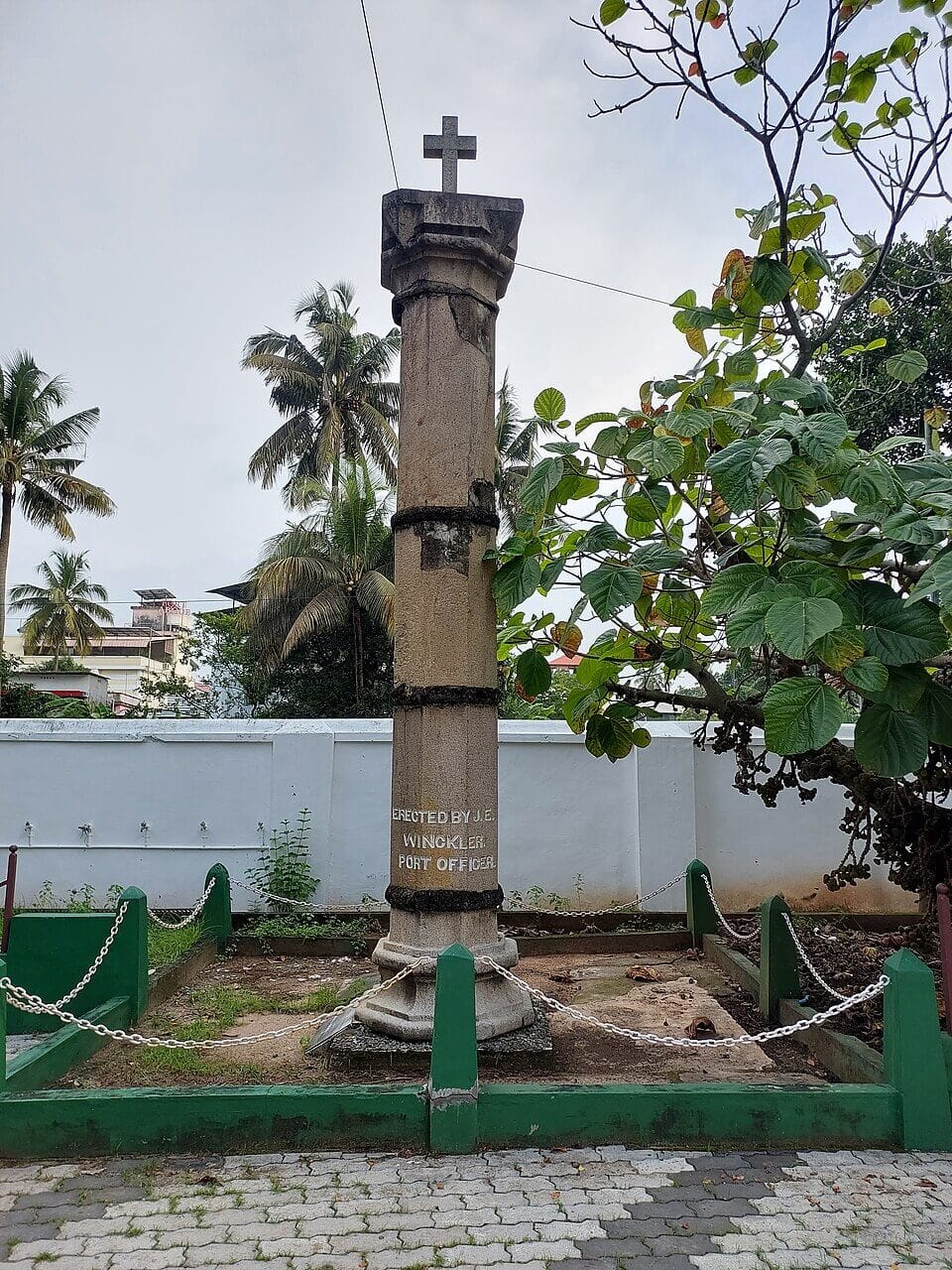
But one piece survived. A decorative granite pillar from the original 1505 cathedral. You can still find it at the southeastern corner of the current basilica grounds. It has been standing there, quietly outliving every empire that tried to erase it, for over 500 years.
The Rebuild: A Century of Patience
For about a hundred years after the demolition, nothing happened. The old cathedral was just a memory and a single granite pillar.
Then in 1887, Bishop João Gomes Ferreira arrived in Cochin with a plan to rebuild. He started the construction. He didn't finish it. His successor, Bishop Mateus de Oliveira Xavier, carried the project forward from 1897. The bishop wanted the new cathedral to look like the great churches of Europe. He needed an artist who could make that happen.
He found Antonio Moscheni.
The Painter from Bergamo
Moscheni was born in 1854 in Stezzano, a small town near Bergamo in northern Italy. He trained at the Accademia Carrara, one of Italy's great art schools. He went to Rome to study Michelangelo's work at the Vatican. His career was taking off. Churches across Lombardy were commissioning him.
Then at 35, he gave it all up. He joined the Society of Jesus as a lay brother.
His Jesuit superiors weren't about to waste his talent. They sent him to paint churches in Croatia, Albania, and back in Italy. In 1898, they sent him to India to paint the chapel at St. Aloysius College in Mangalore. That chapel, with every wall and ceiling covered in Moscheni's work, still draws thousands of visitors a year.
One of his paintings there shows the Hindu goddess Saraswati, something you wouldn't expect from a Jesuit painter. He was paying attention to where he was.
After Mangalore, he painted churches across Karnataka and the Holy Name Cathedral in Mumbai. In 1905, Bishop Xavier personally invited him to Fort Kochi to paint Santa Cruz.
What He Left Behind
Walk into Santa Cruz Basilica today and look up.
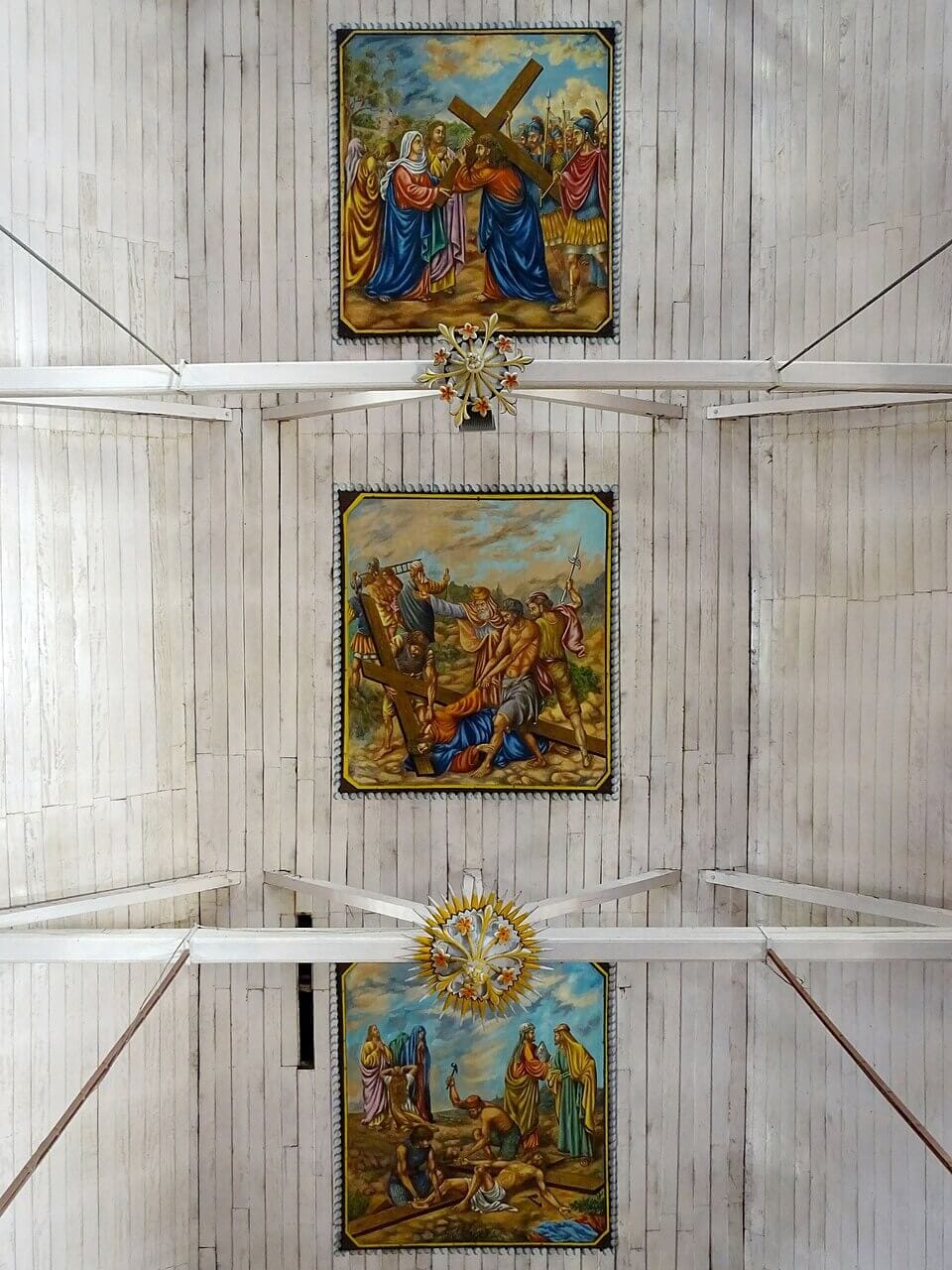
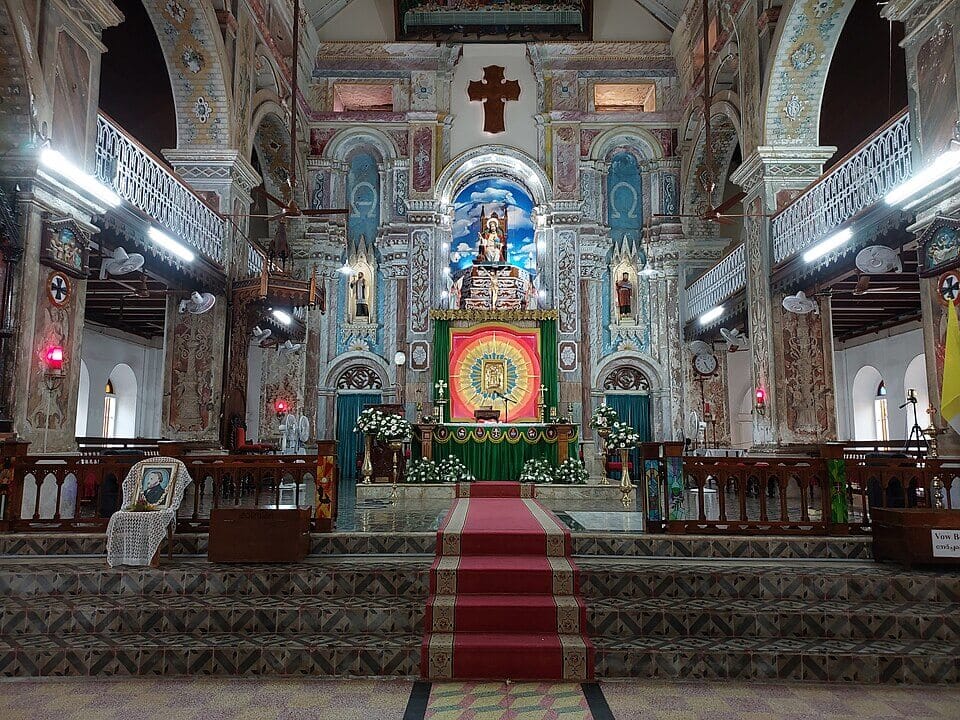
The white exterior gives no warning of what's inside. The interior is a wash of pastel colours, Gothic arches, and painted surfaces everywhere you look. Moscheni and his student Fr. De Gama of Mangalore painted frescoes on the columns, scenes from the Via Crucis on the ceiling, and seven large canvas paintings showing the passion and death of Christ.
Ceiling
The most striking one is a version of the Last Supper, modelled on Leonardo da Vinci's original. It hangs behind the altar. The stained glass windows add coloured light across all of it.
Moscheni finished the work despite worsening dysentery. He died on 15 November 1905. The cathedral was consecrated on 19 November by Bishop Sebastião José Pereira, the Bishop of Damao. The painter missed it by four days.
If you've been to our guide to the 32 things to do in Fort Kochi, you know this town rewards the curious. Santa Cruz Basilica is one of the places where that's most true. You can see it in five minutes. But once you know what happened here, you can't unsee it.
Visiting Santa Cruz Basilica
The basilica is on KB Jacob Road in Fort Kochi, a short walk from Tibetan Chef's Restaurant and about 200 metres from St. Francis Church. Entry is free. ⛪ Walk to the beautiful Santa Cruz Basilica (Daily, 9AM - 1PM & 3- 5PM) Map 📍
In 1984, Pope John Paul II elevated Santa Cruz to the status of a basilica through a decree titled "Constat Sane Templum Sanctae Cruci." It is one of nine basilicas in Kerala and 34 in India.
A relic of the Holy Cross is kept on the right side of the church. Outside, there's a shrine to Our Lady of Fátima. The annual Santa Cruz Basilica Feast begins on 26 December and runs until 31 December.
Look for the old granite pillar at the southeastern corner of the grounds. It's the only surviving piece of the 1505 original. Five centuries, three colonial powers, one pillar still standing.
A walk through Fort Kochi is a walk through centuries - spice-scented lanes, colonial architecture, and the Arabian Sea at every turn. Here's your guide to exploring one of Kerala's most charming corners.
...I couldn’t help but feel a flicker of gratitude in my fur. It's so much easier in the cat world. We don’t really care for labels. Gender isn't that popular a concept, as are most boxes that aren't cardboard.