
Where Vasco da Gama Was Buried for 14 years: A Visit to St. Francis Church in Fort Kochi
Three colonial powers. One wooden church turned stone. And a tombstone that tells 500 years of Fort Kochi's story.
Three colonial powers. One wooden church turned stone. And a tombstone that tells 500 years of Fort Kochi's story.

Planning your Fort Kochi visit? Scroll to your date for a ready-made itinerary — morning cafes, heritage walks, afternoon rest spots, sunset times, and night plans.

Built by the Portuguese. Wrecked by the British. Painted by a dying Italian. Santa Cruz Basilica has stories most visitors miss.

Three colonial powers. One wooden church turned stone. And a tombstone that tells 500 years of Fort Kochi's story.

There's a stone slab on the floor of St. Francis Church that visitors walk past, stop, and walk back to. It's plain. No gold. No engraving you'd notice from a distance. But that slab marks where Vasco da Gama's body lay for 14 years before his bones were shipped back to Lisbon (Portugal).
That's the kind of place this is. Nothing shouts. Everything whispers
St. Francis Church was first built in 1503, just five years after Vasco da Gama landed at Kappad near Kozhikode (Calicut). Portuguese Franciscan friars who arrived with Pedro Alvares Cabral put together a cdddhurch out of wood and mud inside Fort Emmanuel, near what is now Fort Kochi Beach.
The Raja of Cochin gave them permission. He also allowed, in 1506, the Portuguese viceroy Francisco de Almeida to rebuild the wooden structures in stone. By 1516, the church was reconstructed and renamed after St. Antony, the patron saint of Portugal.
That makes this church over 500 years old. The neighbourhood around it is still called Fort Kochi because of the original Portuguese fort.
When the Dutch captured Kochi in 1663, they were fiercely anti-Catholic. They destroyed almost all Catholic buildings, convents, and churches in the area—but both St. Francis and Santa Cruz were notably spared, though for very different reasons:
Vasco da Gama died in Fort Kochi on Christmas Eve, 1524, during his third visit to India. He was buried right here, inside St. Francis Church. For 14 years, the explorer who opened the sea route from Europe to India rested in this small church by the Arabian Sea.
Then his son had his remains dug up and taken back to Portugal. Today, Vasco da Gama's body is at the Jerónimos Monastery in Lisbon. But the tombstone in Fort Kochi remains. You can still see the marked spot on the church floor. It's one of the most photographed corners of the building.
What makes St. Francis unusual is that it passed through three colonial powers, and each one left something behind.
The Portuguese built it and gave it its original shape. They controlled the church for about 160 years.
In 1663, the Dutch captured Kochi. They were Protestant. They tore down every other Catholic church in the area. Every single one. But they spared St. Francis. They converted it into a Protestant church and used it for government purposes. The Dutch also left behind a fascinating document: the "Doop Book," a baptism and marriage register dating from 1751 to 1804. Dutch citizens still visit the church today to look through its pages and trace their family roots.
Around 1795, the British took control. They renamed the church St. Francis and rebuilt it to its current shape in 1886 under the Anglican Church. One leftover from British days still works inside the church: manually operated punkah fans, the large cloth-on-frame fans that swing above the seating area. Someone still pulls them during services.
In 1923, St. Francis became a protected monument under the Protected Monuments Act of 1904.
The architecture is simple. White walls, a tiled roof on a timber frame, stone flooring, semi-circular arched windows. No heavy decoration. No gold ceilings. That simplicity is what makes it spiritual and calming.
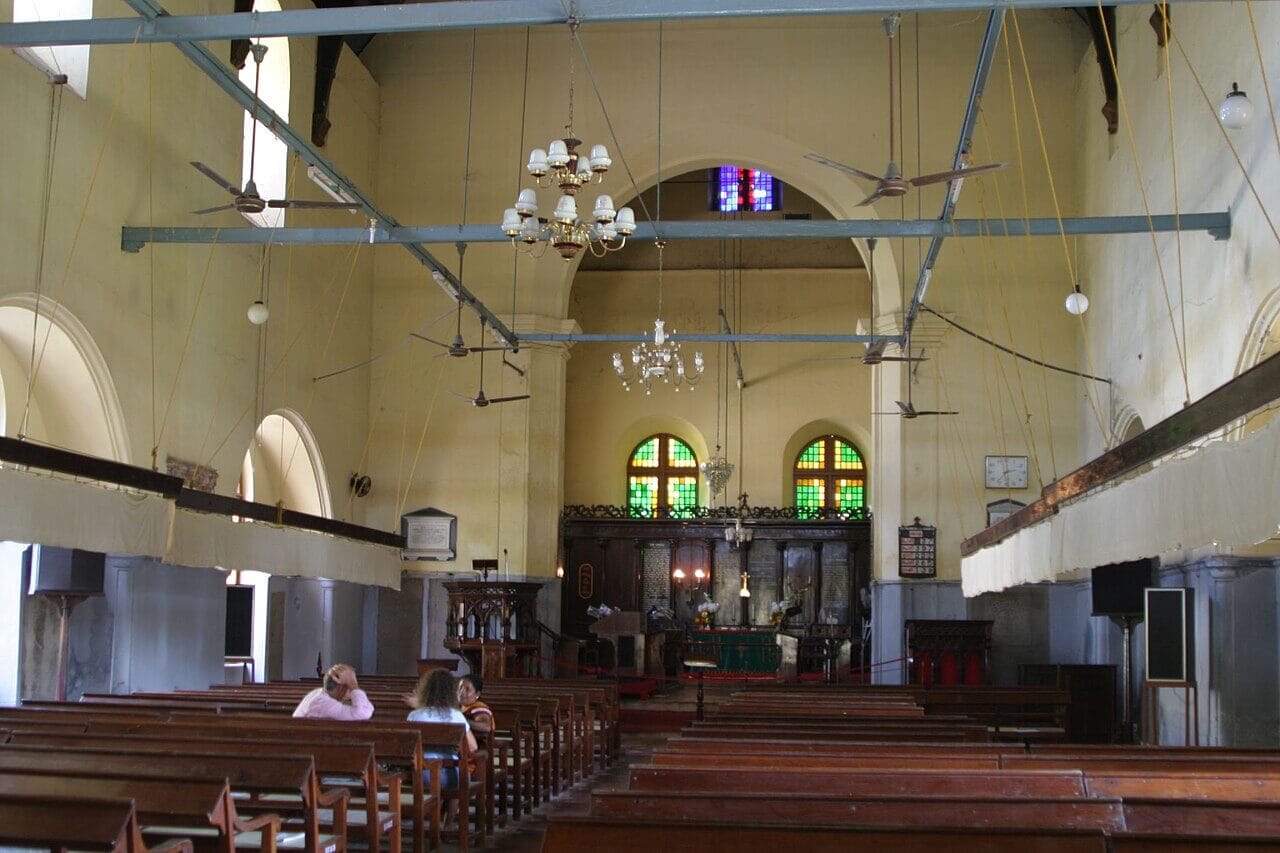
Look at the walls. The Portuguese tombstones are fixed to the northern wall. The Dutch tombstones line the southern wall. They were originally embedded in the floor but moved to the walls during the 1886 renovation. Reading those gravestones is like reading a roll call of European families who lived and died in this small corner of Kerala across three centuries.
The wooden pulpit, carved with care, is still intact. So is the old baptism platform. And near the entrance, the original title deed of the land, the one the Raja of Cochin gave the Portuguese, is still kept inside. It was written on palm leaf.
Outside, a cenotaph stands in the churchyard. It was built in 1920 to remember soldiers from Kochi who died in World War I.
St. Francis Church sits right opposite the Head Post Office on St. Francis Church Road. It's a natural starting or stopping point for any Fort Kochi heritage walk. From here you can walk to the Chinese Fishing Nets in about ten minutes. The Paradesi Synagogue in Jew Town is a short auto ride or a longer walk through the spice smelling (and selling) streets of Mattancherry. The Santa Cruz Basilica, another colonial-era church with a completely different personality (painted ceilings, Italian frescoes), is just around the corner.
If you're doing the full Fort Kochi circuit, St. Francis fits naturally between the waterfront and the older Mattancherry area.
The church is free to enter. It is open from 9 AM to 5 PM on weekdays. Saturday hours are shorter, with the church closing around 1 PM on some days. On Sundays, a CSI worship service takes place, and tourist access may pause during services.
You can reach Fort Kochi from Ernakulam (High Court Water Metro Station) by the Kochi Water Metro (the most scenic option, about 25 minutes), by auto or cab (about 45 minutes by road depending on traffic), or by city buses (more like F1 racing buses). The Fort Kochi Water Metro terminal is a short walk from the church.
Plan about 30 to 45 minutes here. Read the tombstones. Look at the punkah fans. Find the Vasco da Gama slab. And then step outside into Fort Kochi's lanes, where every other building has its own story waiting.

Planning your Fort Kochi visit? Scroll to your date for a ready-made itinerary — morning cafes, heritage walks, afternoon rest spots, sunset times, and night plans.

Built by the Portuguese. Wrecked by the British. Painted by a dying Italian. Santa Cruz Basilica has stories most visitors miss.

...I couldn’t help but feel a flicker of gratitude in my fur. It's so much easier in the cat world. We don’t really care for labels. Gender isn't that popular a concept, as are most boxes that aren't cardboard.


Allow me to take you into the world of Kathakali—a fascinating dance-drama that originates from Kerala, India.
Join 1500+ others & Sign up for the newsletter and get our latest posts delivered straight to your inbox.