
The Ultimate Travel Guide for Fort Kochi Itinerary Planning 2026
Plan your Fort Kochi visit with day by day itineraries for 2026. Morning cafes, heritage walks, sunset times & night plans all in one place.
Plan your Fort Kochi visit with day by day itineraries for 2026. Morning cafes, heritage walks, sunset times & night plans all in one place.

This is our Fort Kochi insider guide for you curated experiences, updated regularly by the cats who call this place home. Whether you're here for the Heritage, the food, or just the light on the harbour at dusk, we've got you.


Hidden spots in Fort Kochi and Mattancherry for authentic samosas, jalebis, dhoklas, lassis, erachi choru, parottas and more
Silpi Rajan, Midhun Mohan, Mohamed A. A small, intimate gallery at Fort Kochi about dreams, death, and the spaces in between.

Inside Kara, a a beautiful heritage hotel opposite the hisotoric parade grounds of Fort Kochi, three artists are having a conversation about death.
The exhibition is called Death Has Its Own Metaphors* — Beneath, between & beyond. It is small. It does not announce itself loudly. And that, somehow, is exactly the point. The asterisk in the title is a small footnote. It says: Line from a poem by Maythil Radhakrishnan
Silpi Rajan's sculptures, the colour of old wood and laterite, sit like quiet visitors.
Midhun Mohan's paintings glow in deep blues, with animals and moons that feel half-mythic.
Mohamed A's photographs of excavation sites pull your eye downward, into reddish-brown earth, etched stones, things just unearthed.
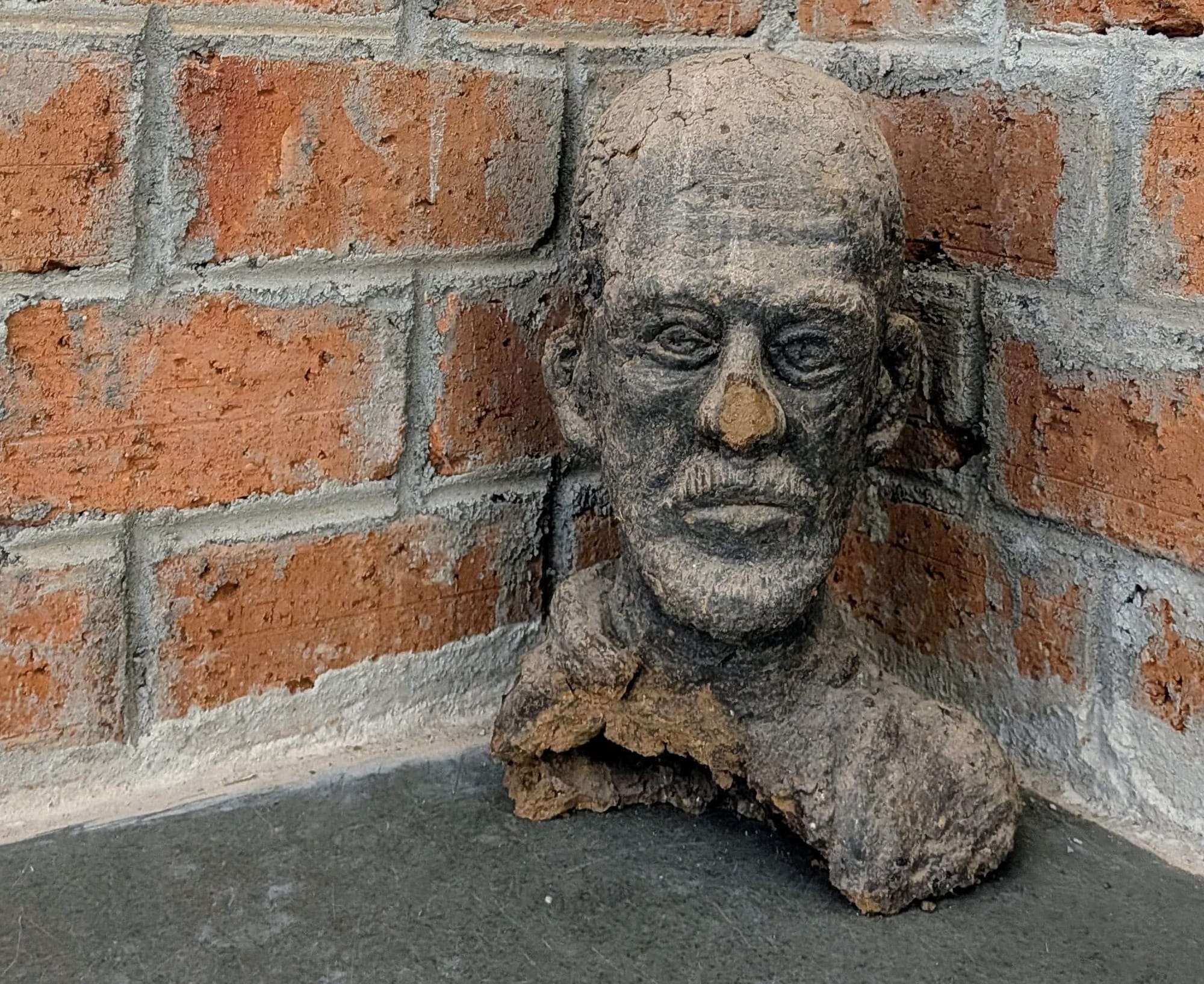
The show is a project by Aazhi Archives, the artist-and-scholar collective co-founded by Riyas Komu. Komu is also the artistic director. If you have visited the bigger show Amphibian Aesthetics at Ishara House in Mattancherry, you already know this team. This show at Kara is a more intimate extension of the same thinking.
The curatorial frame uses three states of consciousness from Indian philosophy:
Three artists, three mediums (sculpture, painting, photography), three modes of being. The show argues that death is not an ending. It is a passage. A space in between. Another way of being present.
You can take that as philosophy. You can take it as poetry. Either way, the work earns it. One artist looks down into the ground. One looks inward into dreams. One pulls forms out of the dirt with his hands. The conversation between them is the show.
Silpi Rajan is from Nedupuzha village near Thrissur, Kerala. He is self-taught. He works in whatever the earth gives him: newspaper, clay, cement, wood, bamboo, coconut wood, iron, laterite. His sculptures look like they have been pulled out of the ground rather than made. They do not have titles. He prefers it that way. He once told a reporter that names make visitors prejudge things.
At this exhibition, his figures look like children of the soil, which is the phrase the wall text uses. It fits.
Midhun Mohan was born in Shoranur, Palakkad in 1985. He died on 5 June 2023 in Goa, in his sleep, of a heart attack.
He was a multidisciplinary artist whose work moved across painting, digital media, video, theatre design, and archival forms. His themes were maritime histories, colonialism, diaspora, slavery, marginality, myth.
The line of his that everyone quotes now is this one: "Pixels are the proletariats of the digital surface." It tells you something about how he saw the world. The smallest unit, the most overlooked thing, carrying the most weight.
His paintings at Kara are dark and dreamlike. A bull. A moon. A creature you cannot quite name. You stand in front of them knowing the man who made them is gone, and the work feels, very specifically, like a conversation he is still trying to have with you, his audience.
Mohamed A is from Thiruvananthapuram. He has over two decades of experience as a photographer and cinematographer.
You may know his work without knowing his name. He shot the 2018 Malayalam film Udalaazham, which followed the life of a tribal trans woman from the Paniya community in Wayanad. The film travelled to film festivals around the world.
For this show, he turns the camera toward archaeological excavation sites. His photographs are deep. Reddish soil. Cut stone. Ancient grooves. The kind of images that make you feel time differently. You will see soil differently once you have seen his photographs.
The wall text uses a small invented word for what his images do: Terrest'real. Terrestrial and real, with a small slip in the middle. The slip is the point.
The show is at Kara 📍, a boutique hotel & gallery in Fort Kochi.
Entry to the exhibition is free (starts at 10AM, closes at 6.30PM).
Kara is a working hotel. Be quiet, respectful, and check at reception before walking through. Allow at least 30 to 45 minutes to immerse yourself.
Cafe is open from 12 Noon to 6PM. The hotel and gallery space sits within walking distance of most of the Fort Kochi sights like St. Francis Church , Post Office.
You may also like,
 Bandit

Plan your Fort Kochi visit with day by day itineraries for 2026. Morning cafes, heritage walks, sunset times & night plans all in one place.

This is our Fort Kochi insider guide for you curated experiences, updated regularly by the cats who call this place home. Whether you're here for the Heritage, the food, or just the light on the harbour at dusk, we've got you.

Hidden spots in Fort Kochi and Mattancherry for authentic samosas, jalebis, dhoklas, lassis, erachi choru, parottas and more

The Biennale is over. The galleries are not. Inside the Mattanchéré Summer Salon at Muziris Contemporary, Jew Town.