


Fort Kochi
Fort Kochi
Fort Manuel, founded 1503, was the first European fortress in India.
Fort Kochi is the old seaward quarter of Kochi, where the Portuguese built their first European fort in Asia. The Water Metro runs from the High Court terminal in Ernakulam to a station near the beach, on a 3.5 kilometre route with two stations.
Old houses built by the Portuguese, Dutch and British line the streets. The Parade Ground lies beside St Francis Church, an open ground of about four acres. The Portuguese, Dutch and British held military parades and drills there, and the tricolour was raised on it in 1947.
Construction of Fort Manuel began on 26 September 1503, and the walls were double rows of coconut tree stems. Portuguese rule over the territory lasted until 1663, when the Dutch captured it. The Dutch made it the capital of Dutch Malabar and cut the old Portuguese town down. The quarter takes its name from that fort.
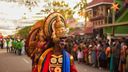
The Cochin Carnival is held at Fort Kochi every year in the last week of December, ending with a New Year’s Day procession led by elephants. The Kochi-Muziris Biennale lists the Parade Ground among its venues.
Did you know
The very first European fortress in India was founded in Fort Kochi on September 26, 1503, and named Fort Manuel after the reigning King of Portugal. Remarkably, it was not constructed from stone: its walls were composed of two parallel rows of cocoanut tree trunks driven into the ground, bound together by iron hoops and large nails, with earth rammed in between and a wet ditch around it.
When the Dutch rebuilt Fort Kochi on a reduced scale in 1697, they kept the street grid and gave the streets literal names: de Linde straat (Lime Tree Street), de Heere straat (Gentleman’s Street), de Peeterceelie straat (Parsley Street), de Osse straat (Ox Street), de Kalven straat (Calf Street), de Burgen straat (Citizens Street), de Bree straat (Broad Street), and de Smee straat (Smith’s Street).
Long before modern municipal corporations, Dutch Cochin was highly organized: inhabitants paid an annual municipal tax dedicated entirely to keeping the street drains clean and maintaining the public streetlights.
Colonial Cochin had a large permanent gallows beside the Santa Cruz Cathedral warehouse near the river. About a mile away, a low island in the backwater called Gallows’ Island served as the site for military executions and later as a burial ground for paupers.
In 1762, the Rajah of Cochin established a detailed tax scale on trees around Fort Cochin, paid in a local currency called the Poothen, valued at approximately one anna and eight pies. A fruit-bearing cocoanut tree was taxed at two poothens, a jackfruit tree at eight poothens, and a betel-nut tree at a quarter of a poothen. Brahmans were exempt from paying house or dwelling taxes, regardless of where they lived.
In 1550, a major campaign against Cochin by the Samorin of Calicut was delayed while his astrologers tried to name a fortunate day for battle. The delay gave the Cochin and Portuguese forces time to consolidate their positions and rescue the Ranee, the Rajah’s aunt, whom the Portuguese had held in their custody.
The Kochi-Muziris Biennale lists the Parade Ground among its exhibition sites.
The Cochin Carnival is held at Fort Kochi every year in the last week of December.
The tricolour was hoisted at the Parade Ground in 1947, and the ground then became a sporting arena.
The Portuguese, Dutch and British colonists all held military parades and drills on the Parade Ground.
The Parade Ground is an open ground of about four acres next to St Francis Church.
Fort Kochi takes its name from Fort Manuel, the fort the Portuguese built here.
The Dutch reduced the old Portuguese town and destroyed most of the public buildings the Portuguese had built.
The Dutch made Fort Kochi the capital of Dutch Malabar after capturing it in 1663.
The Portuguese held Fort Kochi until 1663, when the Dutch captured the territory.
By 1806 the Dutch, and later the British, had destroyed most of the fort walls and bastions.
The walls of Fort Manuel were double rows of coconut tree stems, with earth rammed between them.
Construction of Fort Manuel began on 26 September 1503.
The Fort Kochi Water Metro station is near Fort Kochi beach and connects to High Court station.
The Water Metro route from High Court to Fort Kochi is 3.5 kilometres long and has two stations.
Guides
21- Heritage & History in Fort Kochi



- Beer & Wine Places
- Kerala Traditional Meals (Sadhya)
- Experience Pigeon Feeding at Fort Kochi’s Jain Temple: A Fun Mid-Day Activity
- Tibetan Cuisine in Fort Kochi


Readings
19
- The Painter Who Died Four Days Before His Church Opened: Santa Cruz Basilica, Fort Kochi

- Chavittu Natakam - the Indian Opera with Christian roots from Kerala






Events
32
- Mehfils, Brass Bands, and Vanishing Songs: ARPO Traces Kochi’s Sonic Roots at Fort KochiEnded · 12 Apr 2026
- Macrame Workshop: Make Your Own Jewellery [April 4]Ended · 4 Apr 2026


- Indus Valley Dancing Girl: Hallucinations of an Artifact [Feb 14,15]Ended · 15 Feb 2026

- Dhriti — Kerala’s First Mental Health Festival in Fort Kochi [Feb 14]Ended · 14 Feb 2026
- Food walks, A Floating Concert on Sea, Basheer on Stage & more in Fort KochiEnded · 15 Feb 2026
- 4 Ceramics: Be inspired by 4 Women of Golden Bridge Pottery in Fort Kochi [Feb 6-23]Ended · 23 Feb 2026
- Short Stories, Long Shadows: Contemporary Malayalam Voices at Fort Kochi [Feb 4-6]Ended · 6 Feb 2026
- Tales From The Table: Peruvian & Mattancherry Food Traditions Meet in Fort Kochi [Feb 4]Ended · 4 Feb 2026
- Kochi’s Burning PappanjiEnded · 1 Jan 2026
- 6 Dec ’25 - 30 Jan ’26: A photographic journey with archaeologyEnded · 30 Jan 2026


Drawn from OpenStreetMap, by its contributors.
Is this page useful?
Thank you for your feedback.
That did not send. Please try again in a moment.