
Coz Layover Cafe, Mattancherry: Iced Coffee in a 600-Year-Old Trading Street
Iced coffee in a former godown on a 600-year-old spice street. Coz Layover Cafe, Mattancherry in Fort Kochi
Iced coffee in a former godown on a 600-year-old spice street. Coz Layover Cafe, Mattancherry in Fort Kochi

Rainforests, incense sculptures, insect paintings - all read through a 2,000-year-old Tamil system of landscape and emotion.


Making Kochi Water Metro more accessible to the travelers & humans of Kochi. Carefully curated water metro route maps, timings, feeder buses, tips and more.

Rainforests, incense sculptures, insect paintings - all read through a 2,000-year-old Tamil system of landscape and emotion.

Two thousand years ago, Tamil poets had an idea that no one has managed to improve on: every human feeling has a landscape.
Mountains at midnight, when the kurinji flower blooms once in twelve years? That's union. Forests in the evening, with jasmine and the sound of cattle returning? That's patient waiting. The seashore at dusk, waves against sand? That's longing. Croplands in the early morning? That's the friction between lovers who know each other too well.
These are the thinais - from the Sangam era of Tamil literature, codified in the ancient treatise Tholkappiyam. Each thinai is named after a local flower and is tied to an actual terrain of India. Together, they form a complete system where emotion, ecology, time of day, colour, flora, and fauna are all bound into one thing. Literary critic S. Murali has called this "the earliest attempt at formulating an environmental aesthetic, where the human bhava (emotion) seeks its correspondence in the natural vibhava (cause)."
The Tholkappiyam also divides poetic expression into two modes. Akam turns inward - intimate, feminine, anonymous, centred on love in all its stages. Puram looks outward - the masculine sphere of heroism, conflict, and public life.
An exhibition in My Beloved Fort Kochi takes this 2,000-year-old framework and holds it up against the work of nine contemporary artists. And the fit is surprisingly natural.
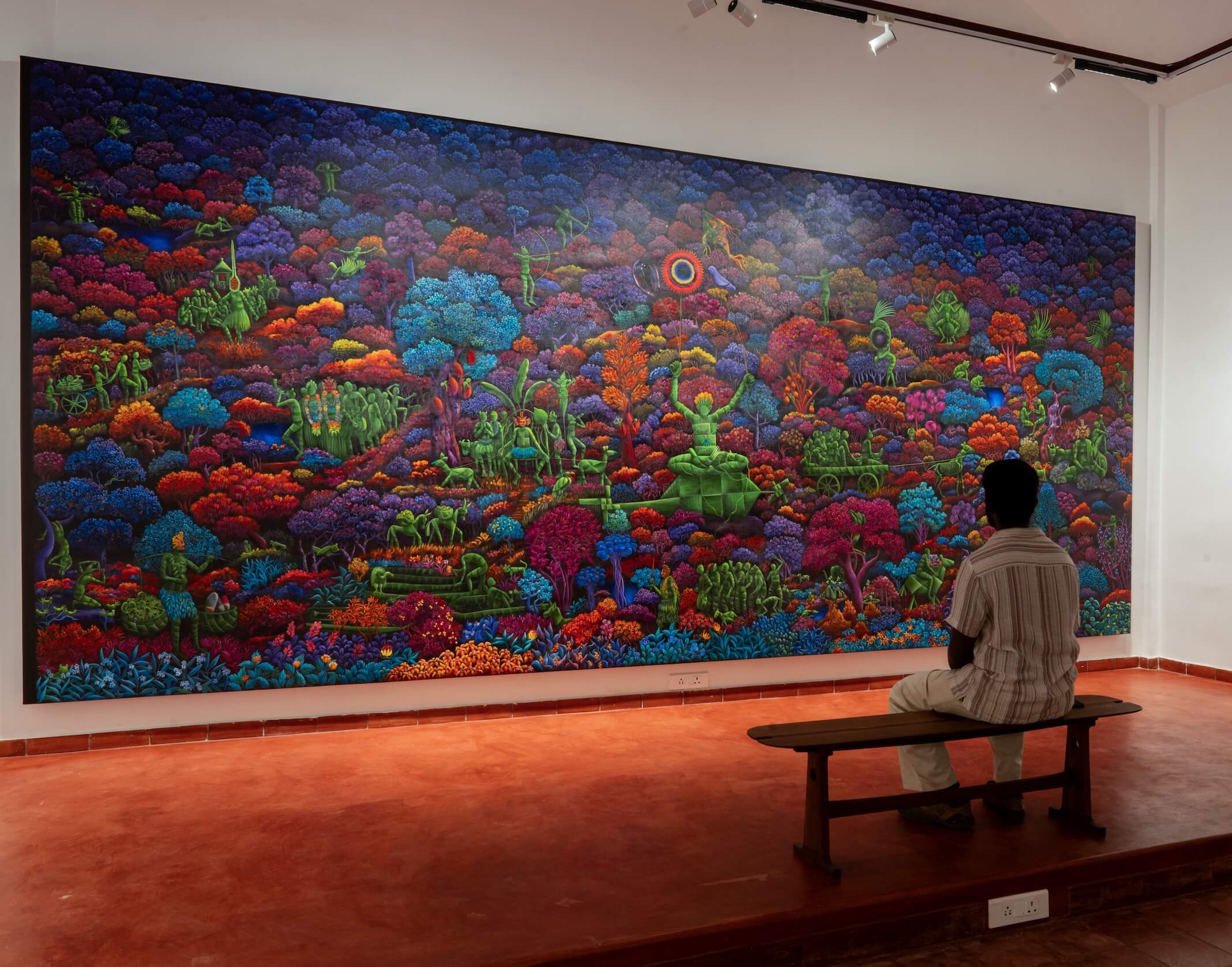
The curatorial idea is simple but powerful: the five Akam thinais offer a way to read art that goes beyond style, medium, or period. If you accept that human feeling is inseparable from the environment it grows in - and that Sangam poets already mapped this out in detail - then nearly any artwork from the subcontinent can be seen through the lens of its ecological and emotional bearings.
The artists gathered here each hold what the curators call "an intuitive link to these world-making systems." Some fit neatly into a single thinai. Others move between them. Here's how the exhibition reads each one.
Before the five landscape-thinais, there's the larger division: Akam (the inner world) and Puram (the outer world). Two artists in this exhibition seem to anchor those poles.
Kamala Das is not a visual artist. She was a poet, short story writer, memoirist, and newspaper columnist who wrote in English and in Malayalam under the pen name Madhavikutty. She's here because no conversation about Akam - the intimate, the feminine, the raw interior of feeling - is complete without her.
Born in 1934 in Thrissur district to a literary family (her mother, Balamani Amma, was a celebrated Malayalam poet), Das was married at fifteen. She started writing in both languages and by the 1960s was part of a generation of Indian English poets turning away from colonial subjects and toward their own bodies, desires, and disappointments.
What set her apart was her refusal to soften anything. She wrote about female desire, loneliness, the weight of her own body, the suffocation of marriage, and the search for love with a directness that conservative India was not prepared for. Her autobiography "My Story" (1976) remains one of the most raw books in Indian literature.
She won the Sahitya Akademi Award, was nominated for the Nobel Prize in 1984, and received Kerala's highest literary honour, the Ezhuthachan Award.
In the exhibition's framing, Das is a fierce Akam presence. Her work is interior, anonymous in feeling even when autobiographical, and shaped almost entirely by a woman's voice. The Sangam poets who wrote Akam verse did so without naming their characters. Das names herself constantly, but the effect is the same - you feel the emotion before you register the person.
If Das is Akam, Riyas Komu is Puram. His work looks outward. It confronts war, displacement, migration, and what happens when we grow numb to violence.
Born in 1971 in Kerala, Komu makes hyper-realistic oil portraits that recall propaganda posters, and works across sculpture, video, and installation. But his largest mark on Kochi's art life is institutional. Komu is the ideator and co-founder of the Kochi-Muziris Biennale.
The exhibition reads his Puram work against the Sangam tradition of public poetry about heroism and its costs.
Puram poetry doesn't flinch from battle. Neither does Komu. His art asks what war does to the people who watch it happen on screens, at a distance, and do nothing.
Kurinci is the mountain thinai. Its flower, the kurinji, blooms once in twelve years in the hill country. Its colour is purple. Its time is midnight. Its emotion is union - and the fear that union might not last.
Santhi EN paints children. They play hopscotch, hide and seek, and quiet games in the shade of palm trees. They read outdoors. They do things that children in Kerala did thirty years ago and many don't do anymore.
Her paintings work in muted, earthy palettes with a noticeable command of purple. Nothing screams. The compositions are still, like looking at a faded photograph of a village afternoon. Specific enough to feel like a real memory. General enough to feel like everyone's.
These are paintings of union with a world that's slipping away. The purple that runs through her palette matches the colour code of the mountain thinai. And the emotion - a deep, quiet ache for something you once had and can feel disappearing - sits right at the intersection of union and the fear of losing it.
I looked at a Santhi EN painting and I remembered what grass felt like.
Marutham is the thinai of cropland and river plains. Its flower is the marutham tree blossom. Its time is early morning. In Sangam poetry, Marutham deals with the friction between people who are deeply connected - lovers quarrelling, the push-and-pull of intimacy after the initial rush fades.
But underneath the friction, there's a bond to the land. Agriculture requires patience, attention, and a willingness to work with what the earth gives you.
When Benitha Perciyal makes a sculpture, you can smell it before you see it. She works with frankincense, myrrh, cinnamon, cloves, lemongrass, cedar wood, bark powder, coal, and Tacoma seeds. She mixes organic materials into dough and shapes them into human forms - saints, biblical characters, and hybrid figures drawn from Kerala's long Christian history.
The Marutham connection is in her materials. Perciyal doesn't impose form on nature - she collaborates with it. Her use of Tacoma seeds, bark, resin, and spice is a direct conversation with the land.
The sculptures change with the weather. They age. They give back to the environment that made them. That's Marutham: you work with the earth, and the earth works on you.
Smitha GS paints snails, beetles, grasshoppers, spiders, praying mantises, chameleons, and antlions. She paints the creatures most people step over. She paints them large, surrounded by forests so dense you feel the humidity rising off the canvas.
A self-taught artist from Kerala, Smitha grew up watching insects near her home. Her father made toys from coconut leaves. She imagined them coming alive. She paints mostly at night, which could be why blue and violet dominate her backgrounds.
In this exhibition, her shola forest paintings sit within the Marutham frame. The shola forests of the Western Ghats are micro-ecosystems where grasslands and forest patches exist in close, interdependent relationship. Smitha's art mirrors that interdependence. Her insects, plants, and landscapes aren't separate subjects - they're one system.
She worries that insecticides will wipe out these creatures before future children ever see them. That worry itself is Marutham: you tend the land, or you lose what lives on it.
In 1970, when most serious Kerala painters were leaving the state for Mumbai or Delhi, C.N. Karunakaran moved back to Kochi. He stayed for the rest of his life. That choice was almost unheard of then. There was no art market in Kerala, no gallery system, no collectors.
His paintings fuse Kerala mural traditions with Indian miniature styles, mythology, and folk elements. The women in his work are instantly recognisable - stylised, ornamental, full of colour. He also painted landscapes. And those landscapes - his impressionist wetlands of Kerala, rich with water and light - are what place him in the Marutham thinai.
Marutham is cropland, river basins, morning light on paddy fields. Karunakaran's wetland paintings carry that same quality: a patient, lived-in relationship with water and earth.
Mullai is the forest thinai. Its flower is jasmine. Its time is evening. Its emotion is patient waiting - the lover who trusts that the beloved will return, even when the distance feels impossible.
KG Babu grew up in Kerala's forest country. He moved to the city for work, then moved back. That return changed his art. He started spending time with Adivasi communities and saw something the city had taken from him - a complete absence of separation between people and the land around them.
"There was no separation," he has said. "They lived as one. One for the other, giving and taking, intricately woven together."
His paintings are dense with colour and life. Wide-eyed children sit among butterflies and dragonflies. The skin tones of his figures carry the same greens and browns as the foliage surrounding them. You can't pull the people out of the forest. They belong to it.
The dragonfly appears again and again. In Kerala mythology, dragonflies carry the souls of the departed. "The Dragonfly is me," Babu has written. "My soul that has wandered in search of deeper meanings of life."
The Mullai reading fits Babu exactly. His figures don't act - they wait, they watch, they exist inside the forest with a stillness that feels like trust.
The intimacy between his human subjects and their green world is Mullai's core emotion: a longing that is patient because it knows the connection is real.
Neythal is the coastal thinai. Its flower is the water lily. Its time is dusk. Its emotion is pining - the ache of separation, the endless rhythmic patience of waves on a shore.
Senaka Senanayake is best known for his saturated rainforest canvases - macaws, butterflies, lotuses, hummingbirds in jewel-toned colour. But in this exhibition, you see a different side. The works on paper carry a quieter, more contemplative energy. Stripped of the lush intensity of his famous oil paintings, these pieces open up space. They breathe.
Senanayake was born in Sri Lanka. He studied art and architecture at Yale and returned to Sri Lanka to paint full-time - against the wishes of a family.
His early work captured Sri Lankan daily life. Then came a Buddhist phase, where he developed his signature halo around figures, inspired by the idea that life is circular until Nirvana. After a 2005 visit to a Sri Lankan rainforest, he committed to painting what remained of the island's forests.
Seventy percent of the original forest cover has been felled. His response is beauty: paint what's left so vividly that no one can pretend it doesn't matter.
The curators read his paper works through Neythal. There's a contemplative openness to them that feels coastal - the spaciousness of a horizon line, the repetition of water. Where his oil canvases overwhelm with detail and colour, these works sit back and let you come to them. That's the Neythal mood: something loved is at a distance, and the waiting itself becomes the subject.
Arieno Kera is from Nagaland, in India's northeast. The thinai system was built from the terrains of peninsular India - Tamil country, specifically. But the Sangam poets also recognised that elements travel between regions. Nature doesn't obey strict boundaries. Neither does this exhibition.
In this exhibition, Kera's rhododendrons - rooted in the flora of her Nagaland homeland - extend thinai-like sensibilities into another cultural landscape. The curators aren't saying Nagaland is a thinai. They're saying the logic works: where you grow up shapes how you feel, and the plants around you carry that feeling into your art.
Kera's work proves the thinai principle travels further than Tamil Nadu. Wherever artists root their practice in the relationship between people and land, the thinais endure.
The thinai system was built before the idea of "landscape painting" existed in the West. Two thousand years ago, Tamil poets were already saying: you cannot separate a feeling from the place where it happens. Mountains produce one kind of love. Forests produce another. The coast produces a third. And the relationship between people and land isn't decoration or backdrop - it's the thing itself.
Reading contemporary art through this framework does something useful. It stops you from asking "what does this artwork mean?" and starts you asking "where does this artwork live?" Where is its emotional terrain? What grows there?
The nine artists in this exhibition were not making "thinai art." They were making their own work, from their own lives and concerns. But as the exhibition came together, the curators must have noticed how naturally the thinais surfaced. A sculptor working with bark and seeds sits in Marutham without trying. A painter of forests sits in Mullai without knowing it. A poet writing about desire sits in Akam because that's the only place such writing can live.
The invitation is simple: walk through, see the work, and notice where your own feelings land. The thinais have been doing this for two millennia. They're still doing it now.

Iced coffee in a former godown on a 600-year-old spice street. Coz Layover Cafe, Mattancherry in Fort Kochi

Making Kochi Water Metro more accessible to the travelers & humans of Kochi. Carefully curated water metro route maps, timings, feeder buses, tips and more.

Chinese tiles, Ethiopian rugs, a Malayalam clock tower. What if I told you that Kochi's oldest synagogue is a world in one room?

Three colonial powers. One wooden church turned stone. And a tombstone that tells 500 years of Fort Kochi's story.

Join 1500+ others & Sign up for the newsletter and get our latest posts delivered straight to your inbox.