
The Ultimate Guide & Map to the Kochi-Muziris Biennale 2025/26 Venues
Kochi-Muziris Biennale is finally here. Browse through Daily Schedules, Highlights, Events, Galleries, Artists in this ultimate guide
Kochi-Muziris Biennale is finally here. Browse through Daily Schedules, Highlights, Events, Galleries, Artists in this ultimate guide

I created a Google Calendar to Keep Track of Events. I update it every 1-2 days. You can click on each and add to your Calendar.

A 200-year-old godown in Mattancherry holds eight of the Biennale's most political works. From Flint's water crisis to the Parliament of Ghosts, Anand Warehouse holds the Biennale's toughest stories
Every summer, the water near Kochi lights up electric blue. Here's the science behind it - It's not magic. It's not a filter. Tiny creatures in the water near Kochi make their own light. Here's how.


Drag your hand through the water near Kumbalangi on a dark summer night, and your fingers leave a trail of electric blue light. It's not a trick. You have just scared millions of tiny living things making their own light to fight you away. Nature is fascinating. Isn't it?
Locals call it kavaru (captivating). Science calls it bioluminescence. And every year between March and May, it shows up in the backwaters and pokkali fields near Fort Kochi - mostly around Kumbalangi and Chellanam, about 12-15 km from the Fort Koochi centre.
In Malayalam, the root word "Kavar" (കവർ) or "Kavaruka" means to captivate, fascinate, or even to steal (like stealing someone's heart).
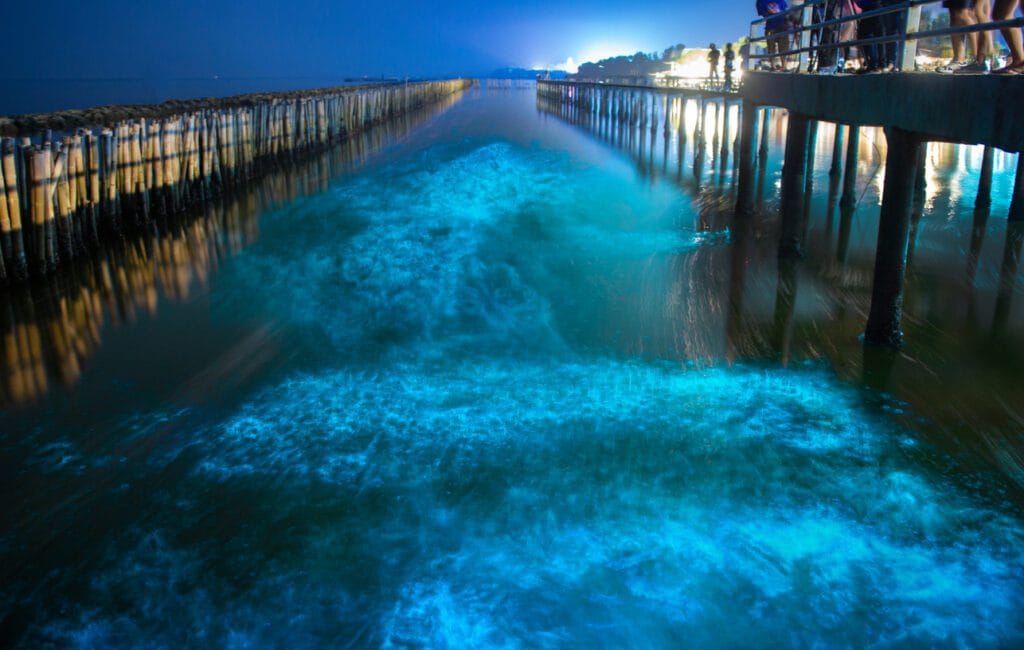
If you saw the 2019 Malayalam film Kumbalangi Nights, you've already seen it. Bonnie and Nylah rowing through glowing blue water. That scene made kavaru famous across India. But this phenomenon has been part of life in these fishing villages for generations, long before any camera captured it.
Choose a dark, moonless night. The glow is nearly invisible when the moon is bright. In early March, when the full moon is up, kavaru is hard to spot before 2 AM. By mid-March onwards, as the moon wanes, you can see it from dusk.
Go by kayak or traditional vanji (wooden boat) if possible. Every paddle stroke sets off the glow right next to you. Some homestays in Kumbalangi arrange night kayaking sessions.
Keep your phone flashlight off. Your eyes need 15-20 minutes to adjust to the dark. One flash of white light resets that clock.
Talk to local fishermen. They've known kavaru for generations and can tell you exactly which stretch is glowing on any given night.
And one more thing: the pokkali fields are working farms. Be respectful. Stick to paths. Don't trample the bunds.

Do you need someone to help you visit this place? We are Cuber - a fun hyper local "Uber" run by cats to connect you with local cab/taxi drivers.
Here's how it actually works. And we're going to keep this so simple that you could explain it to a 10-year-old over lunch.
The star of the show is a tiny organism that scientists lovingly call sea sparkle. How tiny? Each one is about the size of a pinhead. It's a single cell. No eyes. No brain. No legs. Just a round, jelly-like blob floating in the water with a little whip-like tail.
Most of them make their own food from sunlight (like plants). Some hunt and eat other tiny things (like animals). They eats bacteria, tiny algae, and even fish eggs - swallowing them whole through a little mouth on its body.
But eating isn't what makes Sea Sparkles famous. Its party trick is light.
Here's where it gets good. Inside its body, there are two special chemicals:
Luciferin - the fuel (think of it as the match)
Luciferase - the spark (the enzyme that lights the match)
These two chemicals are kept separate inside tiny pockets called scintillons. As long as they stay apart, nothing happens. The creature floats in the dark, minding its own business.
But the moment something disturbs the water - a wave, a paddle, a fish swimming past, your hand dragging through the surface - the cell gets jostled. This opens a kind of chemical gate. Acid floods in from one pocket to another, changing the shape of the luciferase enzyme and releasing the luciferin fuel. The two chemicals finally meet. In the presence of oxygen, luciferin gets oxidised (a fancy way of saying it reacts with oxygen), and that reaction releases energy.
Not heat. Light.
A flash of blue light, lasting about 80 milliseconds. That's less than the time it takes you to blink.
Now multiply that by millions of organisms, all flashing at once because you disturbed the water. That's kavaru. Kavaru is brightest between midnight and the early hours before sunrise.
Do you need someone to help you visit this place? We are Cuber - a fun hyper local "Uber" run by cats to connect you with local cab/taxi drivers.
Good question. Scientists call it the "burglar alarm" theory.
Imagine you're a tiny creature trying to eat sea sparkles in the dark. You bump into it. Suddenly, a bright flash of blue light goes off - like a burglar alarm in a quiet house. Now every bigger predator in the area can see you. The flash doesn't protect Sea Sparkle directly. Instead, it attracts the attention of larger fish that might eat the attacker. Like that friend of yours in School who tells the teacher that your best friend also copied the homework and tries to get the focus elsewhere.
It's like screaming "HEY LOOK, THERE'S A THIEF HERE!" so that the neighbourhood dogs come running.
Kavaru is most commonly seen in two areas near Fort Kochi:
Kumbalangi - an island village about 12 km from Kochi city centre, famous as India's first eco-tourism village. The best spots are in the south-western parts of Kumbalangi, around Kallanchery, Anjilithara, Attathadom, and Kulakkadavu.
Chellanam - a fishing village a little further south, with vast pokkali paddy fields that flood with salt water during summer.
The season typically runs March to May, peaking when summer heat raises the salinity of the backwaters. Here's what triggers it:
After the monsoon rains end and summer sets in, the water in the pokkali fields and backwaters gets saltier. Salinity levels climb to around 30-35 parts per thousand. At the same time, nutrient levels rise from agricultural and urban runoff. This creates ideal conditions for Sea Sparkles to multiply rapidly - sometimes exceeding half a million organisms per litre of water.
When the population gets this dense, the daytime water can actually look red or pink (what scientists call a "red tide"). But at night, any disturbance turns the water blue.
Do you need someone to help you visit this place? We are Cuber - a fun hyper local "Uber" run by cats to connect you with local cab/taxi drivers.
Pokkali is a traditional farming system unique to the coastal areas of Ernakulam, Thrissur, and Alappuzha districts. The idea is simple but clever: for six months, you grow rice. For the other six months, you farm shrimp and fish in the same fields.
During summer, when the fields flood with salt water for aquaculture, the salinity rises sharply. Nutrients from the previous rice crop, from the fish, and from surrounding drainage all accumulate. These are exactly the conditions that Noctiluca loves. Warm. Salty. Nutrient-rich.
So kavaru isn't random. It shows up in pokkali fields because the farming cycle creates the perfect environment for these organisms to bloom.
Now you know more about kavaru than 99% of the people who photograph it. :)
If you're visiting Fort Kochi and want to see this for yourself, check with local homestays in Kumbalangi or Chellanam. The cats of kochi guide to things to do in Fort Kochi is updated regularly with seasonal activities. And remember: dark night, no moonlight, patience.
 Aroo
Aroo

Kochi-Muziris Biennale is finally here. Browse through Daily Schedules, Highlights, Events, Galleries, Artists in this ultimate guide

I created a Google Calendar to Keep Track of Events. I update it every 1-2 days. You can click on each and add to your Calendar.

A 200-year-old godown in Mattancherry holds eight of the Biennale's most political works. From Flint's water crisis to the Parliament of Ghosts, Anand Warehouse holds the Biennale's toughest stories

Fort Kochi has a beach everyone visits. But not faraway, there are shores with 500 years of stories and almost no tourists. From a beach that once held Portuguese cannons to a fishing village where nothing has changed in a century Kochi's best beaches aren't the ones on the map.