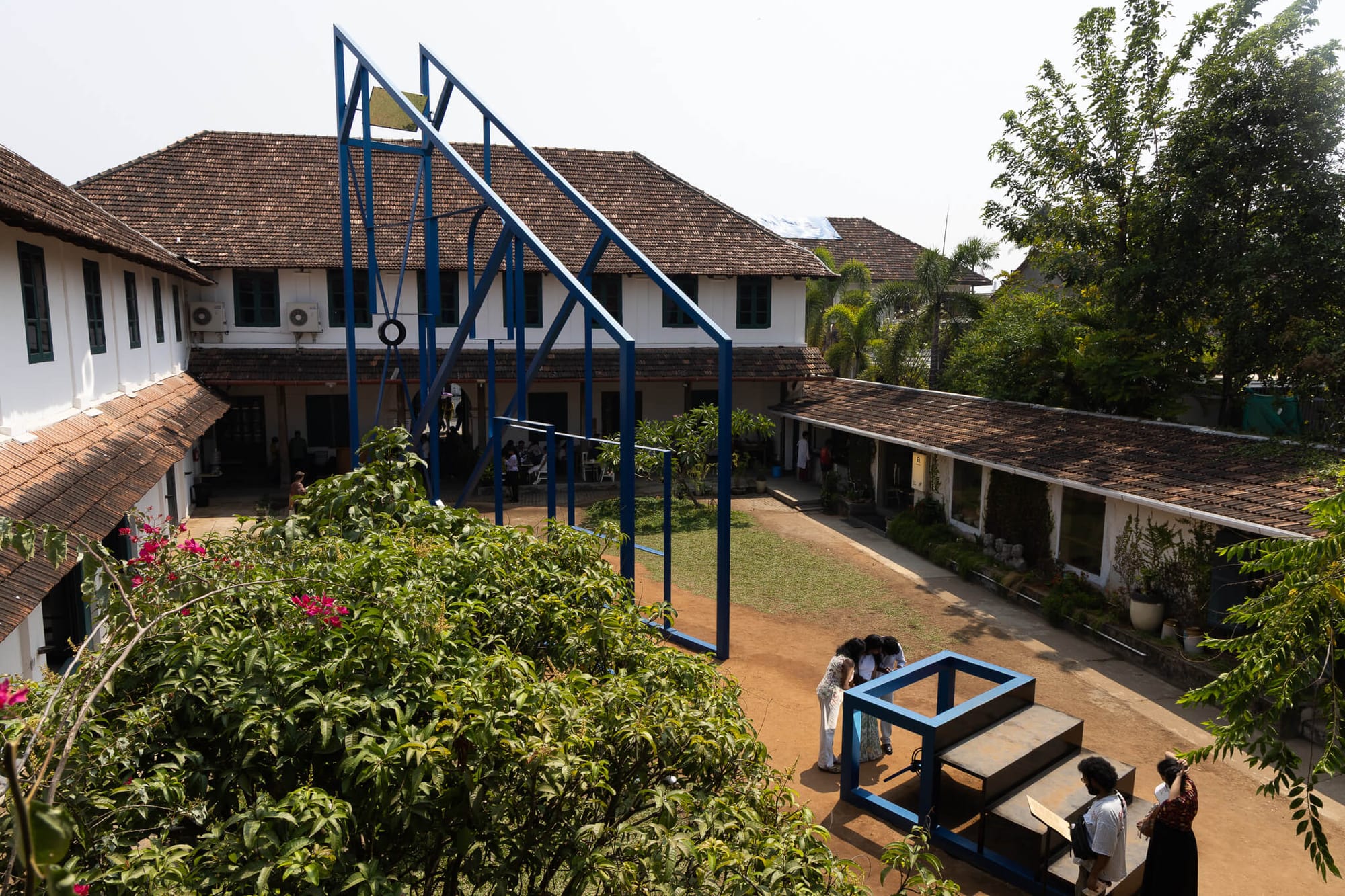
A steel sundial stands in the courtyard of Pepper House, angled at exactly 32 degrees north. That's the latitude of Palestine. Here's what's inside Pepper House at the Kochi Biennale
Pepper House at Kochi Biennale: Ghosts, Sundials, and the Mundanity of Collapse
A steel sundial stands in the courtyard of Pepper House, angled at exactly 32 degrees north. That's the latitude of Palestine. Here's what's inside Pepper House at the Kochi Biennale
A steel sundial stands in the courtyard of Pepper House, angled at exactly 32 degrees north. That's the latitude of Palestine. Walk around it and you'll see the Kochi waterfront reflected in its mirror panels. Two geographies, stitched together by a single angle.
Ghost clothes play stringed instruments. A typewriter types dead names on loop. Five artists turn Pepper House into a site of memory and resistance. This is how Pepper House operates at the Kochi-Muziris Biennale. Every room holds a different world. Five artists working across painting, installation, sound, video, and sculpture have turned this 16th-century spice warehouse into one of the most layered venues in the entire Biennale.
If you're short on time, Pepper House is the venue you shouldn't skip. Start in the courtyard and work your way inward. Here's what you'll find.
Utsa Hazarika, Where Protest Meets Astronomy
New York-based artist Utsa Hazarika has the most ambitious spread at Pepper House. Her work fills the courtyard, the gallery rooms, and even an adjacent wall. The thread connecting all of it: the Jantar Mantar observatory in Delhi.
Jantar Mantar was built in the 1700s as a set of massive instruments for reading the sky. Over the past century, it became India's most famous protest site. Hazarika treats these two identities as inseparable.
Yantra (32°N/Horizon), The Courtyard Sculpture
The outdoor sculpture Yantra (32°N/Horizon) (2025) takes the form of the Samrat Yantra, the giant sundial at Jantar Mantar. But Hazarika has angled its gnomon at 32 degrees north, the latitude of Palestine. The steel structure has mirror panels embedded in it, and those mirrors reflect the horizon line of Kochi. You can climb it, sit on it, walk through it. This is interactive political art done well. First shown at Socrates Sculpture Park in New York, the Kochi version invites direct physical contact.
Arc/Anchor, Inside the Gallery
Step inside and you'll find Arc/Anchor (2025), a curved band of polished steel that cuts through the room. It takes its shape from the measuring scale of the Samrat Yantra. But where the original scale marks hours and minutes, this one is perforated with the names of political prisoners in India, written in morse code. Two spotlights creep along its surface, mimicking sunlight. When the beams meet, they light up the iridescent lines of the anchor piece. To decode the names, you have to look closely and know morse. The work asks you to participate in an act of reading that governments have tried to make invisible.
Bloom (10°N/28°N), The Growing Jasmine
Bloom (10°N/28°N) (2021-ongoing) is a vitrine housing two raat ki rani (night-blooming jasmine) plants. The original version was enclosed. This time, the top is open. Over the Biennale's 110 days, the jasmine will grow past the container's boundaries. The pedestal is angled at 10 degrees (Kochi's latitude) and the plexiglass at 28.7 degrees (Delhi's latitude, matching the Samrat Yantra). The scent of jasmine, Hazarika points out, can't be stopped by borders. It's a small, stubborn metaphor for what nation-states can't contain.
We Cannot Let Go of This Earth & India, 1492
On an adjacent wall, the video We Cannot Let Go of This Earth (2025) documents indigenous communities in Eastern India defending their sacred lands from mining. The subtitles appear separately on a panel beside the screen rather than overlaid on the footage. It's a deliberate choice to preserve the community's own linguistic world within the film.
India, 1492 (2021-ongoing) is a 12-minute video installation on accordion-style archival display. It brings together colonial maps of India drawn by European authorities and medieval European maps that placed the Garden of Eden in India. Columbus carried a map influenced by these Eden-locating charts when he sailed west and accidentally reached the Americas. The work traces how the search for paradise shaped colonial expansion in both directions.
Moonis Ahmad Shah, What Disappearance Sounds Like
Moonis Ahmad Shah (b. 1992, Kashmir) works across installation, video, sound, sculpture, and programming. His room at Pepper House is one of the most unsettling spaces in the Biennale.
The centrepiece is Almost Entirely Sisyphus (2021). A typewriter sits in the room, stripped of paper. It has been programmed to type the names of Kashmiri people who were disappeared during different periods of colonial and military control. Without paper, the typewriter produces only sound and faint marks on the platen. The names are typed in an infinite loop. A bureaucratic tool designed for documentation is turned into an instrument of haunting.
Next to it, All That You Make Disappear in my Fret is but Immortal (2023-ongoing) presents assembled figures made from the debris of explosions and demolitions in Kashmir. Projectile fragments and rubble are reconfigured into mutant shapes that refuse the linear timeline of siege and occupation.
Accidentally Miraculous Everyday from That Heaven (2021) tackles the 2019 communications blackout in Kashmir after the abrogation of Article 370. Images are projected onto a cube suspended in the room. They stitch together and fall apart, mimicking the fractured experience of time under internet shutdowns.
And then there's Dilli ke paani se Kashmiri paani banane ki machine (2025). The title translates roughly to "a machine for making Kashmiri water from Delhi water." It's an absurd apparatus that tries to move water between glasses while leaking and spilling everywhere. The work treats the colonial desire to control landscapes with dark humour. The leaks and spills are the point.
Nityan Unnikrishnan, Paintings That Refuse a Focal Point
Nityan Unnikrishnan trained in ceramics at the National Institute of Design in Ahmedabad and made pots for a decade before turning to painting. He now works in acrylic on canvas, building dense compositions crammed with figures, furniture, and micro-stories that bleed into one another.
His series All of Us (2025) consists of four large paintings hung so they flow into each other. There is no central focal point in any of them. Your eye drifts across human bodies and gestures that overlap but never quite settle. The wall text describes them as showing "the lexicons of existence in landscapes of devastation." In simpler terms: crowded scenes of ordinary life where something has gone wrong, but nobody has stopped to notice.
Two other works are especially worth pausing at. Hymns For The Drowning (2025) is a six-panel painting that mixes text with images of crumbling urban scenes and carnivalesque crowds. Sing You To Sleep (2025) shows a domestic bedroom where violence presses against the walls and windows while a child sleeps on a cot. The scale shifts between the intimate and the apocalyptic without warning.
Unnikrishnan's gallery at Chatterjee & Lal in Mumbai has represented him for over a decade. A recent Aspinwall House guide on catsofkochi.com covers the other main venue — pair both for a complete Fort Kochi Biennale circuit.
Jompet Kuswidananto, Ghost Clothes That Play Music
Indonesian artist Jompet Kuswidananto has spent years working with Teater Garasi, a contemporary theatre group. His installations blend light, sound, found objects, costumes, and stage design. At Pepper House, he presents Ghost Ballad (2025).
The installation is a crowd of ghost figures made from used, everyday clothing and shoes collected from people in Kochi and Yogyakarta. These bodiless forms carry small, portable automated instruments. They play stringed instruments on their own. A soundscape fills the room with layered recordings of Fado (Portuguese melancholic sea songs still sung in Goa and Kerala), Keroncong (Javanese music brought by Portuguese sailors in the 16th century), and other musical forms.
The connection between Kerala and Indonesia runs through Portuguese colonialism. Both coastlines absorbed and transformed Portuguese musical traditions. Kuswidananto traces how the experience of colonial trauma has been preserved through these songs. The voices of Goan singer Nadia Rebelo and Indonesian singer Giwang Topo anchor the soundscape.
If you visited Devassy Jose & Sons in Mattancherry, you'll recognise the Biennale's recurring interest in how colonial trade routes shaped culture. Ghost Ballad is that theme made audible.
💌 Get notified about new events
Minam Apang, Charcoal Forests and a River's Score
Goa-based artist Minam Apang works primarily with charcoal on cloth. Her practice draws from the indigenous folklore and oral traditions of her home region in northeast India.
At Pepper House, she shows Spectre of War: Big Thief (2025), a two-part installation. The first part consists of large charcoal drawings on cloth showing a forest being entered by military figures. These evolved from an earlier series, War on War (2022), which was based on transparency sheets sourced from war propaganda comics. Translated into charcoal, the forest takes on an eerie energy. The forms feel wispy and spectral, as if the land itself is alive and pushing back.
This isn't abstract. In Apang's home region, one of India's largest proposed dams threatens to submerge the Siang Gorge, the homeland of the Adi people. The Siang River is sacred to the Adi community. Its name means "heart of all rivers" in the Adi language. The proposed dam would destroy flora, fauna, river systems, and generations of cultural history.
The second part, Ma (2025), is an abstract drawing score. The title refers both to "mother" (the Siang is sometimes called Siang Anne) and to the Japanese concept of "ma," the charged interval or pause that gives form to what surrounds it. Ma works as a graphic score for a sound piece built from two layers: an old Adi song called Yatem, where a lead voice is answered by a chorus, and field recordings made during a residency at the Ladakh Arts and Media Organisation in Leh.
Open daily, 10 AM to 6 PM, until March 31, 2026. You'll need the all-access Biennale ticket, available at Aspinwall House or online.
Give yourself at least 90 minutes for Pepper House. The Hazarika courtyard sculpture and the Kuswidananto sound installation both reward slow viewing. The café inside the Pepper House complex is a good pause point between rooms, and the house brownie with coffee is worth the stop.
If you're planning your Biennale route, pair Pepper House with Aspinwall House (next door) in the morning, and then walk to other Fort Kochi spots on our 32 Things list in the afternoon.
🐈
Join our Whatsapp Channel for updates, or simply sign up here for email updates on the latest things to do in Fort Kochi and insider details.
Every summer, the water near Kochi lights up electric blue. Here's the science behind it - It's not magic. It's not a filter. Tiny creatures in the water near Kochi make their own light. Here's how.