


Those most affected by climate change are usually the last ones asked what they think. Women, indigenous groups, and coastal workers bear the weight of rising seas and pollution — and their stories rarely make it into mainstream conversations about the crisis.
Along the compound of the Indian Coast Guard Office in My Beloved Fort Kochi — is a long, pale blue stretch of wall. For the two years that I have been here, it was just another boundary wall. Then, sometime in late 2024, a group of artists from six countries picked up their brushes. And when they were done, This wall had a story to tell.
It tells a story that most visitors to My Beloved Fort Kochi never hear — about the people who hold this coastline together.
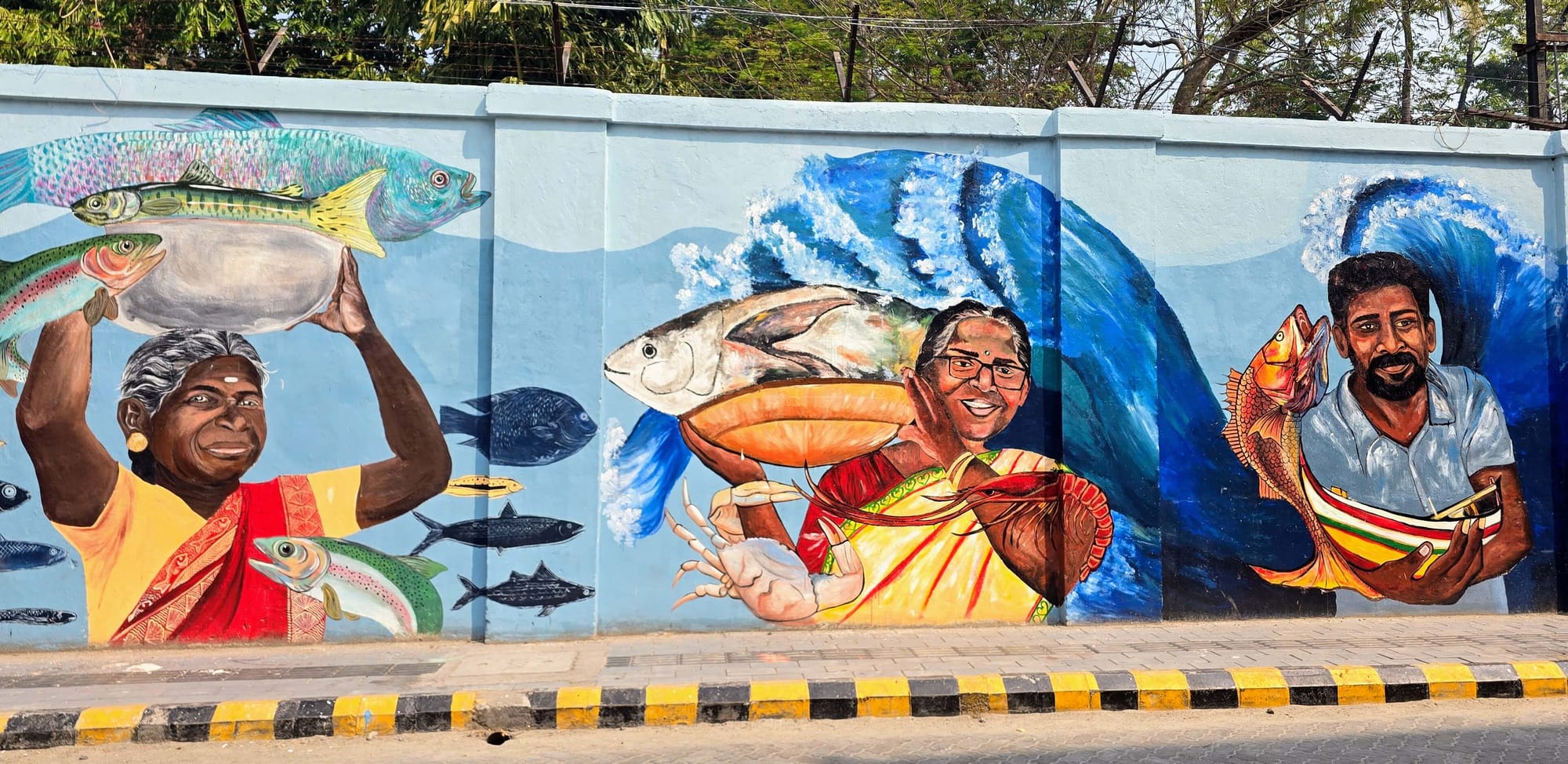
What's on the Wall
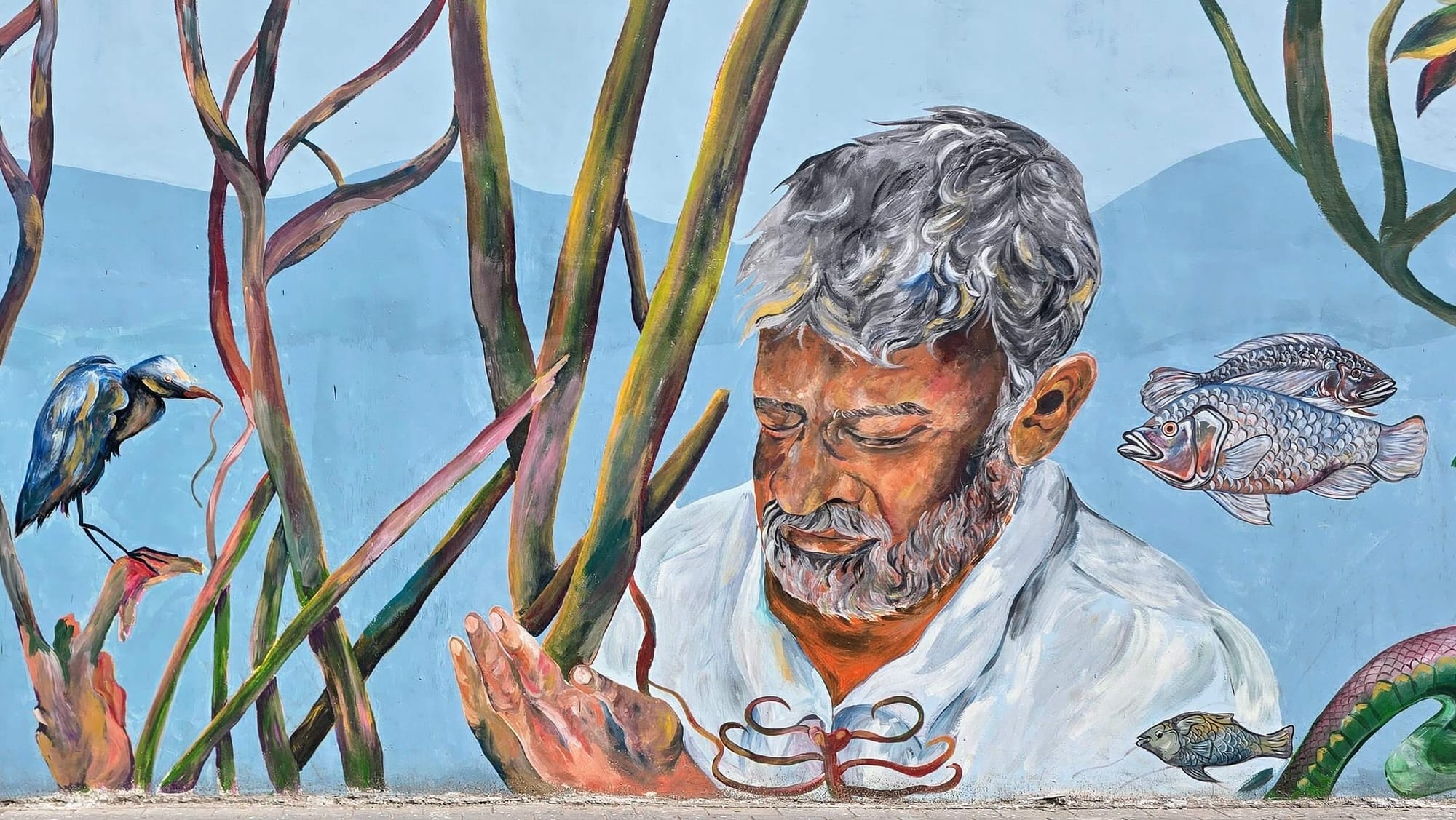
The mural honours three groups of people who rarely get credited for keeping Kochi's coast alive: the Indian Coast Guard who patrol these waters, the mangrove planters who rebuild what extractive forces destroy, and the fishing communities whose knowledge of the sea goes back generations.
One section compares the Coast Guard to lighthouses — standing tall in darkness, beaming their lights across deep oceans, safeguarding biodiversity while keeping our coasts safe. Another speaks of fisherfolk carrying age-old traditions and indigenous knowledge now threatened by coastal erosion. There's a reference to കടലമ്മ (kadalamma) — "Mother Ocean" in Malayalam — and the unwavering faith these communities hold in the sea that sustains them.
The writing on the wall puts it plainly: water here is both metaphor and movement. It flows, transforms, and gives life. The labour of protecting it — often invisible, often across caste and gender lines — is what keeps this shore standing.
And in one section it says: "We set our fears aside and dive in."
Who Made It
The mural was led by Fearless Foundation for the Arts, an organisation started in 2012 by Bangalore-based artist Shilo Shiv Suleman. Fearless has painted over 52 murals across 20+ countries — with refugee communities in Beirut, indigenous groups in Brazil, and at protest sites like Shaheen Bagh and Gotagogama in Sri Lanka.
The Fort Kochi mural was co-created by a group of 10 Fearless Ambassadors — artists and activists from India, Nepal, Bangladesh, Sri Lanka, Uzbekistan, and Myanmar. The wall credits them by name: Ahsana Angona, Chuu Wai, Feruza Abdullaeva, Krisha Joshi, Manga Samarasinghe, Nandhini Moitra, Remille Bargi, Sahana Ihthisam, Shraddha Shrestha, and Vicky Shahjehan.
But this wasn't just an artist project. That's not how Fearless works. The mural was painted through open community sessions — local residents, Coast Guard personnel, mangrove workers, and fisherfolk joined the painting.
Why This Wall Matters
Fort Kochi has plenty of street art. The Biennale editions have left bold murals across Burger Street, Princess Street, and Mattancherry's lanes. But most of that art speaks to art-world visitors. This wall speaks to the neighbourhood.
The mural is part of Fearless' climate justice programme called "At the Root." The idea is simple but hard to argue with: the people most affected by climate change are usually the last ones asked what they think. Women, indigenous groups, and coastal workers bear the weight of rising seas and pollution — and their stories rarely make it into mainstream conversations about the crisis.
In Fort Kochi, the project grew out of listening circles and story-sharing sessions. People talked about ancestral knowledge, everyday risks, and the pressure of living with rising waters. The result is a mural that works like a visual archive — not of climate data, but of lived experience.
How to Find It
Google Map Location here
The mural runs along the compound wall of the Indian Coast Guard Office on Calvathy Road — that's the navy side of Fort Kochi, a quieter stretch most tourists skip in favour of the busier Burger Street and Princess Street areas. If you're walking from the Chinese fishing nets toward the Calvathy junction, you'll see it on your left.
There's no entry fee, no opening hours. It's a public wall on a public road. Walk it slowly. The mural unfolds in sections — each one painted in soft blue tones with text in English. Give yourself 15-20 minutes to take it all in.
If you're visiting during the Kochi-Muziris Biennale, this makes a perfect addition to your art walk — especially if you've been gallery-hopping all day and want something that sits outside the white-cube world.
 Ginger
 Ginger


![hack4play: DIY Workshops, Live Music in Fort Kochi [Till Mar 6]](/content/images/size/w320/format/webp/2026/02/hacker-cat-svgrepo-com.svg)


