
A Steel Cage With No Door, a Song Trapped in Glass: Inside Ishara House, Kochi
A 200-year-old house in Jew Town becomes the stage for 12 artists asking what it means to survive between land and sea.
A 200-year-old house in Jew Town becomes the stage for 12 artists asking what it means to survive between land and sea.

A steel sundial stands in the courtyard of Pepper House, angled at exactly 32 degrees north. That's the latitude of Palestine. Here's what's inside Pepper House at the Kochi Biennale

Kochi-Muziris Biennale is finally here. Browse through Daily Schedules, Highlights, Events, Galleries, Artists in this ultimate guide
A 200-year-old house in Jew Town becomes the stage for 12 artists asking what it means to survive between land and sea.

There's a steel cage in the middle of a room in Mattancherry. Three meters tall, three meters wide. You can walk around it, look through its bars, press your face against it. But you can't get in. There's no door. Stamped along the top edge, two words: "Free Space."
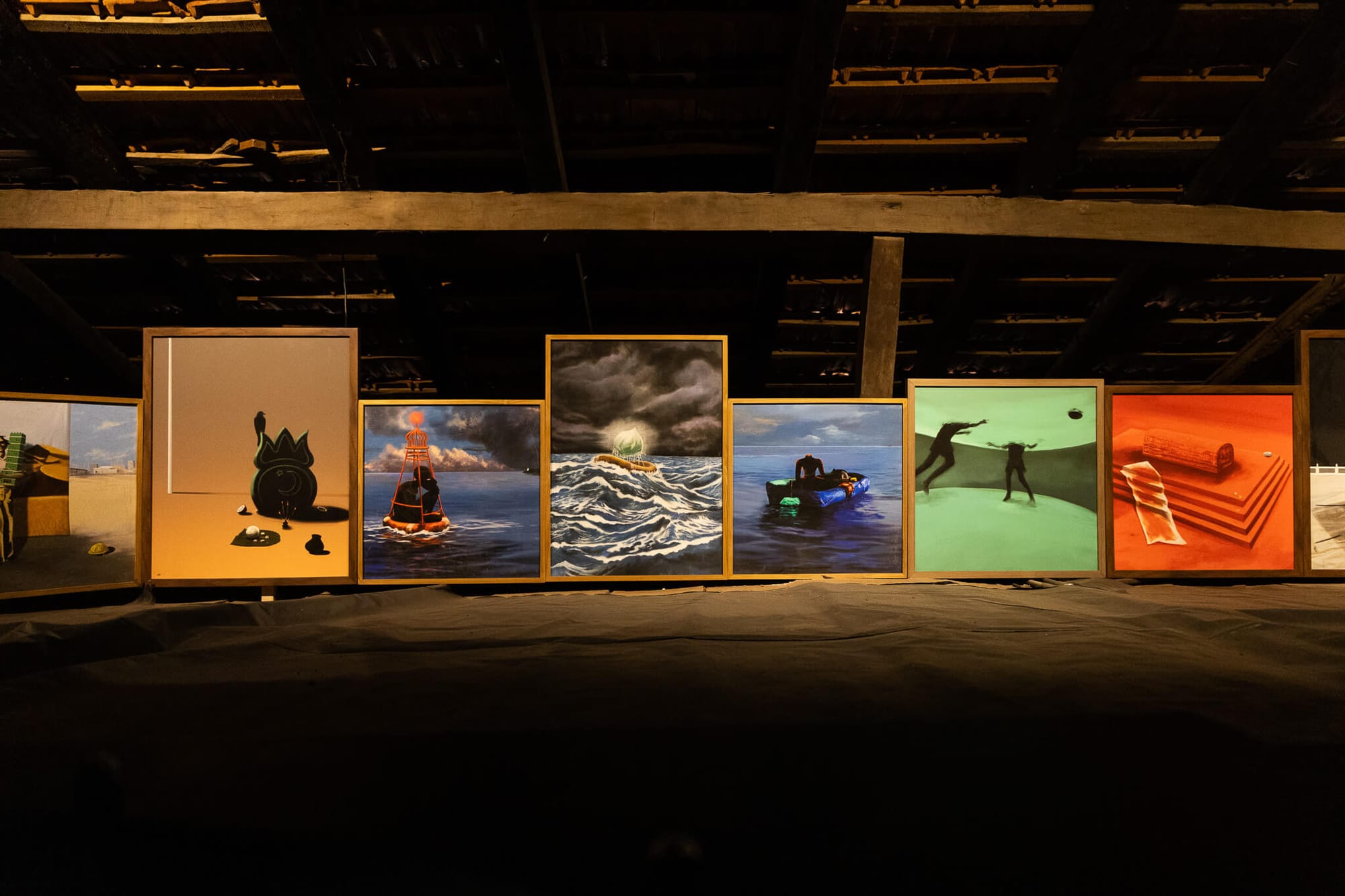
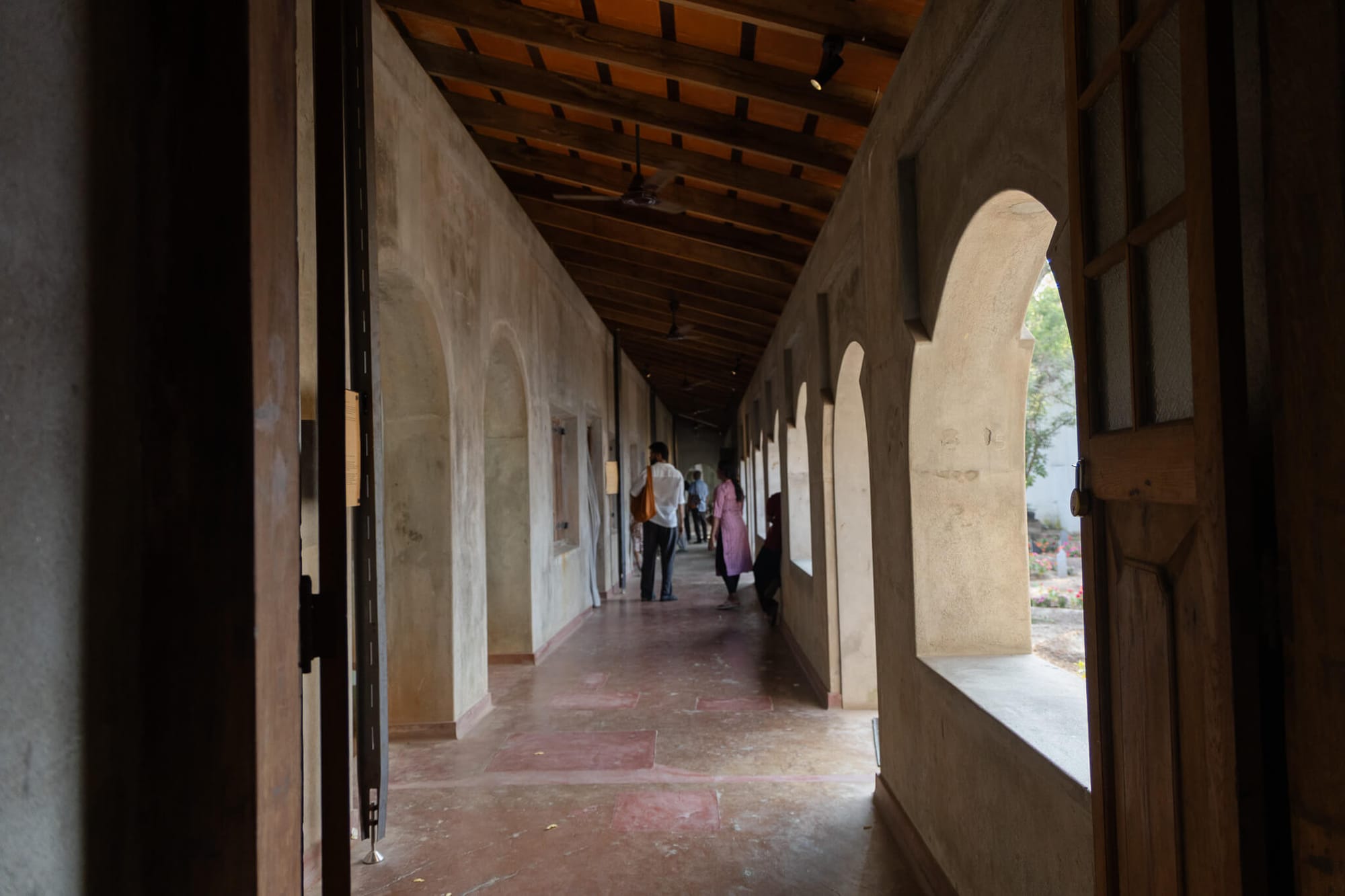
"Amphibian Aesthetics: Art in the Age of Precarity" opened on December 13, 2025, inside Kashi Hallegua House in Jew Town, Mattancherry. The building is over 200 years old, and it sits in one of Kochi's most layered neighbourhoods, a place built by centuries of trade, migration, and coexistence. The exhibition runs alongside the Kochi-Muziris Biennale through March 31, 2026, featuring 12 artists and collectives from India, Italy, Palestine, and the UAE.
It's organized by the Ishara Art Foundation (a Dubai-based nonprofit for South Asian contemporary art) with Riyas Komu as artistic director. Komu is also a co-founder of the Kochi Biennale Foundation, so this isn't a random side show. Aazhi Archives and URU Art Harbour are project partners. Galleria Continua and Alserkal Avenue back the space.
The word "amphibian" does a lot of work in this show. It refers to organisms that live between two worlds - land and water. But for the artists here, it's also a way of thinking about people who live between states: between nations, between memory and forgetting, between visibility and erasure.
Kochi is itself an amphibian city. Its waterways have connected the region to the rest of the world for centuries. Trade brought languages, food, religions, and people from Arabia, China, Portugal, the Netherlands. Mattancherry and Jew Town carry this history in their streets. The exhibition is placed right inside that history.
Two works by the 91-year-old Italian artist, a pioneer of Arte Povera and a nominee for the 2025 Nobel Peace Prize. Both are courtesy of Galleria Continua.
Spazio Libero (The Free Space), 1976-2025. The cage with no entrance. Pistoletto first described this work in his 1976 book "One Hundred Exhibitions in the Month of October" - a collection of ideas for one hundred future works. The first physical version was built in 1999 at San Vittore prison in Milan, made by inmates who installed it in the prison courtyard. A cage inside a cage. The point: freedom isn't a physical state. It's a mental one. Even locked up, your thoughts belong to you.
Division and Multiplication of the Mirror, 2025. Four framed mirrors, each split and angled apart. Pistoletto started this series in 1978 with a simple observation: a mirror can reflect everything except itself. When you divide a mirror and move the halves apart, the reflections multiply. The narrower the angle, the more images you see. What starts as breakage becomes abundance. The series links physical optics to a social argument: sharing produces more than accumulation.
The Indian Garden with Unknown Flowers, 2025. A massive oil-on-linen triptych (549 x 305 cm). Ratheesh paints from the fractures of contemporary India. His work tracks how Brahminical patriarchy has taken political shape through religious communalism, and how ideology filters into daily life - deciding what's visible, what's acceptable, what gets erased. His figures are migrants, workers, mythic characters, ordinary people. All of them adapting, all carrying the weight of historical memory. The 2018 Kerala floods and the COVID-19 pandemic appear as backdrops, moments where infrastructure collapsed but human solidarity didn't. Courtesy of Galerie Mirchandani+Steinruecke.
The World of Amfy B.N. Jose x Frogman, 2025. Digital interventions across online platforms, print, and outdoor murals in Kochi's streets. Appupen works in dark humour, pop aesthetics, and political satire. This series follows a fictional character named Amfy B.N. Jose, who takes a government job hunting a vigilante called Frogman. By day, Amfy manufactures fear through staged news and propaganda. By night, he becomes the very figure he's supposed to catch. A story about what happens when ambition eats conviction. If you've seen Appupen's murals around Fort Kochi during the Biennale, this is the larger narrative they belong to.
When the Stone Sang to the Glass, 2025. Walk into two small rooms. Everything you see - furniture, window panes, tabletops, drinking glasses - came from the neighbourhood around Kashi Hallegua House. Gupta has turned these ordinary objects into instruments. During her site visit, as she touched the surfaces, echoes of "Hum Dekhenge" surfaced - Faiz Ahmad Faiz's protest poem that became a rallying cry for resistance movements across South Asia. The installation connects to Gupta's long engagement with imprisoned poets and suppressed voices. Previous works like "Untitled (Wives of the Disappeared)" (2006) and "Song of the Ground" (2017) explored similar ground. Here, when authorities silence public dissent, sound finds other paths. It seeps into walls and inhabits household objects. With support from neugerriemschneider gallery.
 shemeer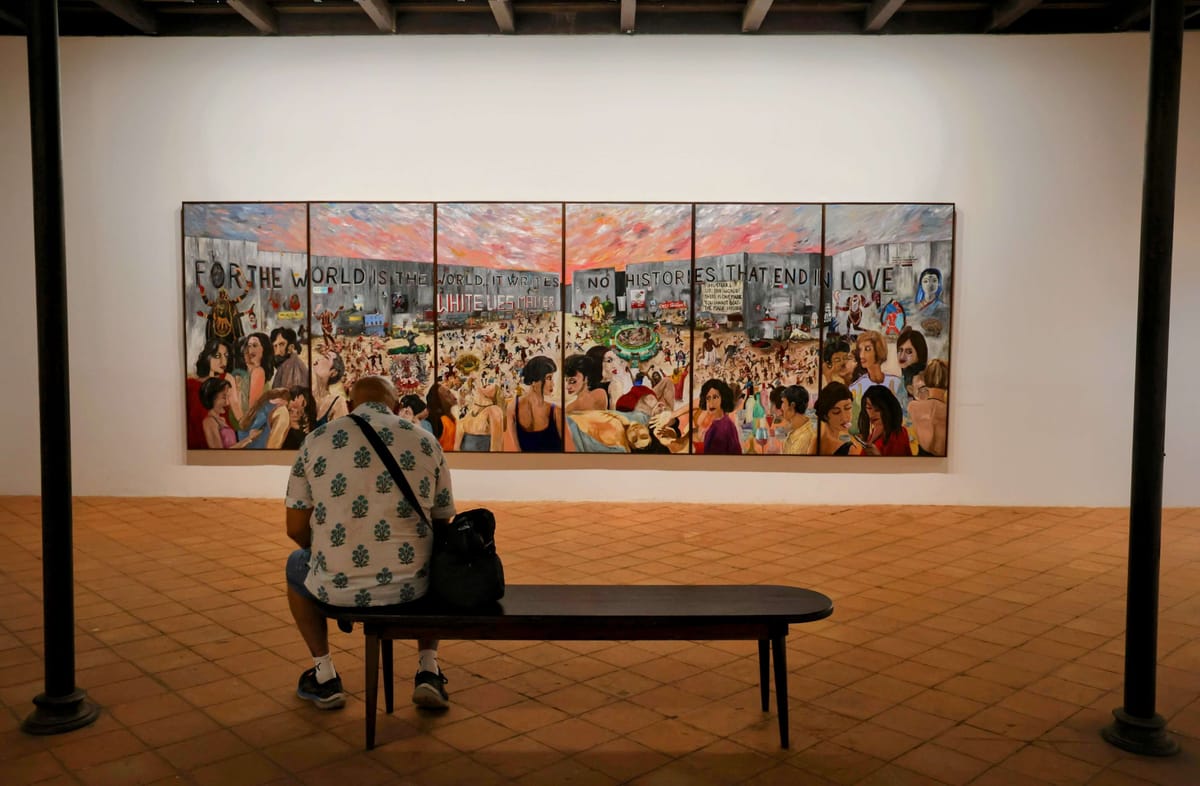
Foundations, 2025. A site-specific installation using bricks and plaster. The floor plan comes from an ancient tomb in Gaza, excavated by British archaeologists in the 1930s. Srouji builds a sonic and physical composition of what remains and what has been erased from the ground in Palestine - both in space and in time. The installation sits with time, moving backwards while waiting for Palestinian liberation. Srouji has shown at the Venice Biennale, Sharjah Architecture Triennial, the V&A, and the Palestinian Museum.
Two works from this collective that has spent 23 years archiving India's mystic poetry tradition.
Akath Katha: The Untellable Tale, 2025. Conceived by Anisha Baid, Smriti Chanchani, and Shabnam Virmani. A multimedia installation drawing from Ajab Shahar, a digital archive of 600 years of mystic poetry. The medieval poets of the Bhakti and Sufi traditions challenged religious sectarianism and moral hypocrisy. Their poems crossed language after language - Malwi, Sindhi, Urdu, Bengali - moving through marketplaces, shrines, and village gatherings. The central tension: these mystics insist on truths that can't be spoken, yet they keep speaking. They mock language while using it. Akath (the unsayable) and Katha (the said) wrestle throughout.
Trail of Mirrors, 2025. An interactive digital archive. Two browsing stations offer curated paths through the Ajab Shahar collection. The first trail explores "Fakiri" or living freely - shedding ego, material attachment, anxious clinging. It asks you directly: what burdens are you carrying, and could you set them down for a few minutes? The second trail mirrors the Kabir Project's own 23-year journey of listening, collecting, and singing with keepers of this tradition.
Two works responding to the ongoing devastation in Gaza.
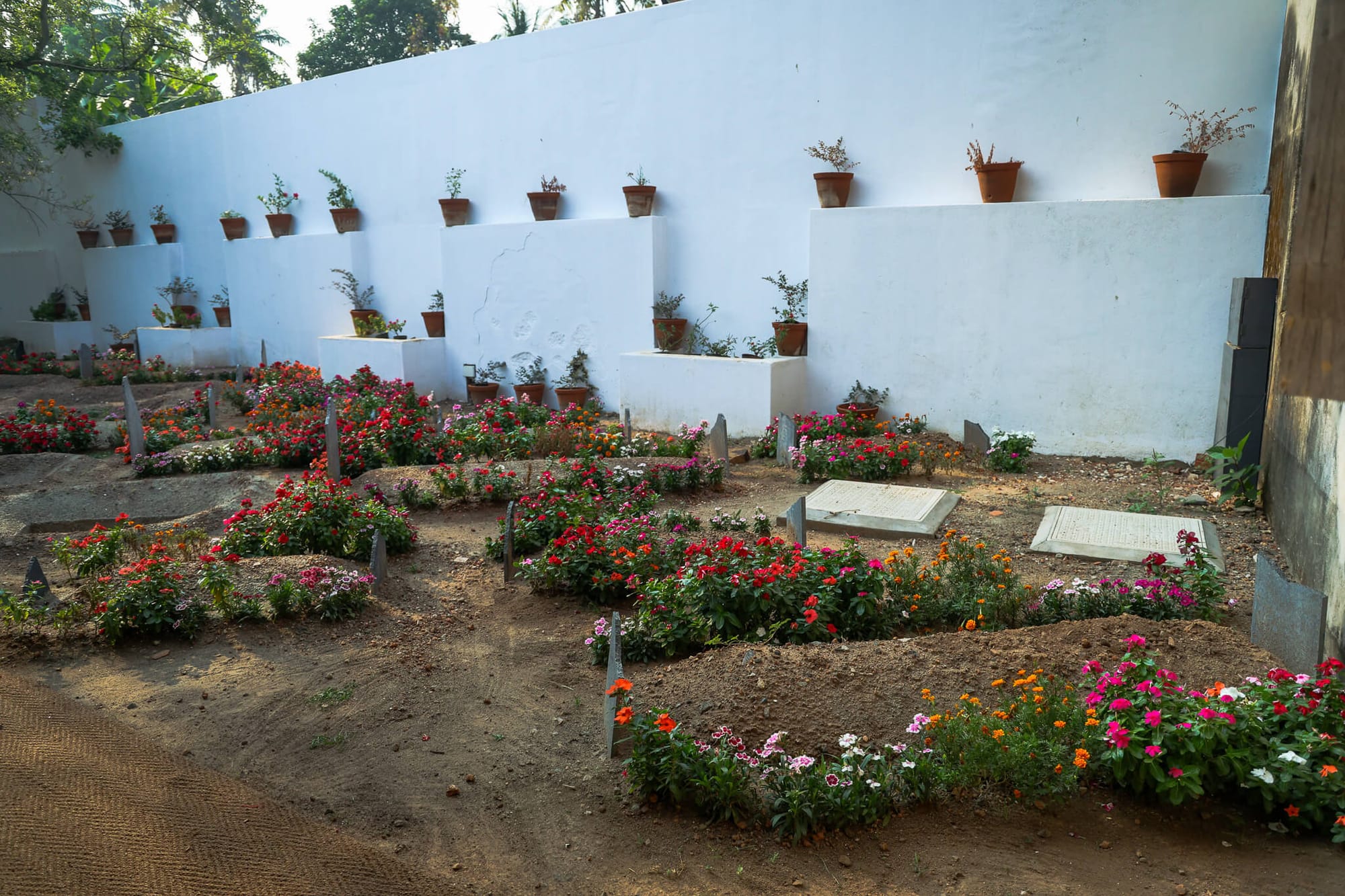
We Were Playing in the Clouds, 2025. A site-specific installation that begins with a quote from Palestinian writer Ghassan Kanafani about children being lifted to the sky during wartime and returning to say they were playing in the clouds. The work centres on Qabars (gravestones) and their place between life and death - what the Arabic term "Barzakh" describes as a state between this world and the afterlife. The installation draws on Vaikom Muhammad Basheer's idea of "infinite time" to ask why gravestones matter in an age of precarity.
Gopalan Solo, 2025. A performance channelling collective grief and rage in response to violence and dehumanization. Gopalan's theatrical approach draws energy from the present moment, turning performance into an act of witnessing.
Three Acts of a Masjid, 2025. Six screens showing more than 200 short, vertical-format videos gathered from public online sources - stories, reels, TikToks. The work assembles a living archive of the mosque as a place of construction, destruction, preservation, devotion, vulnerability, and control. The six screens unfold across three "acts": Destruction (forces that erase sacred spaces through war, redevelopment, or neglect), Preservation (mosques maintained across centuries through care and restoration), and Protection (communities defending what remains through protest, prayer, and documentation). The sounds overlap and bleed between screens. The call to prayer merges with the crash of debris. The footage spans historic centres of worship to neighbourhood mosques across different geographies.
Boatcast: Float with Stories, 2025. Video interviews conducted aboard Kerala's boats. Mirza, a media veteran and artist, uses Kerala's waterways as both stage and subject. The conversations move across locations around the state. The format turns travel into exchange - a series of dialogues in motion.
Fourteen archival prints on paper, ranging from 60x60 cm to 70x60 cm. Works include "Man Holding His Dream," "Sarmad," "Sea Fairy," "Dream Ka Tukda," and others. Mohan worked across visual, digital, haptic, and archival forms, treating mediums as tools to be reconfigured rather than categories to be preserved. His practice explored maritime travel, colonialism, diaspora, slavery, and myth. He offered sharp, satirical counter-narratives against dominant histories. Mohan is no longer with us, and this presentation carries the weight of a practice cut short.
In, Between, 2025. A site-specific installation using steel and sound. Sixtous uses the hull of a boat as both material and metaphor within Kochi's waterfront setting. The hull - always partly underwater - carries traces of labour and migration, of journeys both chosen and forced. Polished interiors against corroded exteriors trace routes of trade and belief. The work connects geographies across the Mediterranean, Gaza, the Aegean, and the Bay of Bengal, lingering in uncertainty rather than resolving the tensions between commerce and conflict. Fabricated by Vinton Engineering.
City As A Spaceship (Susmita Mohanty, Rohini Devasher, Sue Fairburn, Barbara Imhof) works at the threshold between Earth and space. Their contribution includes Amphibious Futures (2022), a set of A2 posters drawing from collaborative field notes - underwater go-pro images, shore-based movement studies, annotated maps, fieldwork photographs. The prints capture raw, unprocessed moments from the edge of sea and space, inviting viewers into the same liminal experience. Across four interconnected works, the collective explores states where land, sea, atmosphere, and cosmos merge.
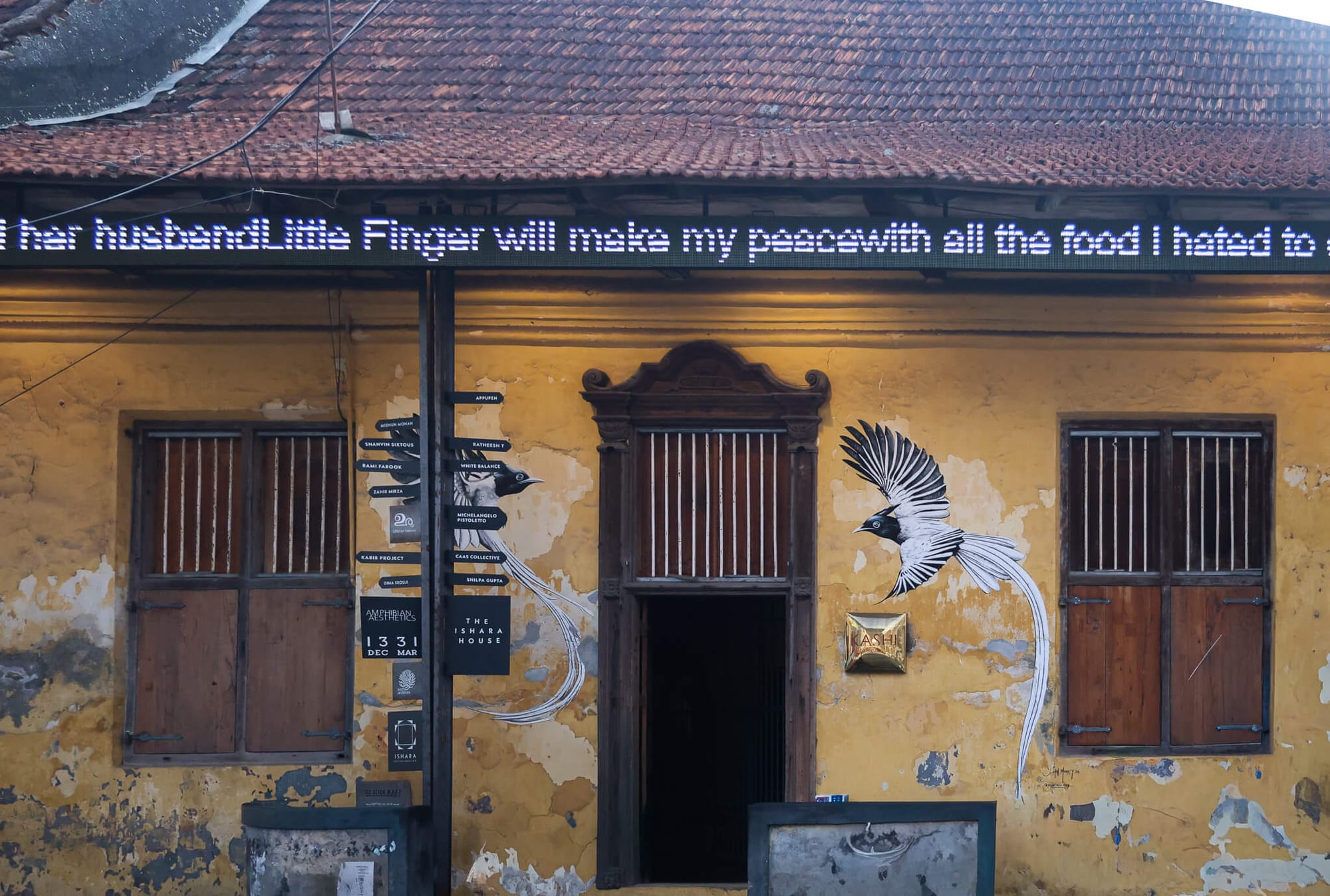
Where: Kashi Hallegua House📍 , Synagogue Road, Jew Town, Mattancherry, Kochi 682002
When: December 13, 2025 to March 31, 2026. Open Monday to Sunday, 10:30 AM to 7 PM.
How to get there: Take the Water Metro to Mattancherry, or an auto from Fort Kochi (about 15 minutes). The house is on Synagogue Road, a short walk from the Paradesi Synagogue.
How long to plan: At least 90 minutes. Some of the sound installations need time to settle in. The Kabir Project's browsing stations can absorb 30 minutes on their own.
Combine with: This is Jew Town - spice shops, antique dealers, and the Synagogue are all within walking distance. The main Biennale venue at Anand Warehouse is a few minutes away. If you're doing a Mattancherry art day, pair Ishara House with Devassy Jose & Sons and the Anand Warehouse venues.

A steel sundial stands in the courtyard of Pepper House, angled at exactly 32 degrees north. That's the latitude of Palestine. Here's what's inside Pepper House at the Kochi Biennale

Kochi-Muziris Biennale is finally here. Browse through Daily Schedules, Highlights, Events, Galleries, Artists in this ultimate guide

Hidden spots in Fort Kochi and Mattancherry for authentic samosas, jalebis, dhoklas, lassis, erachi choru, parottas and more


Every summer, the water near Kochi lights up electric blue. Here's the science behind it - It's not magic. It's not a filter. Tiny creatures in the water near Kochi make their own light. Here's how.
Join 1500+ others & Sign up for the newsletter and get our latest posts delivered straight to your inbox.