A walk through Fort Kochi is a walk through centuries - spice-scented lanes, colonial architecture, and the Arabian Sea at every turn. Here's your guide to exploring one of Kerala's most charming corners.
...I couldn’t help but feel a flicker of gratitude in my fur. It's so much easier in the cat world. We don’t really care for labels. Gender isn't that popular a concept, as are most boxes that aren't cardboard.
Vivan Sundaram's Last Work Comes to Kochi — Six Stations of a Life Pursued at Biennale 2025
He never saw it installed. The iron cages were built. The actor stepped inside. The photographer shot for hours. But Vivan Sundaram — one of India's most important artists — died on March 29, 2023, before his final work could be shown to the world. Now, that work has come to My Beloved Fort Kochi.
He never saw it installed. The iron cages were built. The actor stepped inside. The photographer shot for hours. But Vivan Sundaram — one of India's most important artists — died on March 29, 2023, before his final work could be shown to the world. Now, that work has come to My Beloved Fort Kochi.
Six Stations of a Life Pursued (2022), Sundaram's last major work, is on view at Cube Art Space, Mattancherry, as a Special Project of the Kochi-Muziris Biennale 2025. It is a photography-based installation that moves like a journey through six stops — each one asking you to sit with pain, memory, beauty, horror, and loss.
What I Saw
This is not a show you walk past. It is a show you walk through — slowly.
The installation is built around different kinds of bodies. A wounded body marked by torture. Mourning bodies shown as shadows. A family caught in a quiet charade. A body floating like debris on a lake. A prisoner trying to reclaim what it means to exist. And at the end, the leftover props — concrete objects that hold the weight of everything that came before.
Geeta Kapur, art critic and Sundaram's wife, describes the work as a place where history becomes personal. We don't just look at the past — we feel it pressing against us.
The Six Stations
The installation unfolds through distinct sections, each with its own mood and scale.
Shelter
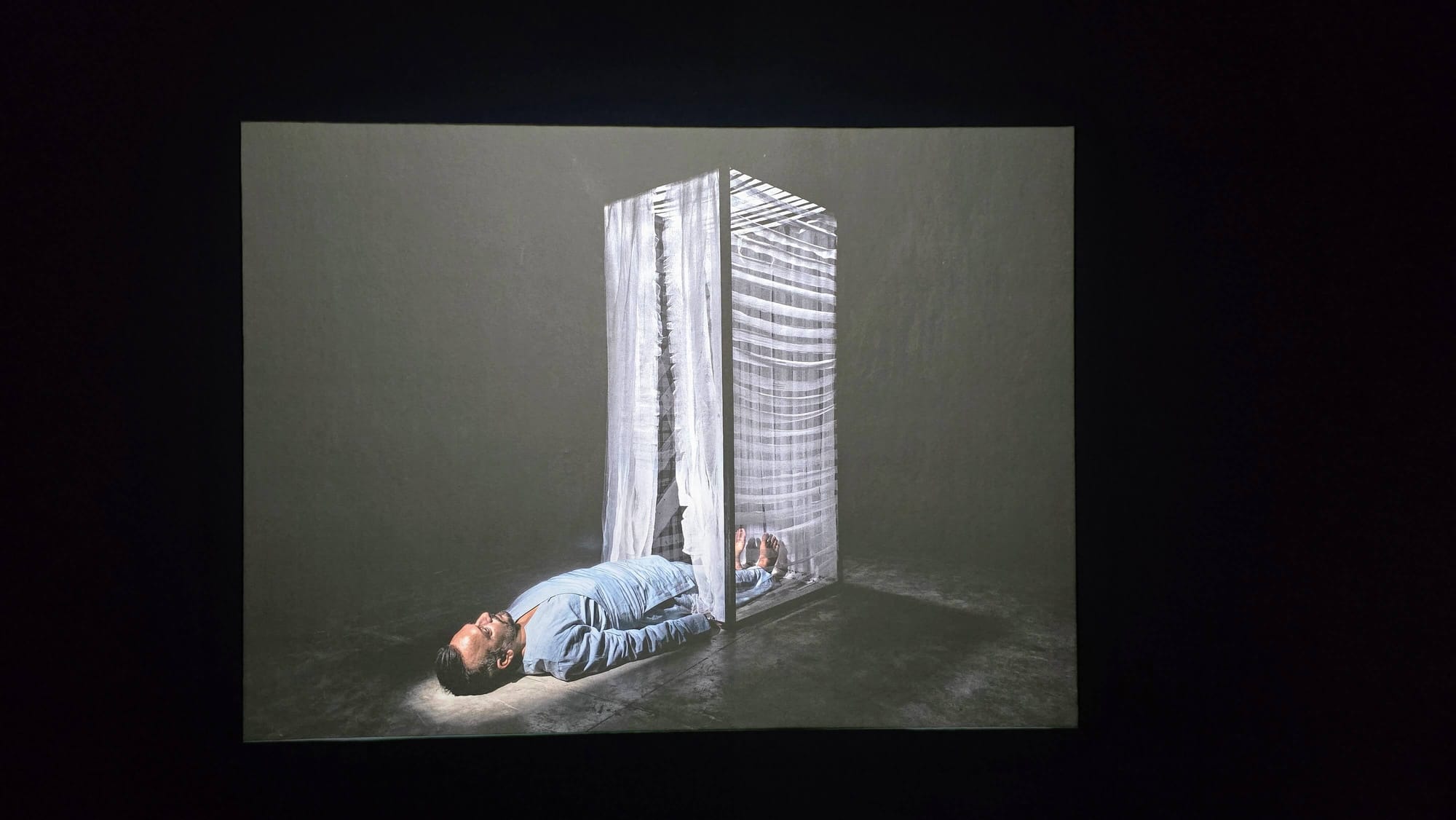
Actor Harish Khanna was chosen to play an incarcerated figure inside a set of eight iron cages, each about 6 by 4 feet. The cages were made with Sundaram's longtime collaborator Shamlal, a junk-yard ironsmith. The process was like a performance in itself — hammering, bending, twisting, locking.
Inside these cage-shelters, everyday objects became tools of violence and survival. A tub filled with water. A bunk bed fixed to stretch a body. An iron hoop that works as both a noose and a halo. Bandages draped across walls. A copy of the Indian Constitution placed with pointed care.
Eight final photographs were chosen from many enactments: a man with his face in a bucket of water, a man looking at the sky through a porthole, a man in a prison cell, a man with a store of destroyed apples, a man at the doorstep of a Kashmiri jaleedar cabin, and a man in a wooden cabin with the Indian Constitution — making an exit to a Chinar grove.
These scenes were lit by Anay Mann and shot by photographer Imran Kokiloo.
Penumbra
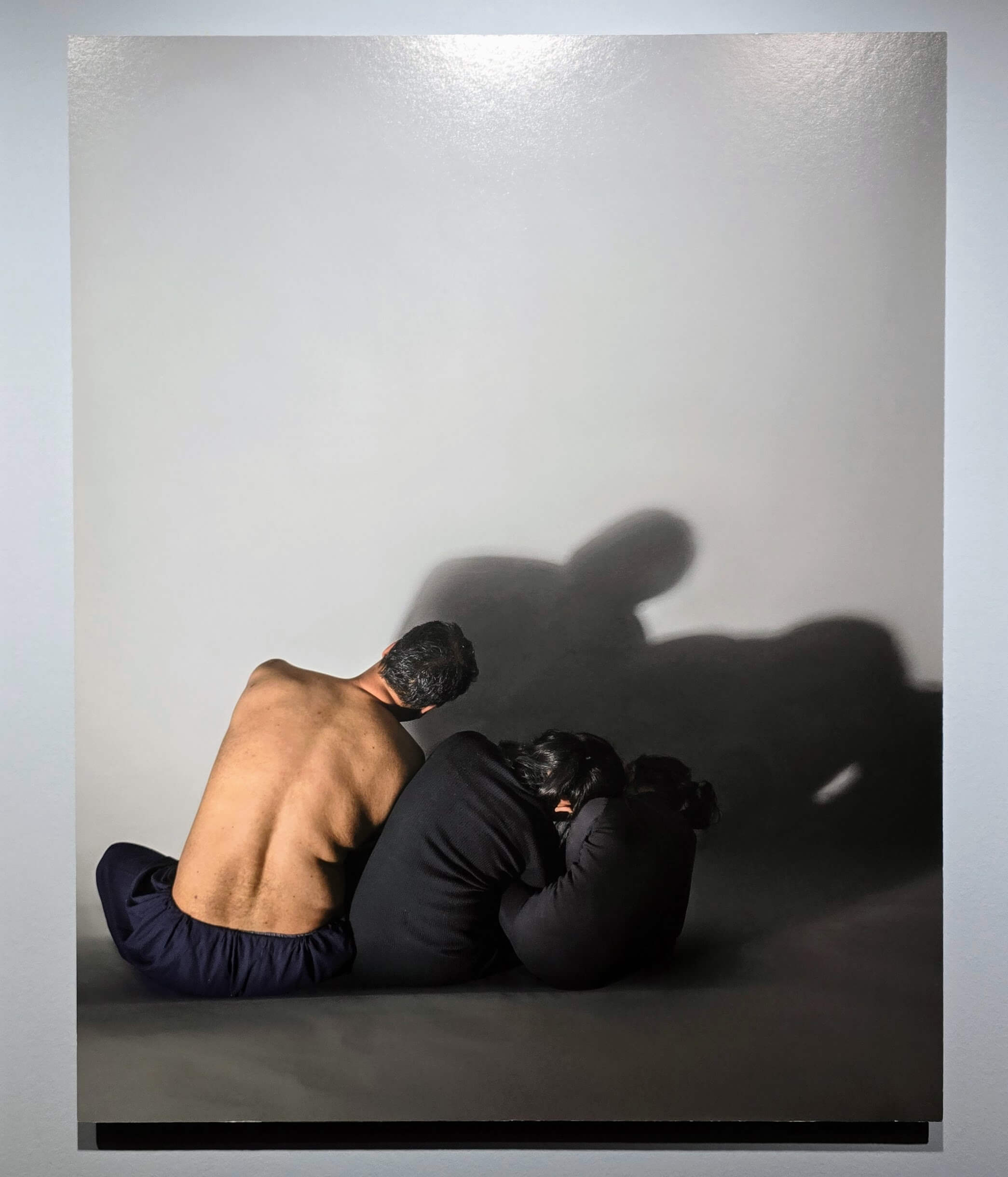
This section is quieter, more ghostly. Photographer Imran Kokiloo and his wife Anita Khemka stage a family portrait with their two young daughters, Azah and Zaara. Shot in silhouette against a dark studio, the figures crouch, fold, cling — looking like dancers, acrobats, or body-bags.
The shadow here is not just a visual effect. It is the subject. The photographs show a 'disappeared' family recalled through phantom movements. A huddle for protection. A getaway stance. And in between, moments of childlike play.
Performers in the Vale
The same family — Imran, Anita, Azah, and Zaara — now moves out of the studio and into the streets and cemeteries of Srinagar. They play the roles of wayfarers, exiled family, and local actors in a series of photomontages. Real locations are photographed in colour, then combined with studio-shot scenes, creating a layered mix of make-believe and documentary.
Lake Sublime
A large photograph of Dal Lake, Srinagar — 58 by 58 inches — made to look like a miniature painting seen from above. The water surface seems peaceful at first. But look closely. Tiny fragments of the artist's own body have been cut and scattered across the lake, mixed with debris. What looks like lilies and lace turns out to be bombs, flags, trucks, guns, and slogans.
Sundaram worked with collaborator Hilal Ahmed to photograph his own torso, miniaturize it, slice it digitally, and embed it in the lake's surface. The result is unsettling — the beautiful and the violent dissolved into one image.
Why this is a must visit
Vivan Sundaram (1943–2023) was one of the most important figures in Indian contemporary art. He studied at the Slade School of Art in London during the student movements of 1968. He returned to India and spent five decades making work that responded to political violence, communal conflict, urban waste, and buried histories.
He was also India's first installation artist. His works ranged from a memorial for victims of the Babri Masjid violence to digital photomontages of his own family's colonial-era photographs. His practice was deeply collaborative — he worked with ironworkers, photographers, actors, and sound artists.
Six Stations of a Life Pursued was first shown at Sharjah Biennial 15 in 2023, an edition conceived by the late curator Okwui Enwezor and titled Thinking Historically in the Present. Enwezor had passed away in 2019, and Hoor Al Qasimi, Director of Sharjah Art Foundation, continued with his title and vision. Sundaram's work was one of 30 specially commissioned projects for SB15's 30th anniversary.
Now, for the first time, it comes to My Beloved Fort Kochi.
🐈
Join our Whatsapp Channel for updates, or simply sign up here for email updates on the latest things to do in Fort Kochi and insider details.
Visiting Details
Exhibition: Vivan Sundaram — Six Stations of a Life Pursued (2022)
A walk through Fort Kochi is a walk through centuries - spice-scented lanes, colonial architecture, and the Arabian Sea at every turn. Here's your guide to exploring one of Kerala's most charming corners.
...I couldn’t help but feel a flicker of gratitude in my fur. It's so much easier in the cat world. We don’t really care for labels. Gender isn't that popular a concept, as are most boxes that aren't cardboard.