


Twelve young artists from Kashmir have summoned beings that refuse to be forgotten.
Artists
Rabia Mohi-ud-din, Basit Qadir, Mansha Bari, Rahil Sajad, Razwan Ahad Lone, Rayees, Saroosh Khan, Sahil Manzoor, Suhail Mohd Khan, Lubna Bashir, and Zainab Bashir Mir—all from the Institute of Music & Fine Arts, University of Kashmir.
Medium
Sculptures (mixed mediums)

Venue
Artshila, Near Parade Ground

This beautiful Kochi Biennale Venue presented by Arthshila is part of their multi-art curations projects across India.
Address: Opposite Parade Ground, Next to entrance of Lily Street
Timings
10AM to 6PM (Monday to Sunday)
Till March 31st, 2026
About
The Conference of Anti-Apocryphal Beings brings together sculptural figures drawn from Kashmiri folklore—creatures like Rantas, Dyev, Yacch, and the unsettling Braid-Chopper—in what the artists describe as "a space of deliberation" rather than a catalogue.
These are not museum-piece mythologies. They are living presences.
Rantas arrives as a winter demon who haunts snowbound villages, carrying generations of unrecorded women's stories. The Dyev slips between deity and demon, sacred and profane. The Braid-Chopper—born from recent panic and political reality—embodies how collective trauma transforms into creaturehood when documentation becomes impossible. The Yacchh, with its forested presence, holds ecological knowledge that modern beliefs have muted.
What makes this work remarkable is its refusal to explain away. The artists write that their figures "claim space not through verification, but through presence." Each holds "a truth that cannot be archived, fear that cannot be contested, memories that cannot be contained."
"This 'conference' is therefore not fictional; it is forensic. It is political."
The installation asks uncomfortable questions: How does a culture absorb violence? How does it name danger while encoding care? How do whispered anxieties transform into shared stories when imagination becomes survival?
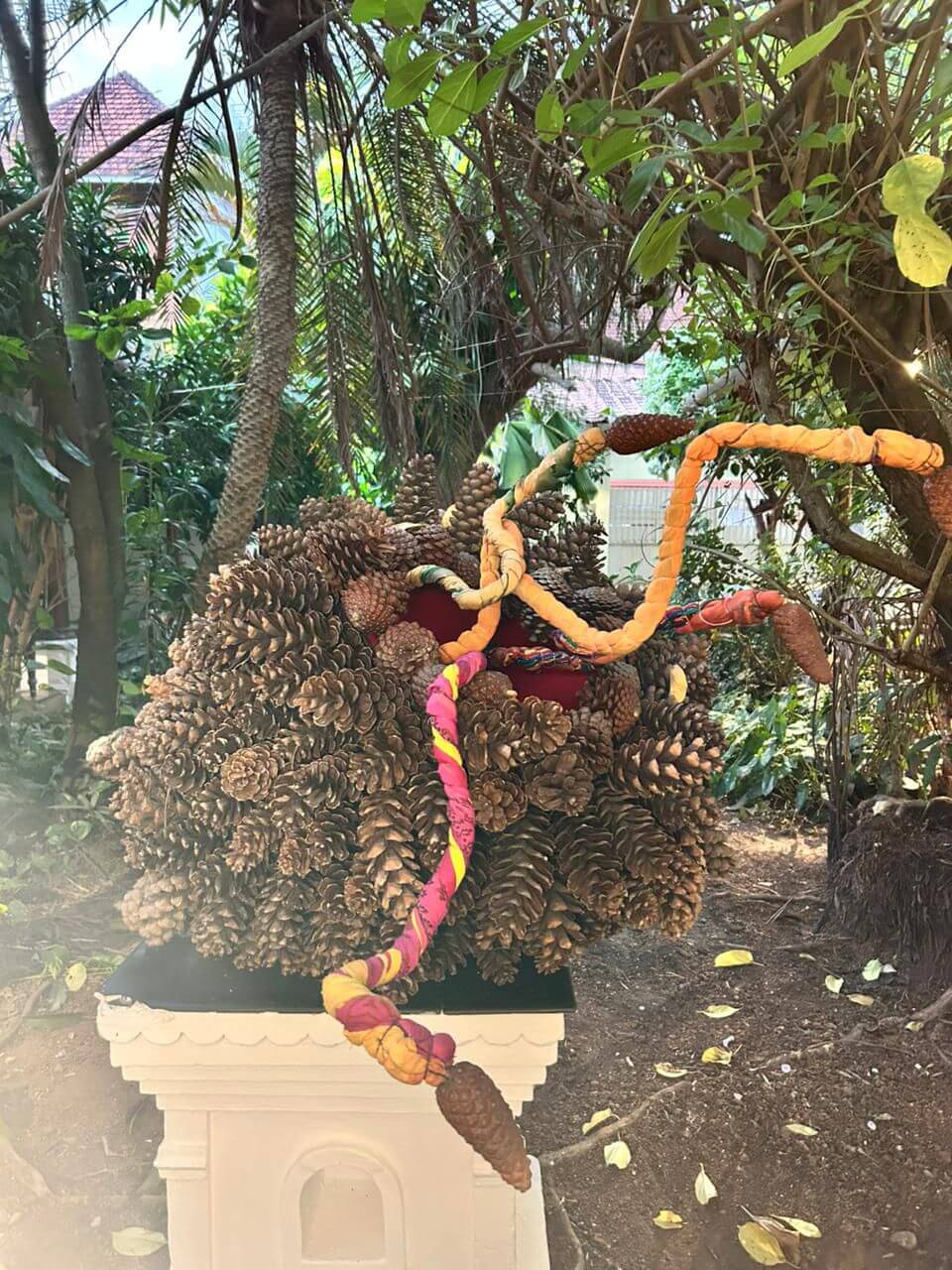
Kochi Biennale 2025
The Students' Biennale, running alongside the Kochi-Muziris Biennale, has always been a space where tomorrow's artistic giants take their first bold leaps. This year's edition brings together young artists from art schools across India—each with stories that demand to be heard.


