
The Paradesi Synagogue: 450 Years of Spice, Prayer, and Hand-Painted Tiles in Mattancherry
Chinese tiles, Ethiopian rugs, a Malayalam clock tower. What if I told you that Kochi's oldest synagogue is a world in one room?
Chinese tiles, Ethiopian rugs, a Malayalam clock tower. What if I told you that Kochi's oldest synagogue is a world in one room?

Three colonial powers. One wooden church turned stone. And a tombstone that tells 500 years of Fort Kochi's story.

Planning your Fort Kochi visit? Scroll to your date for a ready-made itinerary — morning cafes, heritage walks, afternoon rest spots, sunset times, and night plans.
The Students' Biennale at Kochi shows you what Indian art looks like in five years. Here are five artists you should see.


Every morning, Nikhil Chavan boards the Persons With Disabilities coach of a Mumbai local train. He watches. The way a man with one arm grips the overhead bar. The quiet way a woman on crutches shifts her weight at every stop. The courage hidden inside ordinary commutes.
Then he paints what he sees — on train tickets.
Nikhil is one of several student artists showing work at the Students' Biennale, running alongside the Kochi-Muziris Biennale 2025. And while most visitors head straight for the big-name exhibitions at Aspinwall House, the Students' Biennale is where I discovered art that's rawer, more personal.
We curate a Google Calendar to Keep Track of Events. We update it every 1-2 days. Check it out and Add your favorite events to your calendar!
This year's edition brings together student artists from over 175 art institutions across India. Their work is spread across five venues in Mattancherry and Fort Kochi. What struck me about the artists featured here is a shared thread — every one of them is making art about the body. Not the body as a beautiful thing to look at, but the body as a site of struggle, resistance, and quiet power.
Medium: Ink on Paper, Wall Mural in Charcoal and Soft Pastel
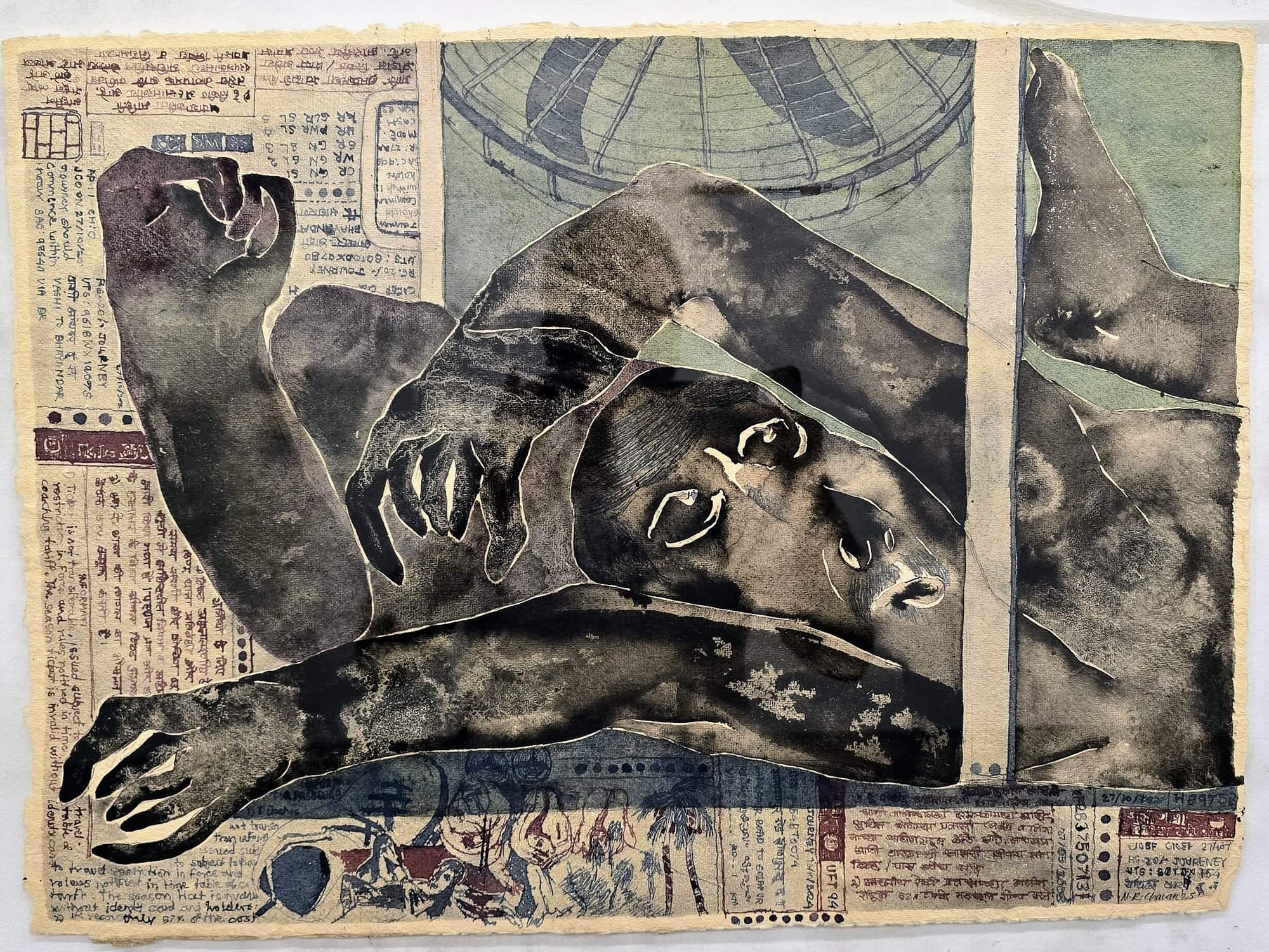
Nikhil's practice begins inside Mumbai's local trains — specifically, the handicap coach. It's a space most people never enter. Inside, he finds people navigating ordinary challenges with extraordinary persistence. He doesn't focus on the disability. He focuses on the courage.
His visual language is distinct. Abstracted limbs, fragmented anatomical forms, distorted gestures. As a person with a physical disability himself, Nikhil challenges the narratives that treat disability as punishment. His work says the opposite — it honours endurance and agency.
What makes this piece remarkable: he started by painting miniatures on train tickets. Tiny, intimate works. For the Biennale, he scaled up to an immersive wall mural. Same observations, but now they fill an entire room. The shift from pocket-sized to wall-sized says something about ambition refusing to be limited by anything.
Sir J.J. School of Art, where Nikhil studies, is India's oldest art institution — founded in 1857 in Mumbai. Its alumni include M.F. Husain, F.N. Souza.
Medium: Mixed media — Embroidery on canvas, cloth, sanitary napkin, plastic/wrappers, paper
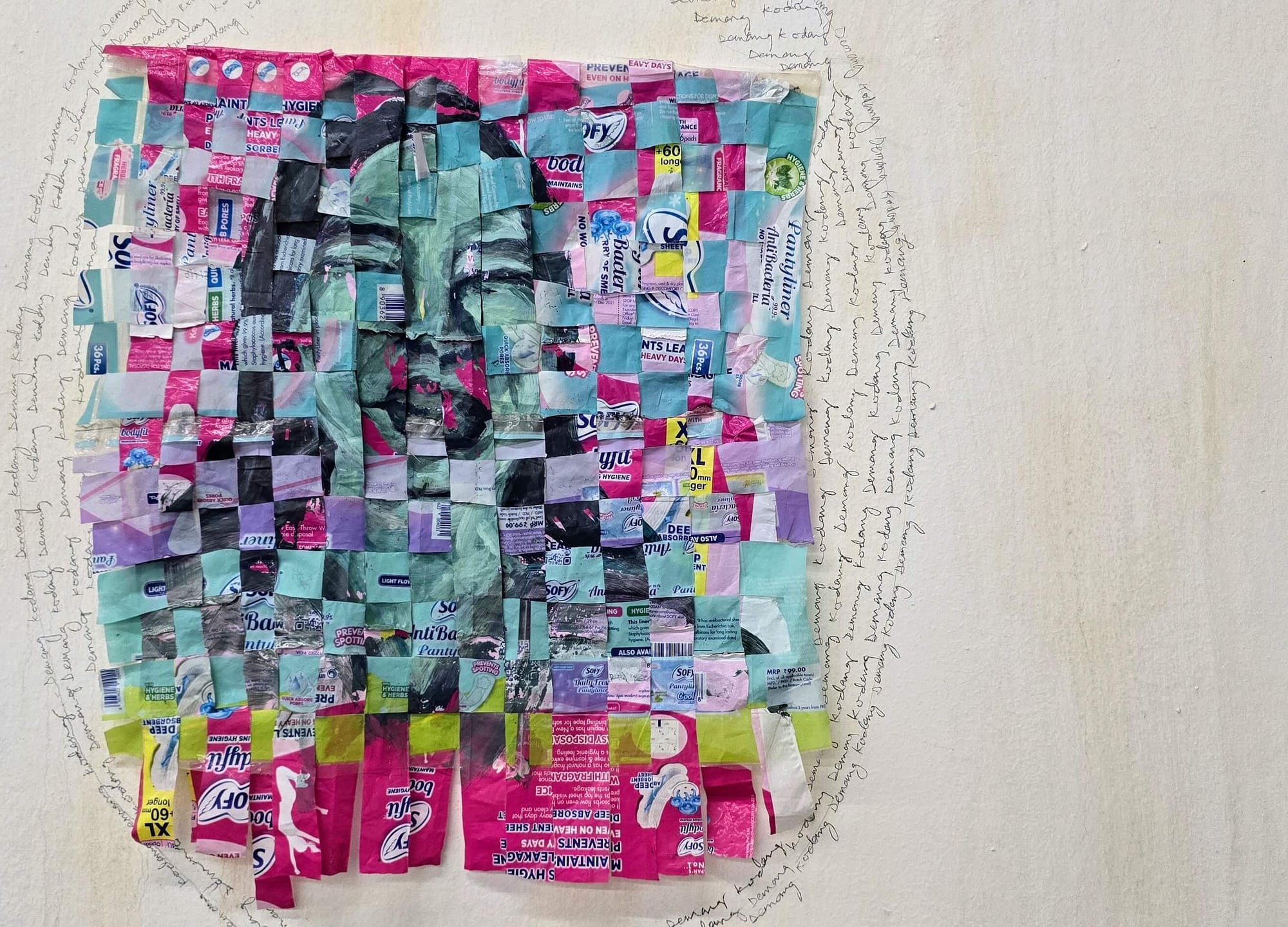
Look at the materials list again. Sanitary napkins. Plastic wrappers. Cloth. These are not conventional art supplies. They are the everyday materials of women's bodies — the things usually hidden, whispered about, or thrown away.
Tokmem and Yambou explore the physical experiences that women go through — menstruation, childbirth, hormonal shifts, scars. Not as medical facts, but as expressions of power, identity, and biological wisdom. They use conversations, interviews, informal gatherings, and participatory creative sessions to understand how these bodily changes are perceived, lived, and ritualised in their communities.
The work directly challenges the shame and silence that surrounds women's bodies. In a country where menstruation is still taboo in many households, embedding actual sanitary napkins into an artwork at India's largest art exhibition is a statement by itself.
Medium: Variable
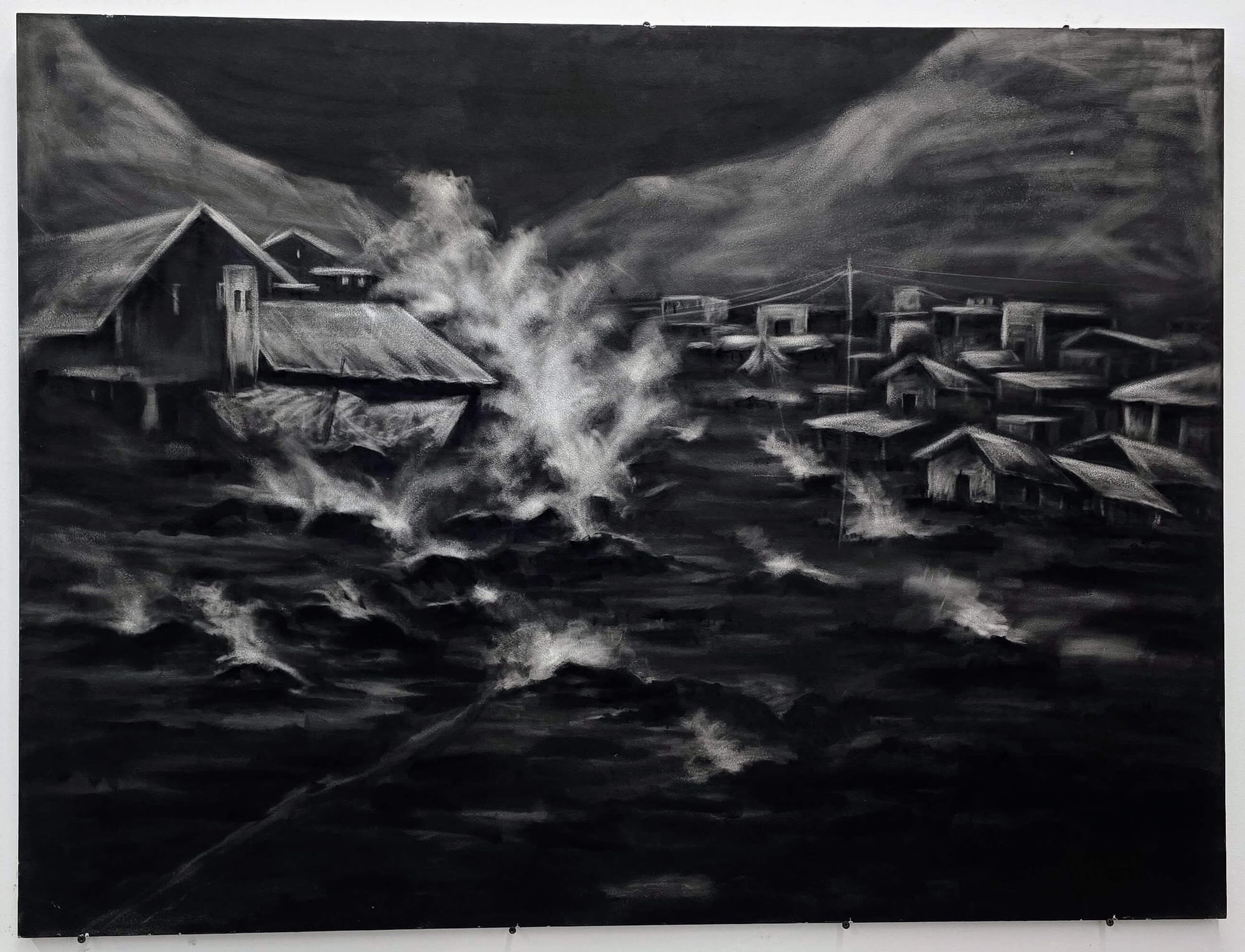
Two artists from two neighbouring states. Two completely different stories. But when shown together, something clicks.
Shailja comes from Jharkhand — a landscape shaped by decades of coal mining and mineral extraction. The soot that settles on everything becomes her material. She gathers it, layers it, rubs it into surfaces. The residue of extraction becomes testimony. Her work is about what coal mining does to people's lives and land — told through the very substance that covers both.
Devpriya is from Patna, Bihar. Her work centres on women's freedom. In her finely etched compositions, women are given wings — symbolic gestures of liberation. She draws a sharp parallel: birds deserve to fly, women deserve to be free. Both are often kept in cages — one made of iron, the other of social boundaries, morality, and walls.
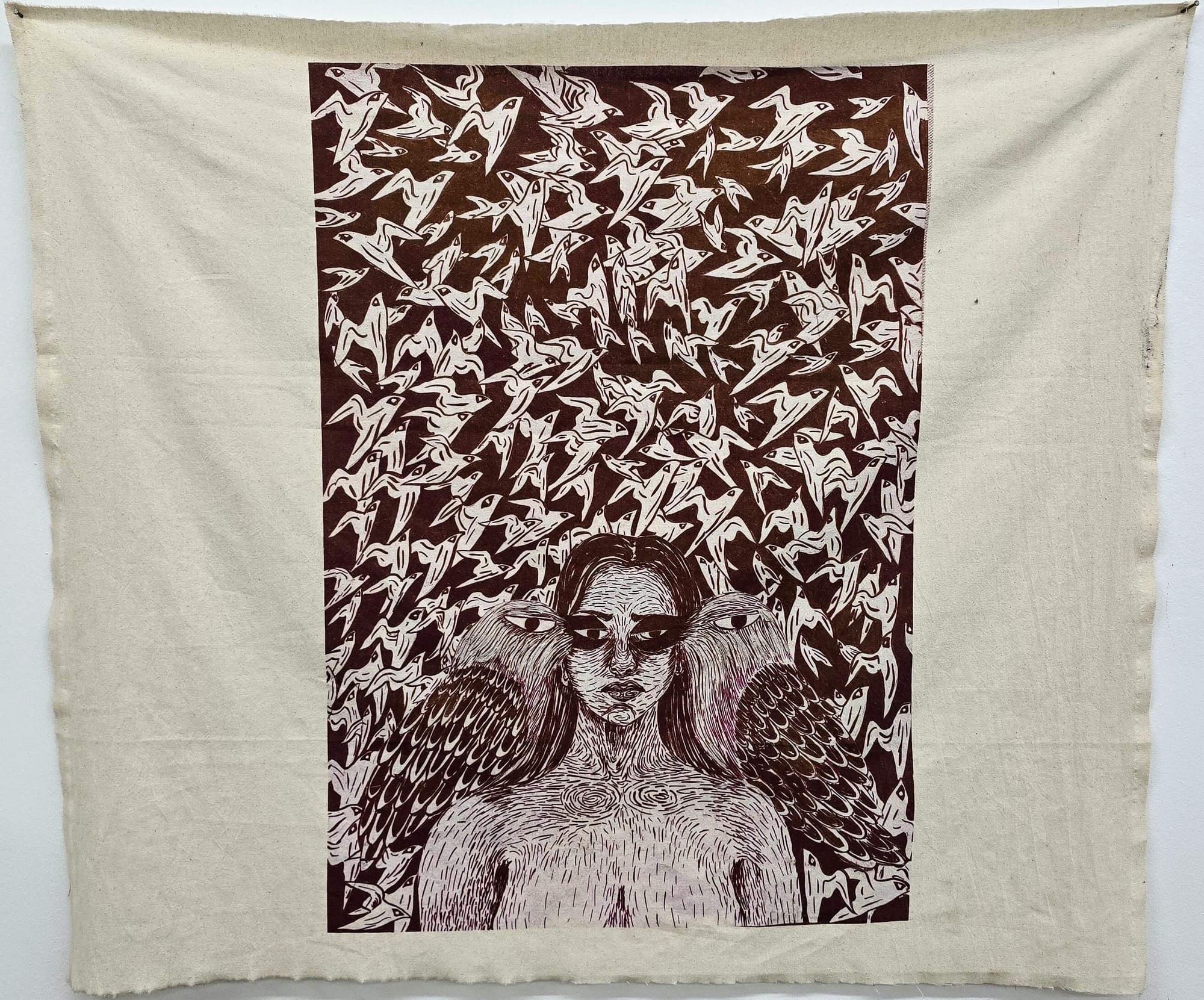
Devpriya's artist statement is worth reading slowly. She writes about witnessing "many dreams dying — dreams of touching the sky, dreams of crossing the threshold of one's home, and dreams of receiving equal respect in society." Her message: the moment you take your first step for yourself, that moment becomes the right time.
Medium: Acrylic on canvas and paper
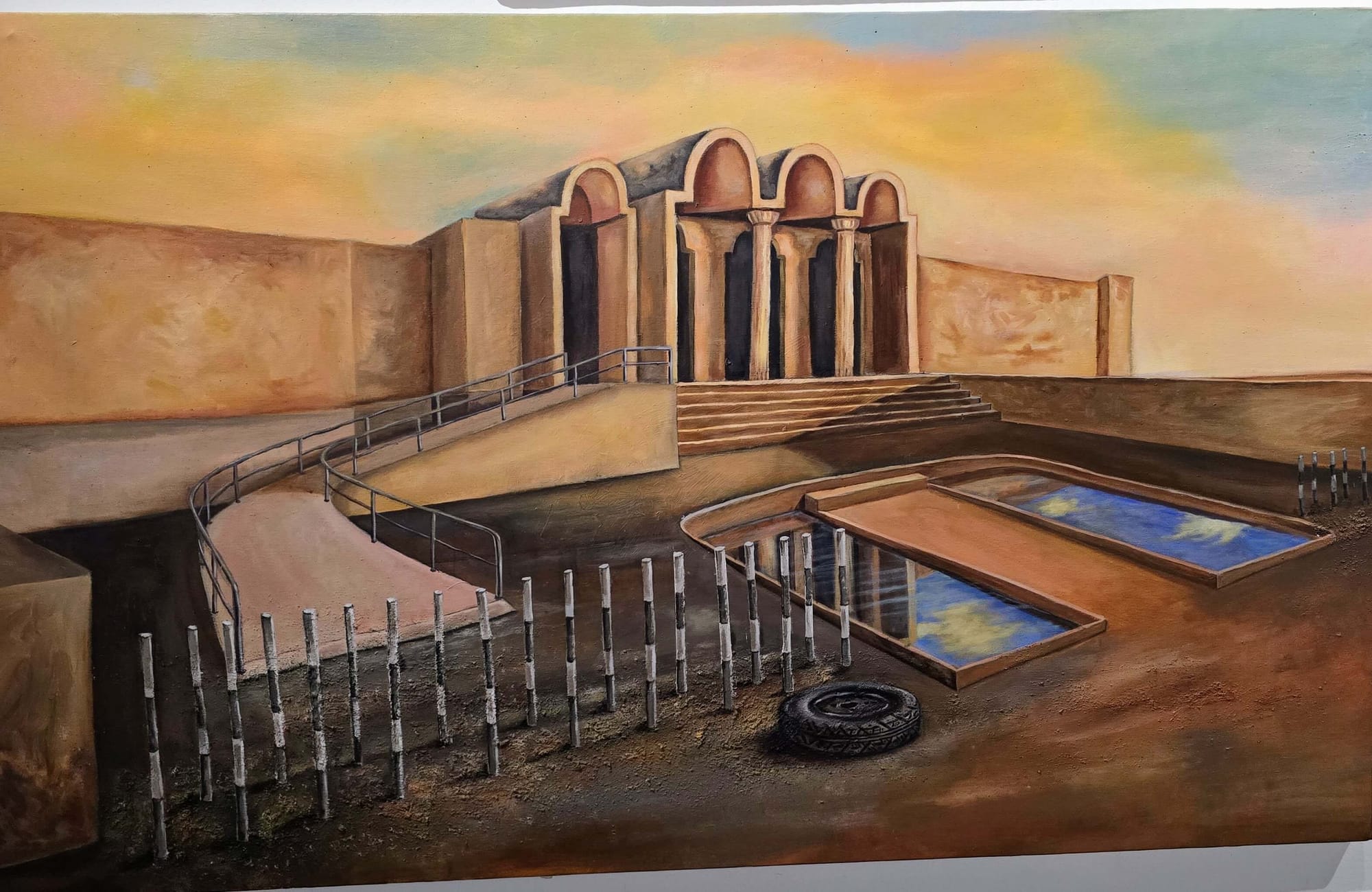
Nabanit is from Nagaon, Assam. He has lived with physical challenges since childhood. Art, he says, helped him observe and express what the world looked like from his position.
During his BFA, his work was personal — about his own experience of limited mobility, rendered in acrylics, watercolours, graphite, and charcoal. During his MVA, his perspective widened. He started thinking about mobility as a social concern. About why so many public spaces are designed as if disabled people don't exist. About why an entrance can be an obstruction.
Look at his titles: Obstructed Entrance. Denied. In A Parallel Universe II. How Much I Listen. Each one is a sentence about what it feels like to move through a world not built for your body.
Together with Nikhil Chavan's work, Nabanit's paintings form an accidental but powerful pair at the Students' Biennale — two artists from opposite ends of the country (Mumbai and Assam), both with physical disabilities, both refusing to let the world look away.
Medium: Variable (Mixed Medium, Paperpulp/White Cement on Panel, Thread on Canvas/Etching on Aquarium Glass)
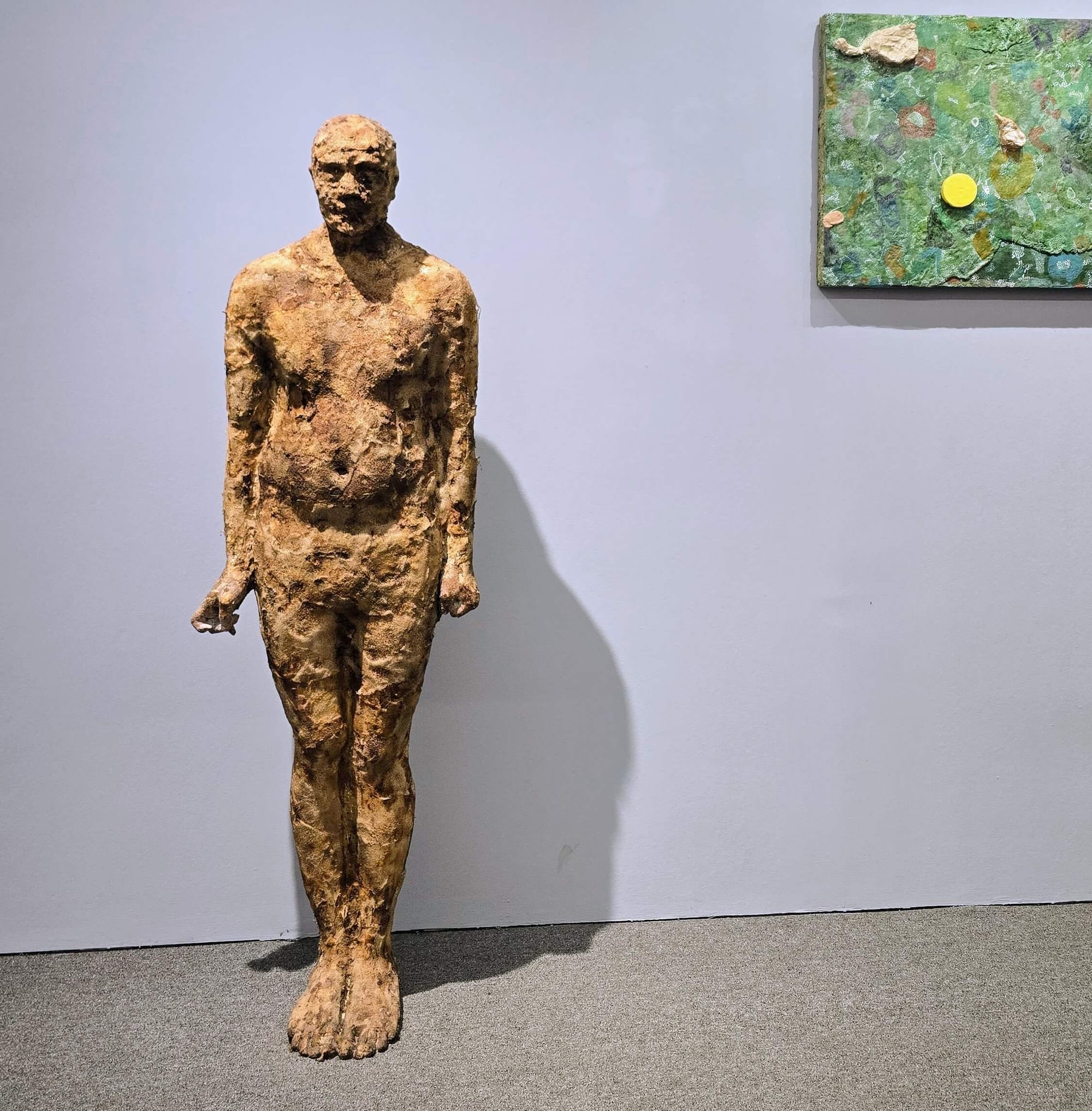
This group project asks a deceptively simple question: what if we stopped putting humans at the centre of nature?
Chandan confronts how art history has built up ideals of the masculine body through mythology and power structures. He presents a body that's raw, textured, and unapologetic. Ashwin works with materials that carry weight — physically and as metaphor. Each material has its own resistance, and he listens to it. Mahalakshmi's work is the most meditative — her thread-on-canvas and etchings on aquarium glass treat the line as a record of life, time, and motion.
Together, the three students propose new ways of understanding the relationship between human bodies and the natural world.
The Students' Biennale doesn't get the attention the main exhibition does. But it serves a purpose nothing else at the Biennale can match — it shows you what Indian art will look like in five years.
These students come from state-funded art colleges. Not private galleries, not MFA programmes abroad. Places like the College of Art and Craft in Patna, Rajiv Gandhi University in Arunachal Pradesh, the University of Hyderabad. The Students' Biennale is often their first time showing work outside a classroom.
This edition is curated by seven curators and collectives working across seven regions of India — including Angaa Art Collective, Ashok Vish, GABAA, and Secular Art Collective among others. The approach is peer-led. Students curate alongside their mentors.
The works featured here share a thread that runs through the entire Biennale's curatorial vision this year. Curator Nikhil Chopra has described this edition as centred on the body as a holder of memory and materiality. These student artists — without perhaps having read that curatorial statement — arrived at the same place through lived experience.
The Students' Biennale runs until March 31, 2026, at VKL Warehouse (Mattancherry), BMS Warehouse, Arthshila Kochi, St. Andrew's Parish Hall, and Space Gallery.
Some of my favorites from other Students Biennale Venues
 Ginger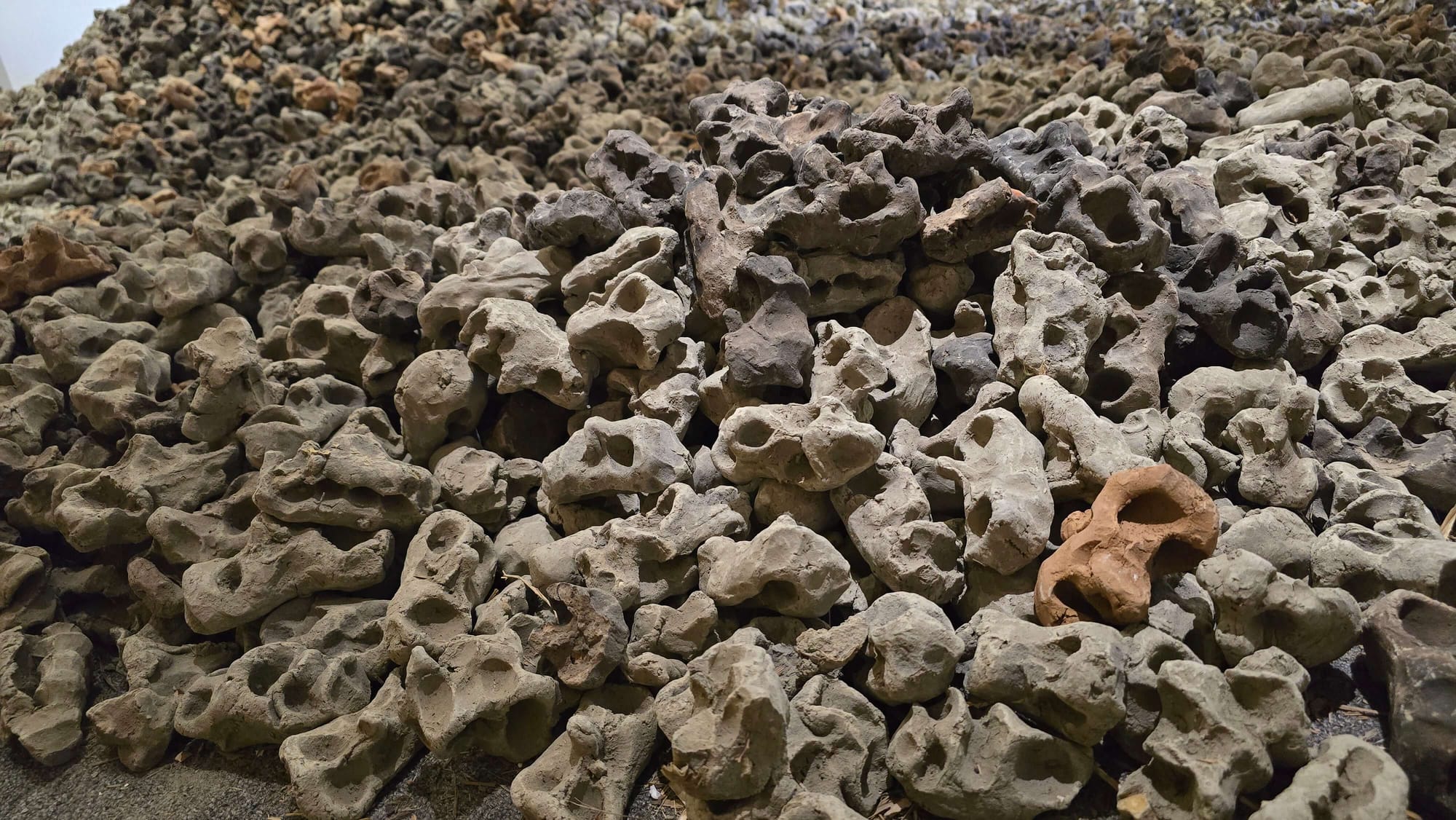
 Ginger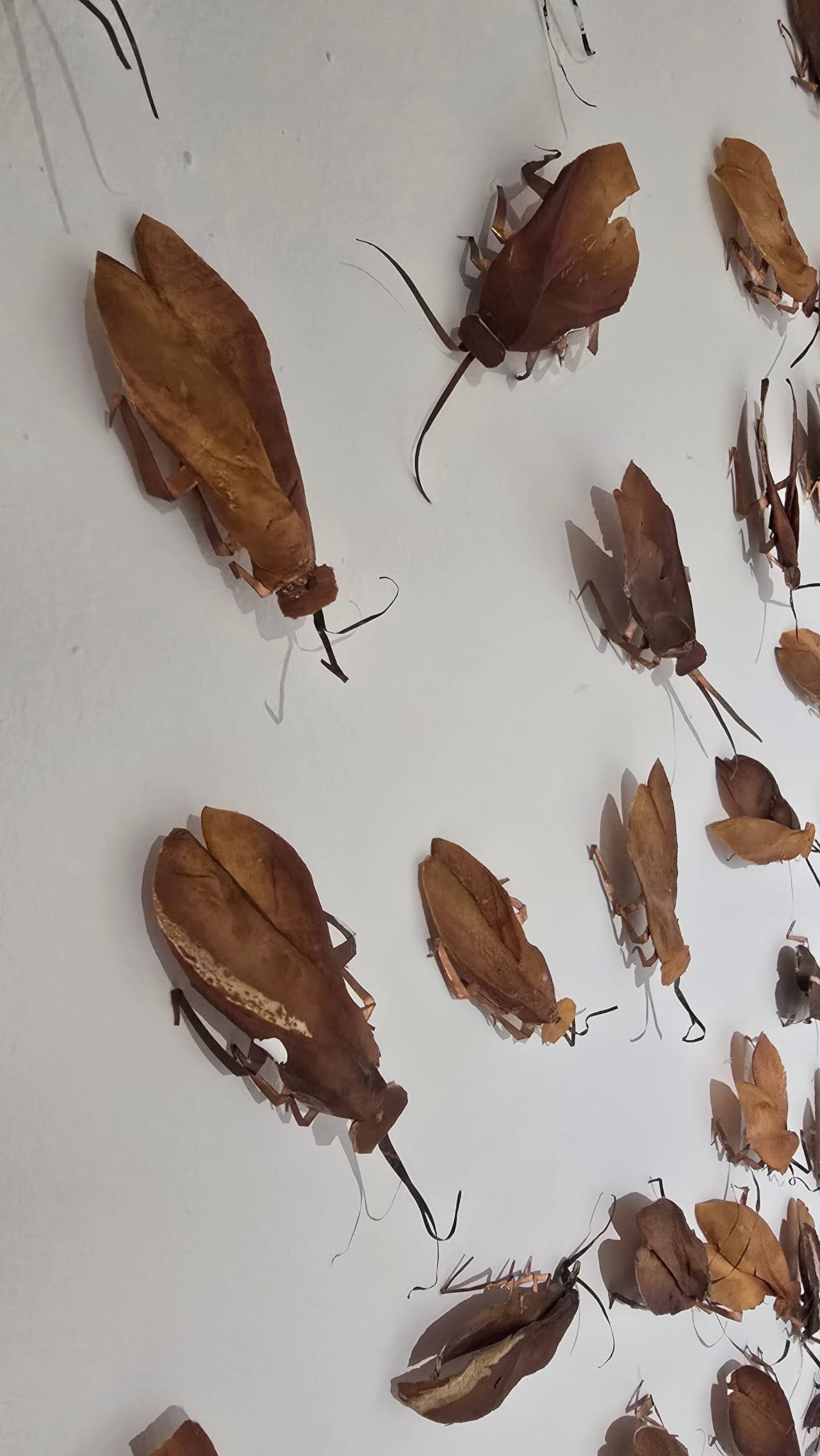
 Alleppey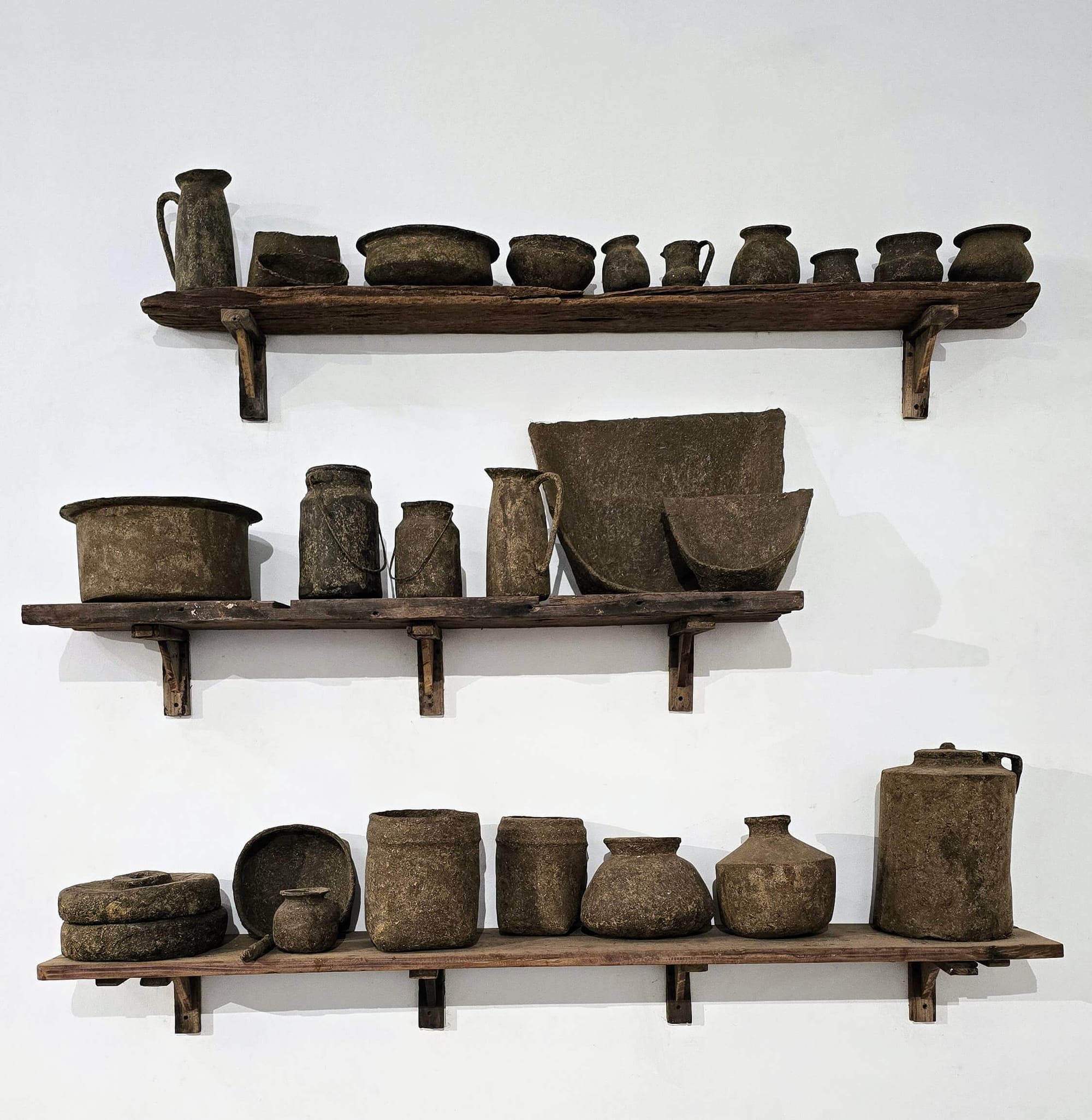

Chinese tiles, Ethiopian rugs, a Malayalam clock tower. What if I told you that Kochi's oldest synagogue is a world in one room?

Three colonial powers. One wooden church turned stone. And a tombstone that tells 500 years of Fort Kochi's story.

Planning your Fort Kochi visit? Scroll to your date for a ready-made itinerary — morning cafes, heritage walks, afternoon rest spots, sunset times, and night plans.

Built by the Portuguese. Wrecked by the British. Painted by a dying Italian. Santa Cruz Basilica has stories most visitors miss.

Join 1500+ others & Sign up for the newsletter and get our latest posts delivered straight to your inbox.