
The Ultimate Guide & Map to the Kochi-Muziris Biennale 2025/26 Venues
Kochi-Muziris Biennale is finally here. Browse through Daily Schedules, Highlights, Events, Galleries, Artists in this ultimate guide
Kochi-Muziris Biennale is finally here. Browse through Daily Schedules, Highlights, Events, Galleries, Artists in this ultimate guide

I created a Google Calendar to Keep Track of Events. I update it every 1-2 days. You can click on each and add to your Calendar.

A 200-year-old godown in Mattancherry holds eight of the Biennale's most political works. From Flint's water crisis to the Parliament of Ghosts, Anand Warehouse holds the Biennale's toughest stories
A missing film. A landfill reborn. A 4,500-year-old dancer. SMS Hall is the Biennale venue you shouldn't skip. Six artists turn bodies, waste, and forgotten histories into something unforgettable


A filmmaker vanishes in 1971. His last documentary, hidden inside a can of cooking flour, has never been found. More than fifty years later, his film reel is still missing - but his ghost is alive and well inside a dark hall in Mattancherry.
This is where SMS Hall begins.
Tucked in the lanes of Mattancherry, SMS Hall is one of the venues of the sixth Kochi-Muziris Biennale (2025-26). The hall holds six artists whose work covers a lot of ground - from the streets of Mumbai to the landfills of Delhi, from a convent sickroom in Kerala to a 4,500-year-old bronze figurine that refuses to stay still.
Born in London. Based in New York. A Turner Prize nominee. Naeem Mohaiemen makes films, drawings, and essays about left-wing movements, borders, and the things that history tries to forget.
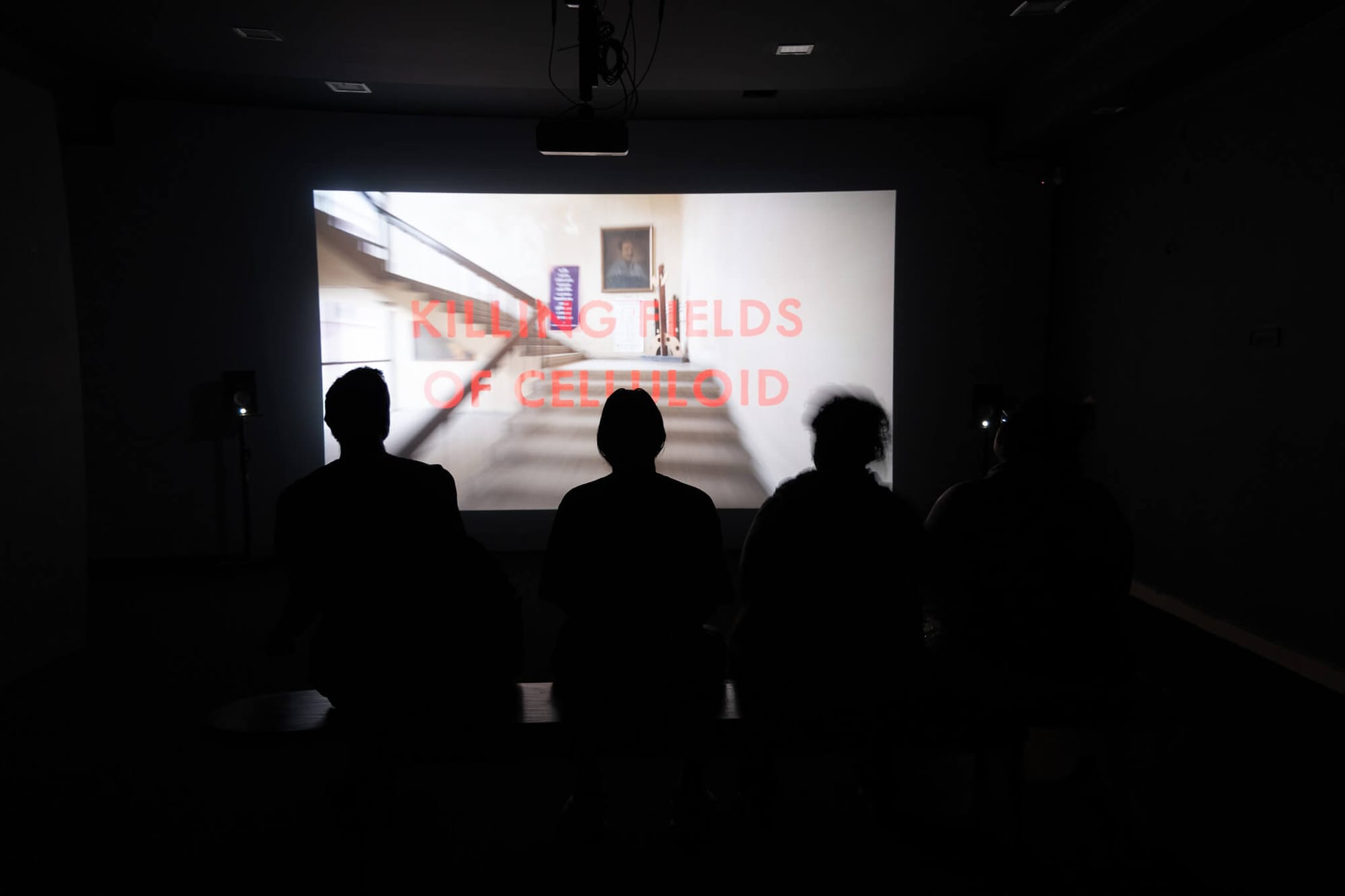
At SMS Hall, he presents A Missing Can of Film (2025), a single-channel film about Zahir Raihan - a Bangladeshi filmmaker and novelist who disappeared shortly after the end of the 1971 Bangladesh Liberation War. Raihan is officially listed as a shaheed (war martyr), but what actually happened to him remains one of Bangladesh's biggest unresolved mysteries.
The film is built from two layers. First, footage shot inside the now-empty Bangladesh Film Development Corporation after the 2024 student uprising. Second, clips from Raihan's own films, sometimes placed side by side in split-screen to create new meanings. Raihan's last documentary followed the style of Soviet Realism and the politics of Third Cinema. He opened with an image of Lenin. More than five decades later, the revolutionary spirit of that era echoes in the power vacuum that followed the 2024 uprising - and in the return of toxic masculinity that filled it.
Then there's the rumour: Raihan had been making a different war film, one embarrassing to his own side. He had left behind a 16 mm film, hidden inside a can of cooking flour. It may not have been the enemy army that killed him.
Mohaiemen doesn't solve the mystery. He sits with it. The camera glides through empty FDC corridors past portraits of Raihan and Satyajit Ray, and the film asks: what happens to dissident history when the evidence is stored in dusty equipment, passed through underground networks, and one day - just gone?
Gieve Patel was three things at once: a painter, a writer, and a working physician in Mumbai. He died in 2023. This is posthumous showing, and it might be the most quietly powerful room in the hall.
His paintings document what most people walk past every day in Mumbai. The daily violence. The small mercies. Mourners with faces twisted by grief. Fresh flowers placed on a dead politician's body. A peacock found among the high-rise buildings of Nariman Point, impossibly far from any forest. The refuse of the city - small dead animals, a torn slipper, a used condom pecked at by crows.
Patel painted from memory, from direct observation, and from newspaper photographs. His subjects were almost always the city's marginalised and floating population. His frames are tight, and the broader public context - poverty, hierarchy, the gap between urban and rural life - shows through the conditions and emotions of the people he painted.
Two works stand out on the wall text. Late Evening Footboard Riders (2021) puts you on the floor of a Mumbai local train alongside tired passengers. You're also looking in through the window from the outside. Both views exist at once. Off Lamington Road (1982-86) unfolds like a neighbourhood drama in miniature - a woman abandoned by her family, a couple talking, a child climbing onto his father's back, people chatting, bargaining, daydreaming.
His later work, Looking into a Well: Leaning Papaya Tree (2023), comes from childhood memories of gazing into brimming wells during monsoons in the seaside village of Nargol. Each painting in this series turns the act of looking down into a well into the act of looking straight ahead at the canvas. The water, sky, and trees blur into an abstracted surface of introspection.
One of the most striking works in the show, according to STIR's review, is Embrace (2016) - two male figures caught in a moment of quiet intimacy, cheeks touching, hands meeting, completely at home in each other's presence. No drama. No performance. Just tenderness.
She's a nun. She lives in a convent. She studied sociology and counselling psychology before picking up a pen. And her drawings will stop you cold.
Sister Roswin CMC, also known as Malu Joy, draws the people she lives with - fellow nuns, elderly mothers, visitors to the convent's sickroom. Her pen drawings (both monochrome and colour) and terracotta sculptures carry a psychological intensity that goes past realism into something rawer. She doesn't idealise her subjects. She shows the marks that labour, time, and resilience have left on their bodies.
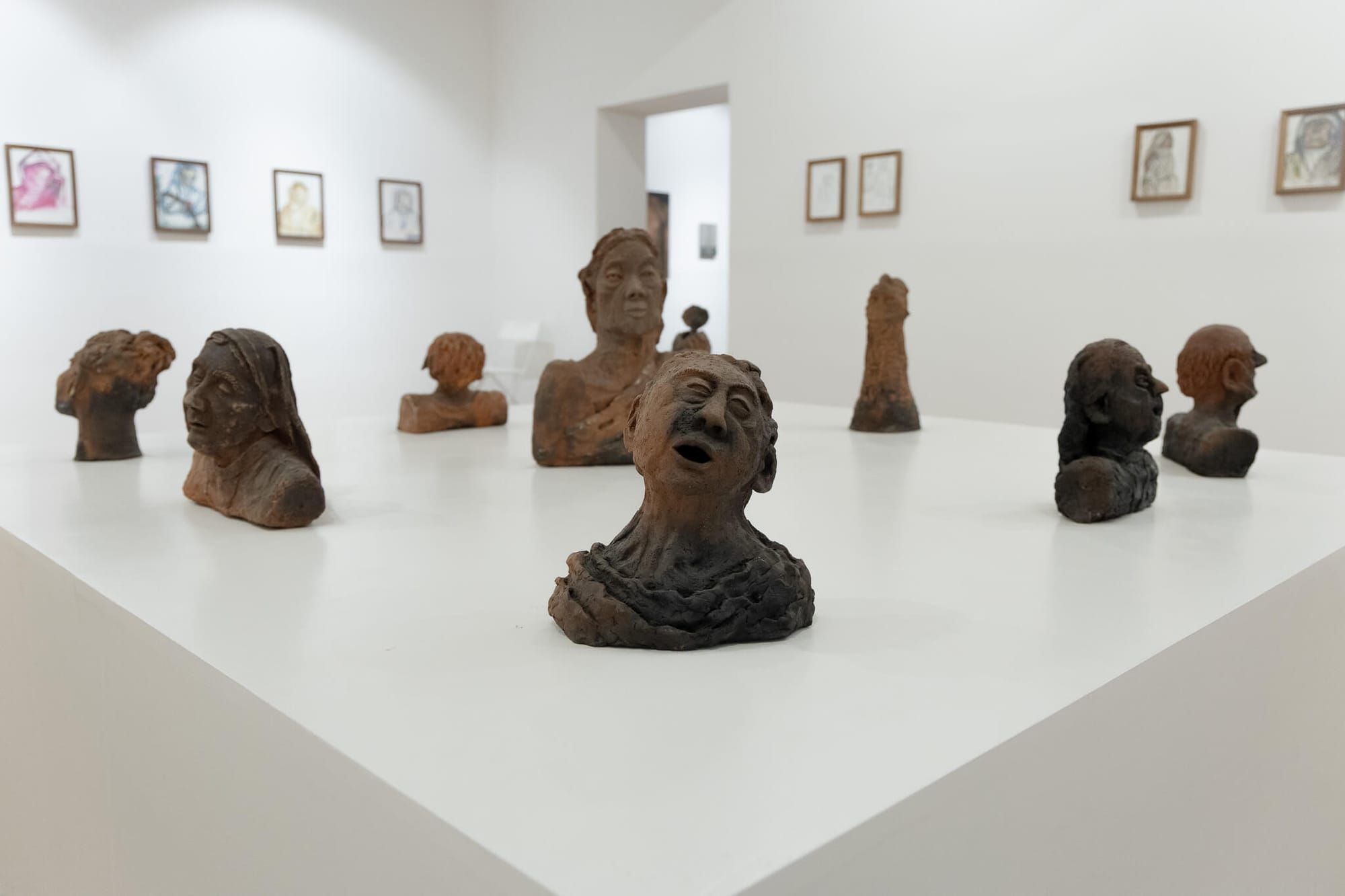
At the Biennale, she exhibits thirty drawings titled Mother I (2025) and Mother II (2025), along with ten terracotta sculptures. Many of these works depict elderly mothers and visitors in states of rest and vulnerability - an elderly nun with her head tilted in exhaustion, a man suspended in the moment he finally yawns after long hours of work.
Joy talks to her subjects as she sketches. She listens for the words or memories that unlock their inner lives. In that exchange, her own memories surface too - creating what the wall text calls "a shared space burgeoning with empathy." Her background in counselling psychology isn't incidental. It shapes how she sees, what she notices, and how her drawings hold both the critical and the tender at the same time.
Pain runs through her work. So does the question of waste and usefulness. She has used paper waste as canvas and sidewalks as exhibition venues. Her art becomes a site of recovery - pulling her subjects out of conditions of rejection through what she calls "the care of absolute co-presence and attention."
For anyone interested in Biennale venues across Mattancherry, SMS Hall is a short walk from Anand Warehouse and the Armaan Collective spaces.
If Gieve Patel looked at the body from the outside, Aditya Puthur opens it up.
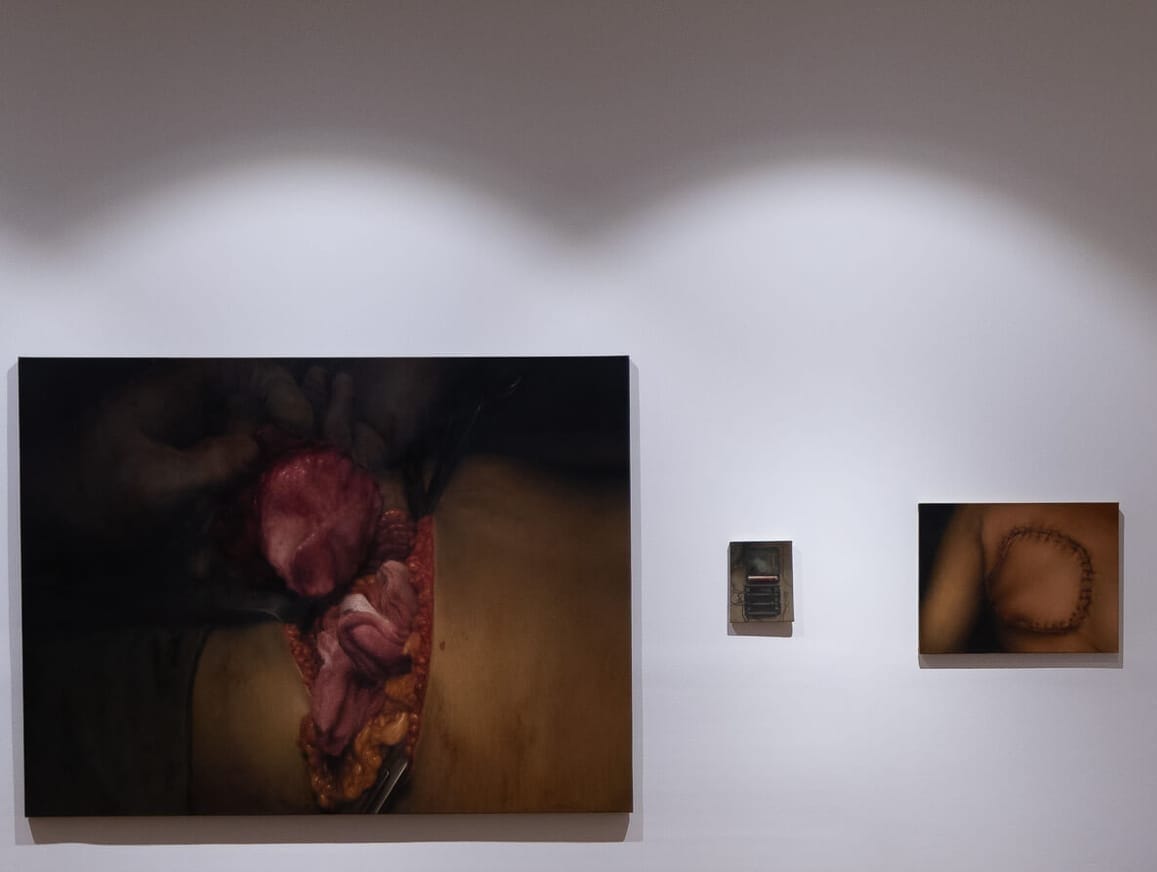
Puthur is a multidisciplinary artist based in Vadodara. He uses medical studies, technological experiments, and the documentary language of photorealism to investigate how human bodies change, decay, and get repaired - alongside animals, plants, and microbes. His oil paintings, documents, and objects feel clinical. Not cold, but precise. Like being inside a lab where the experiment is life itself.
At the Biennale, Puthur sets up a lab-like environment to explore the relationship between the body's physical reality, subjective experience, and how we decide what is real through philosophy and science.
Two projects are on display. Unweaving the Rainbow (2018-20) is a series of paintings and documents that read patterns of fleshy growths and invasive forms in humans, objects, and domestic spaces. The images hover between threat and salvation - bodily innards, shed parts, and infected masses removed from patients sit alongside medical equipment, prosthetics, and life-support machines. Decomposition and extended lifespan, side by side.
Rosabella Believe (2023-ongoing) goes further. It explores paranormal experiences, organ transplantation, cloning procedures, plant propagation cutting techniques, and hallucinations experienced by people close to the artist. The paintings work as witness accounts - restaging half-awake states where ghostly presences, near-death instances, and fragile human bodies negotiate with each other.
The project also includes an interview with the Rationalist Association, grounding the work in a critique of how grief gets exploited by psychics and para-healers. Not dismissing the experiences, but asking: what is the honest response to profound distress?
For five years, Niroj Satpathy worked the night shift at Delhi's Solid Waste Management Department. He supervised landfills. He watched what got dumped, what got hidden, and what got destroyed under cover of darkness. Then he started making art from it.
Today, Satpathy is a Delhi-based multimedia artist whose practice positions landfills as crucial databases - archives of how we produce, consume, and throw away. His home studio holds over 5,000 objects collected from garbage dumps, second-hand markets, and streets across Delhi.
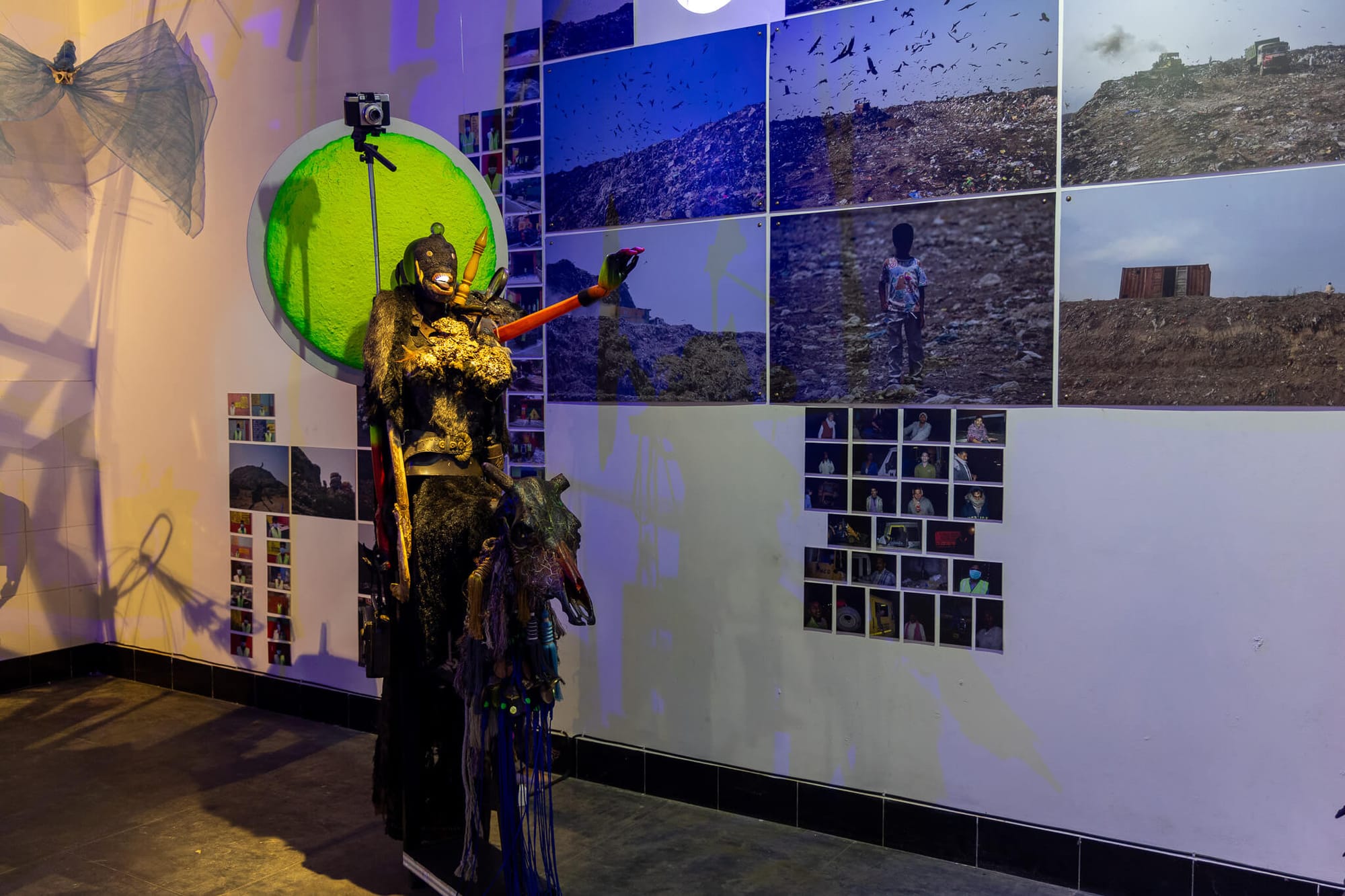
Dhalan (2025) fills SMS Hall with the restlessness of a landfill. Kinetic sculptures, videos, and information repositories glow with an otherworldly light. The installation gives agency to refuse and the marginalised people who live among it.
Rising from the installation are mutant creatures and mythical figures. A demonic figure - composed of taxidermic, skull-like remains and holding a tablet playing videos - looks like a politician delivering an address, while striking a spear-turned-microphone at the audience. A feminine, branched figure, tangled in wires and symbolising the last tree on Earth, guards seeds stolen from toxic terrains.
The walls are covered with photographs, infographic corners, and an irregularly gridded column that rises to the ceiling - documenting unregulated dumping, exhausted capacity, and urban sprawl. Objects collected over years fill the space: American Barbie dolls, Chinese electronics, fragments that compress decades of global consumerism into a single room. There's even a miniature model of SMS Hall itself, stuffed with official documents and records of covered-up violence and illegal dealings that shaped the city's landfill processes.
How does a 4,500-year-old bronze figurine think, move, and respond to 2025?
Mandeep Raikhy is a New Delhi-based dancer and choreographer who uses the body as a site for political resistance. His work disrupts classical dance traditions, stretches fixed codes, and finds nonlinear narratives of rupture and play. He trained at Laban in London and has toured widely with pieces that confront gender, sexuality, and nationalism through movement.
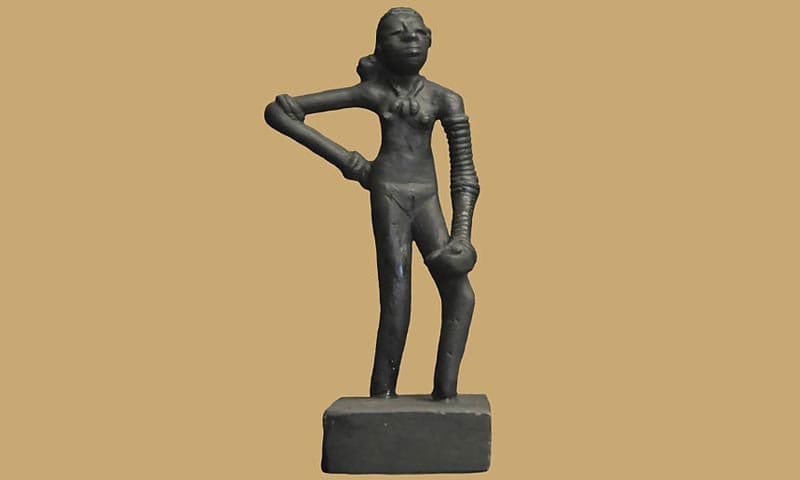
At SMS Hall, he presents Hallucinations of an Artifact (2023) - a performance that brings to life the Dancing Girl of Mohenjo-daro. This 10.5-centimetre bronze figurine from the Indus Valley Civilisation was excavated in 1926 from Sindh (now in Pakistan) and currently sits in a dimly lit vitrine at the National Museum in New Delhi. Since her discovery, she has carried the weight of multiple political claims. In 2016, Pakistan asked India to return her. The Indian Council of Historical Research claimed she was the Hindu goddess Parvati. She has appeared in government propaganda. Art historian Naman Ahuja speculated she may have been a warrior, not a dancer.
Raikhy's performance imagines other lives for the Dancing Girl. Three performers - Akanksha Kumari, Manju Sharma, and Raikhy himself - move around pedestals, travelling across time from the excavation site to a museum to a nightclub. Central to the choreography is the tribhanga - a standing S-shaped posture in Indian classical dance and sculpture. The performers loosen it, reinvent it, and create space within it to play, fight, rest, and dance freely.
The fourth performer is digital. Visual artist Jonathan O'Hear's AI-generated figure of the Dancing Girl becomes a glitching, moving presence on screen. The three human dancers respond to their AI counterpart - and the word "hallucination" in the title is borrowed from AI's tendency to invent responses based on incomplete data. Human resonance in machine error.
The work is presented in three forms: a live hour-long performance, an open rehearsal with the dancers, and an installation where viewers are invited to embody the Dancing Girl themselves. Check the Biennale schedule for performance dates.
SMS Hall is located in Mattancherry, a short walk from Anand Warehouse (where Ibrahim Mahama's Parliament of Ghosts fills an entire room with jute sacks and local carpentry).
The hall is open daily, 10 AM to 5 PM, as part of the sixth Kochi-Muziris Biennale running until March 31, 2026. Mandeep Raikhy's performance happens at specific times - check the daily schedule before you visit.
If you're planning a Mattancherry route, combine SMS Hall with Anand Warehouse, the Devassy Jose & Sons exhibitions, and the Armaan Collective space. End with a walk through Jew Town and the spice markets. You'll need about two hours for SMS Hall alone if you want to sit with the works.
For a full overview of all Biennale venues, maps, and daily programmes, see our Ultimate Guide to Kochi-Muziris Biennale 2025/26.

Kochi-Muziris Biennale is finally here. Browse through Daily Schedules, Highlights, Events, Galleries, Artists in this ultimate guide

I created a Google Calendar to Keep Track of Events. I update it every 1-2 days. You can click on each and add to your Calendar.

A 200-year-old godown in Mattancherry holds eight of the Biennale's most political works. From Flint's water crisis to the Parliament of Ghosts, Anand Warehouse holds the Biennale's toughest stories

Fort Kochi has a beach everyone visits. But not faraway, there are shores with 500 years of stories and almost no tourists. From a beach that once held Portuguese cannons to a fishing village where nothing has changed in a century Kochi's best beaches aren't the ones on the map.