


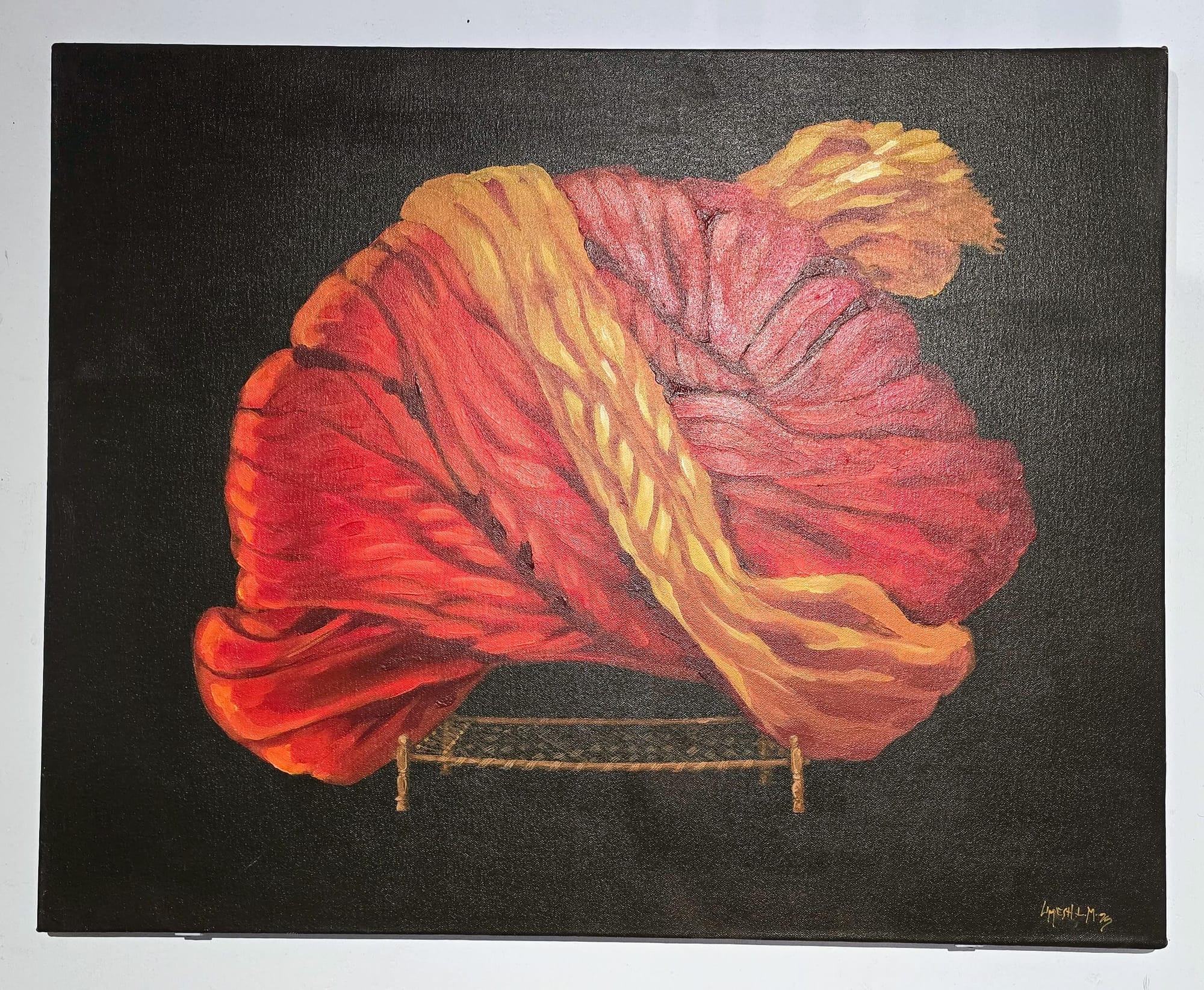
When a farmer places his turban on the bed, it signifies rest, completion of the day's grueling work, and earned repose. Two objects—the Peta and the Mancha—profoundly symbolize a farming life.
Artists
Umesh Manjannavar (Government College of Fine Arts, Dharwad, Karnataka)
Medium
Acrylic on canvas with gunny bag; Acrylic on canvas
Venue
BMS Warehouse. Opposite Holy Cross Church Mattancherry (Kuriachante Nada)
Opposite Holy Cross Church Mattancherry (Kuriachante Nada
Timings
10AM to 6PM (Mon to Sunday)
Till March 31st, 2026
About
Umesh Manjannavar resides in Dharwad, Karnataka—a vibrant center for culture, education, and burgeoning industries. Yet despite this dynamism, strong echoes of its agricultural past persist. The stark reality of the farming cycle—the constant battle between labor and profit—remains a defining characteristic of life here.
The Power of the Peta and Honour explore two objects that profoundly symbolize his farming background: the 'Peta' (a traditional headpiece or turban) and the 'Mancha' (a traditional rope bed).
In a powerful everyday gesture, the turban placed on the bed signifies rest. Completion. Earned repose. These simple objects carry the weight of generations.
Kochi Biennale 2025
The Students' Biennale, running alongside the Kochi-Muziris Biennale, has always been a space where tomorrow's artistic giants take their first bold leaps.


