
The Ultimate Guide & Map to the Kochi-Muziris Biennale 2025/26 Venues
Kochi-Muziris Biennale is finally here. Browse through Daily Schedules, Highlights, Events, Galleries, Artists in this ultimate guide
Kochi-Muziris Biennale is finally here. Browse through Daily Schedules, Highlights, Events, Galleries, Artists in this ultimate guide

I created a Google Calendar to Keep Track of Events. I update it every 1-2 days. You can click on each and add to your Calendar.

A 200-year-old godown in Mattancherry holds eight of the Biennale's most political works. From Flint's water crisis to the Parliament of Ghosts, Anand Warehouse holds the Biennale's toughest stories
A 200-year-old godown in Mattancherry holds eight of the Biennale's most political works. From Flint's water crisis to the Parliament of Ghosts, Anand Warehouse holds the Biennale's toughest stories

You smell the jute before you see anything.
Step through the entrance of Anand Warehouse in Mattancherry, and the first thing that hits you is that dry, earthy smell of old sacking. For over two centuries, this building stored goods moving through Kochi's ports, first under the Dutch, then the British. Pepper, grain, timber, spices. The warehouse remembers all of it.
Today, the goods are gone. In their place, eight artists from four continents have turned this colonial godown into one of the most politically charged spaces in the Kochi-Muziris Biennale 2025. If Aspinwall House is the Biennale's grand showcase, Anand Warehouse is where the conversation gets uncomfortable, specific, and hard to forget.
Here's what you'll find inside, room by room.
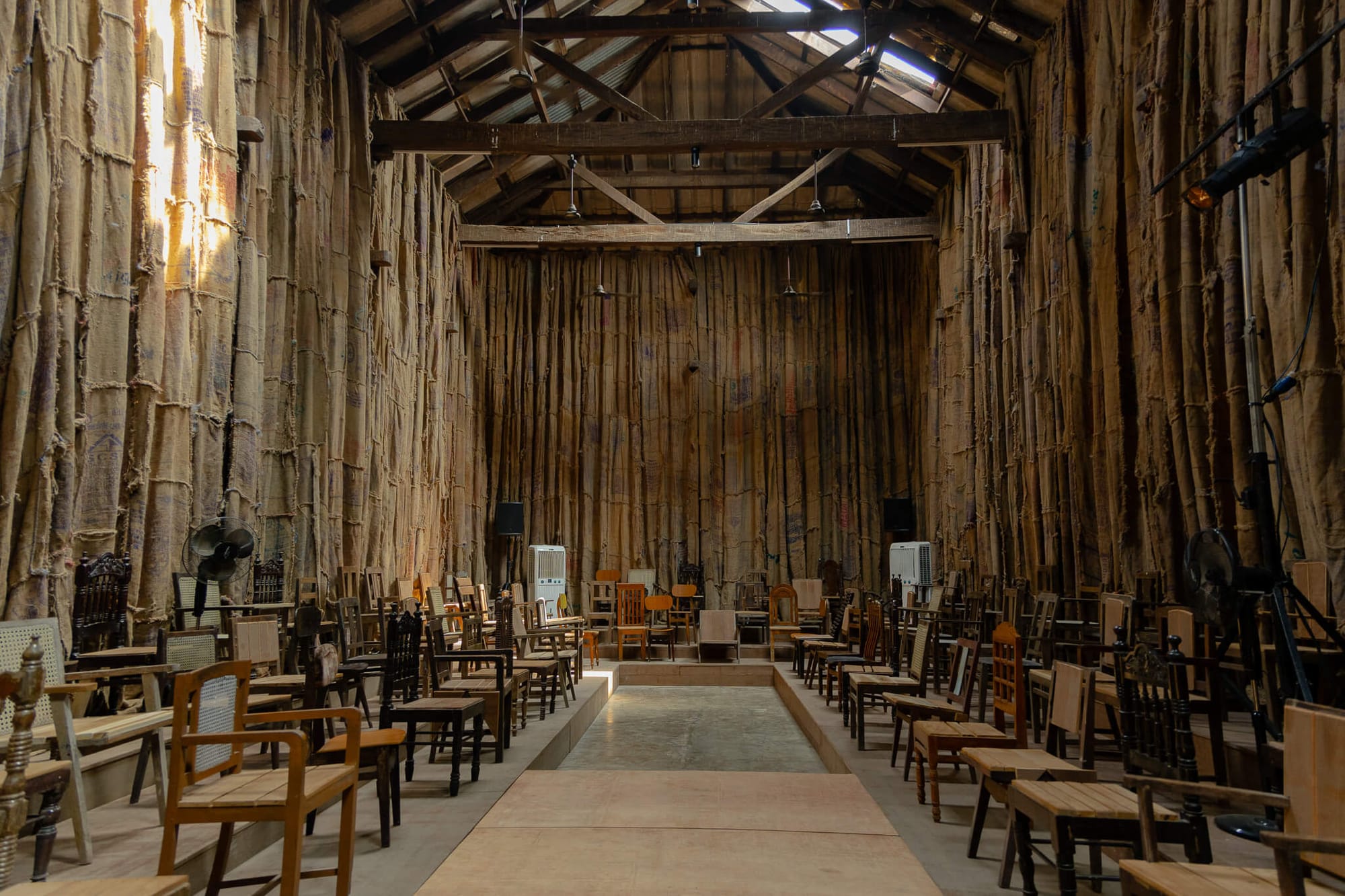
The largest work in the building belongs to Ibrahim Mahama, a Ghana-based artist who topped ArtReview's Power 100 list in 2025, the first African artist ever to claim that spot.
He has turned an entire hall into a room lined with used jute sacks. The sacks were once used to transport pepper, grain, and timber from the colonies to Europe. Their stained surfaces still carry stampings of changing ownerships, rough histories of extraction written in ink and wear. Rows of discarded chairs, collected from secondhand shops across Kochi, fill the room.
The space looks like a parliament, a courtroom, a classroom. It functions as all three. During the Biennale, it hosts book launches, performances, and public conversations. When I visited, a seminar on Palestine was being held inside.
Mahama originally built this project in response to abandoned developmental projects in Ghana, started by Kwame Nkrumah's government after independence, then deserted following political coups. In Kochi, a former British colony, the echoes are obvious.
In 2014, the city of Flint, Michigan switched its water supply to save money. The water turned out to be contaminated with lead. Residents, most of them from Black working-class families, were told everything was fine. It wasn't.
Chicago-based artist LaToya Ruby Frazier spent six years documenting one family's life through this crisis. At Anand Warehouse, you'll see her documentary film Flint is Family (2016) and photographs from the larger project (2016-22). The film follows Shea Cobb, a singer, bus driver, and activist, and her family.
The images are in black and white. Frazier shows daily life alongside protest: lead-infested water fountains in schools, community safety notices, a courthouse family wedding, a daughter's homework. She co-authored the work with Cobb, meaning the people in these pictures had a say in how their story was told.
Braddock, Pennsylvania, where Frazier was born, went through its own version of this story. A steel town that collapsed when the industry left. So this isn't an outsider looking in. It's someone who recognizes the pattern.
Prabhakar Kamble, born in Shendur, India, makes art about caste. Not as metaphor or abstraction, but as a lived system that shapes who gets dignity and who doesn't.
His installation Vichitra Natak is built like a talim, a traditional wrestlers' ring. In the talim, caste doesn't matter. What matters is skill and friendship. Kamble uses this as his starting point.
Chandeliers made from pierced and hollowed terracotta vessels hang from the ceiling in five tiers, mirroring the stratifications of the varnashrama dharma, the caste hierarchy. Rusted metal doors resemble public latrines. Videos of brass bands playing in sugarcane fields add sound to the space.
The materials here are drawn from rural India's visual language: harnesses, earthen pots, brass bands. These are forms typically dismissed as decorative or folk. Kamble reclaims them. He calls this work a contemporary "Arte Povera of the subcontinent," where art comes not from found garbage but from the afterlives of craft, survival, and faith.
Kamble's position is rooted in Ambedkarite consciousness. He positions the annihilation of caste as inseparable from the fight for radical democracy and equality.
Every winter in Punjab, farmers burn the leftover stubble from their rice harvest to clear the fields for wheat. The burning fills the air across northern India with thick smog. City people complain about the pollution. The farmers get blamed. What gets less attention: many of these farmers have no other affordable option. Government support is inadequate and the push toward combine harvesters leaves behind stubble that's too tall to plough under.
Kulpreet Singh, based in Patiala, made a film where he and a group of farmers run across these burning fields. Long canvases trail behind them, collecting soot, ash, and the chemical residue of fertilizers. The canvases become prints, singed records of what the land endures.
The large print that comes from this process tells a story through ashy images: an imperial throne flanked by a fallen tree and a dead bird, ape-like figures referencing human evolution in reverse. The soundtrack carries ambulance sirens, war sounds, crackling fire.
Writer Arundhati Roy, who visited the exhibition, described it as "moving and dangerous." It was, by several accounts, the most memorable work in the entire Biennale.
This one you might encounter before you even reach the warehouse.
Nari Ward's Divine Smiles is a pushcart that travels the streets of Fort Kochi and Mattancherry during the day. It invites people walking by to smile into open cans with a mirrored mylar base. You see your own smile reflected back. Then the can is sealed shut with a hand-turned can sealer mounted on the cart.
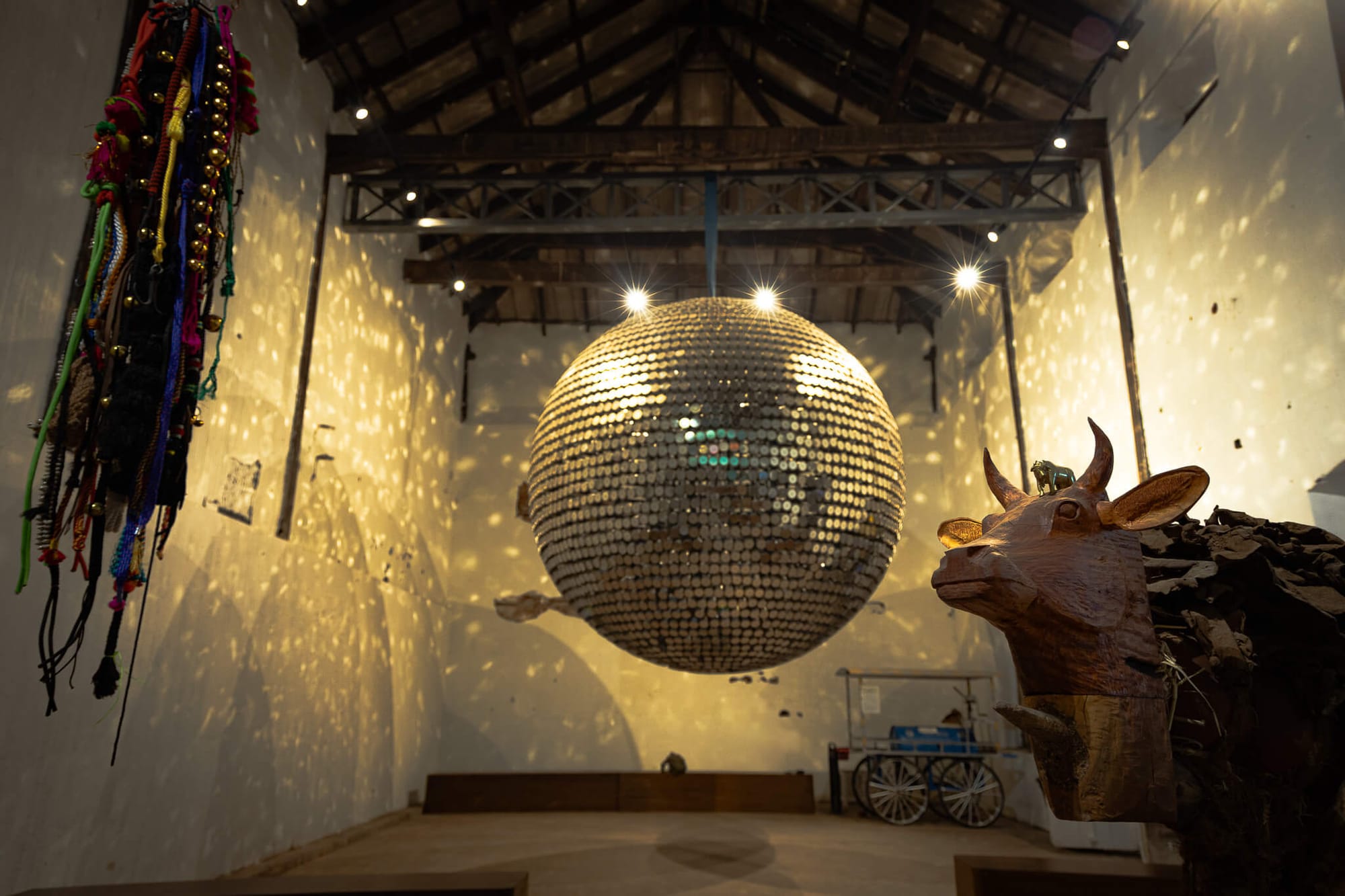
Each person gets a can to keep. A second can goes to Anand Warehouse, where it joins a growing spherical sculpture. Each day, the sphere gets bigger and brighter as more sealed smiles are added, with mylar lids catching and throwing light around the room.
The pushcart itself is hand-painted in gold and silver, with blue linework around a conch shell and the Ashoka Chakra motif. It borrows from the local street sign style of Fort Kochi. Ward, born in Jamaica and based in New York, has been doing versions of this "Canned Smile" project since 2013, each time working with local makers, can manufacturers, mylar sellers, and label printers.
After the Biennale ends on March 31, the cans will be sold, with proceeds going back into the community.
A thirty-foot arched bridge made of industrial metal frames fills the central passage of Anand Warehouse. Mark Prime, who was born in Norwich and now works from Mumbai, built it.
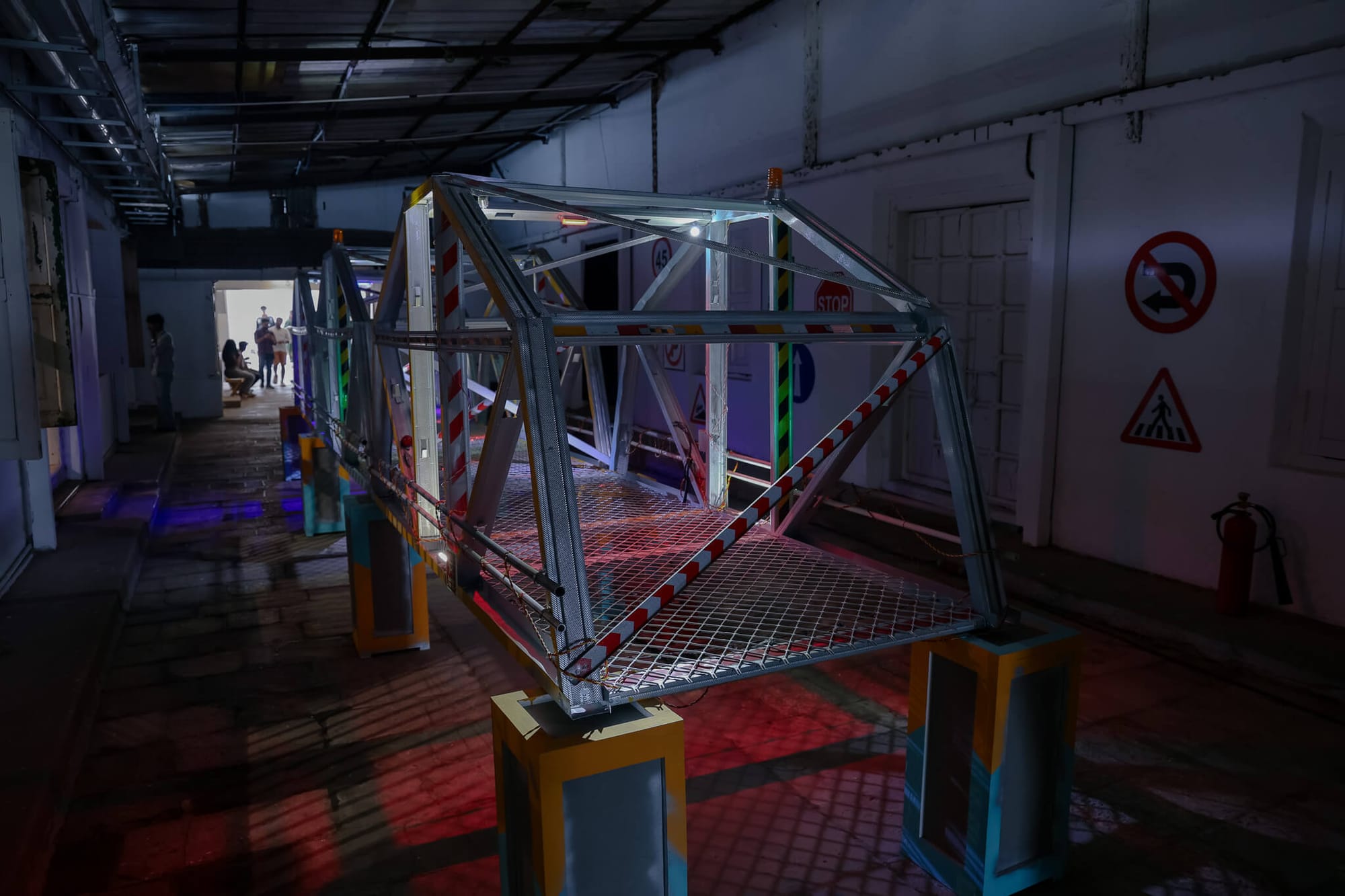
Kochi is a city of bridges. They connect islands to backwaters, old markets to new neighbourhoods. Prime's sculpture is about that connecting function, but also about what passes across bridges and what gets left behind.
The surface is rough, industrial. LED lights and reflective tapes wrap around the metal, giving it a floating quality in the semi-dark space. Look closer and you'll see signs borrowed from shipping: "Danger," "This Side Up." These transport labels, used straight here, become strange and slightly funny in a sculpture.
Prime trained as a musician and grew up working in his father's workshop in England. He brings both of those backgrounds into his sculptural work. Around the bridge, scattered on the floor, are debris of connective technology: antennae, satellite dishes, the physical stuff that once linked people across distances. The debris reminds you that connections have a lifespan too. They break, decay, and get replaced.
The warehouse itself was once a bridge of sorts, linking Kochi's docks with inland markets. Prime's work fits this building like it was built for it.
Kolkata-based artist Jayashree Chakravarty makes her own paper. She uses a tempera ground process, layering fabric between thin sheets, then dips them in water so they become soft and sculptural.
Her paintings at Anand Warehouse, titled Fertile, Emerging, and Energy, are thick with organic materials pressed between translucent paper and paint. Leaves, fibres, roots, jute thread. The effect is a surface that feels alive, somewhere between a painting and a piece of earth.
The larger installation, Shelter: for the time being, takes over more space. Long suspended scrolls stitch together into a cocoon-like structure. A tree-form surfaces from the paper with roots of betel-nut fibre, jute, copper wire, and dry grasses. Light pours through gaps in the paper, throwing long shadows around the shelter.
Chakravarty's work is about interconnectedness between living things, human and non-human. The shelter is meant as a primal space where any being might rest.
The most meditative work in the warehouse. Hicham Berrada, based in Northern France, places copper and iron in a small beaker of water and lets chemistry do the rest.
The beaker sits on a slow-moving turntable, completing one full rotation per week. A camera projects the ongoing reaction onto the wall. What you see looks alien: crystalline formations that resemble fleshy swells, nebulous filaments, fibrous vents. The shapes look like they could come from a seabed or another planet.
Berrada controls the starting conditions but not the outcome. He adds chemicals on a weekly schedule, guiding the reaction's layers without dictating its forms. The result is an image that is both visually striking and philosophically unsettling. Copper and iron were central to the Industrial Revolution. They're also present in living bodies, essential for energy production and connective tissue. And now, increasingly, these same metallic molecules are released from machines and urban waste into soil and water, entering living things.
The projection at Anand Warehouse takes on an extra dimension. The warehouse walls, shaped by Kochi's tropical monsoon climate, are themselves a site of slow chemical change: weathered bricks, rust stains, mould. Berrada's manufactured processes mirror the warehouse's natural decay.

Do you need someone to help you visit this place? We are Cuber - a fun hyper local "Uber" run by cats to connect you with local cab/taxi drivers.
Anand Warehouse is in Mattancherry, a short auto-rickshaw ride from the main Biennale venues in Fort Kochi. Plan at least 90 minutes here. The space is large and dimly lit in parts, so give your eyes time to adjust.
If you're doing Mattancherry on the same day, the Students' Biennale at VKL and BMS Warehouses is a short walk away, and the Paradesi Synagogue and Jew Town spice market are around the corner.
The Kochi-Muziris Biennale runs until March 31, 2026. Tickets are available at Aspinwall House or online.

Kochi-Muziris Biennale is finally here. Browse through Daily Schedules, Highlights, Events, Galleries, Artists in this ultimate guide

I created a Google Calendar to Keep Track of Events. I update it every 1-2 days. You can click on each and add to your Calendar.

Fort Kochi has a beach everyone visits. But not faraway, there are shores with 500 years of stories and almost no tourists. From a beach that once held Portuguese cannons to a fishing village where nothing has changed in a century Kochi's best beaches aren't the ones on the map.

Every summer, the water near Kochi lights up electric blue. Here's the science behind it - It's not magic. It's not a filter. Tiny creatures in the water near Kochi make their own light. Here's how.
