
The Ultimate Guide & Map to the Kochi-Muziris Biennale 2025/26 Venues
Kochi-Muziris Biennale is finally here. Browse through Daily Schedules, Highlights, Events, Galleries, Artists in this ultimate guide
Kochi-Muziris Biennale is finally here. Browse through Daily Schedules, Highlights, Events, Galleries, Artists in this ultimate guide

I created a Google Calendar to Keep Track of Events. I update it every 1-2 days. You can click on each and add to your Calendar.

A 200-year-old godown in Mattancherry holds eight of the Biennale's most political works. From Flint's water crisis to the Parliament of Ghosts, Anand Warehouse holds the Biennale's toughest stories
Glass from Palestine, a living garden, submarine cables, fishing nets, and pepper routes. 111 Markaz packs the whole Biennale into one venue.


You almost miss it. No grand signage. No queue. But walk through 111 Markaz and Cafe, and you'll travel from the glassblowing workshops of Palestine and Uttar Pradesh to the submarine cables buried under Kochi's seabed, from the fishing nets of Mattancherry's markets to the pepper routes that once connected India to the Roman Empire. Are you ready?
Of all the 20-plus venues at this year's Kochi-Muziris Biennale, 111 Markaz is the one that catches people off guard. Five artists. Five very different works. And a journey that keeps pulling you deeper into the building, past walls, through corridors, and eventually out into the open air.
Here's what you'll find inside.
The first thing you walk into smells like peppercorns.
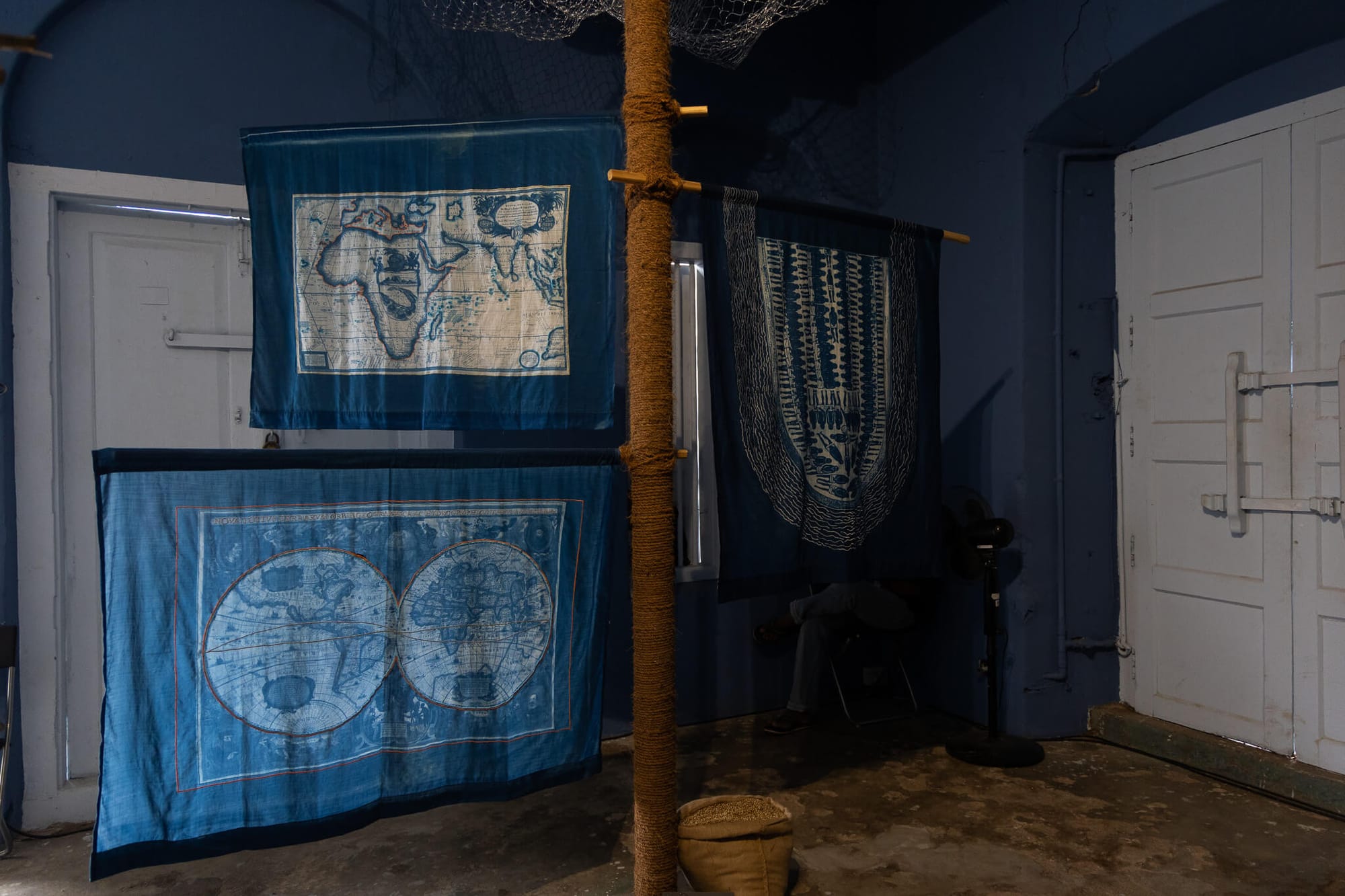
Dhaka-based artist Yasmin Jahan Nupur's installation, Black Gold (2025), tells the story of black pepper, the spice that once drew European ships to the Malabar Coast and reshaped the world in the process. Sail-shaped fabric panels hang from the ceiling, embroidered with maps of the Silk Route and the ancient Golden Road. The fabrics themselves are the story: cotton, silk, and jamdani, all materials with long histories of colonial extraction.
On display are wooden harvesting ladders still used in Kerala pepper farms, vials of spice samples, and fragments of ships. Nupur connects all of this to the present, pointing to the India-Middle East-Europe Economic Corridor as a modern echo of the same old power dynamics dressed in new language.
It's a room you can read like a book. Every object is a chapter.
Upstairs, the air changes.
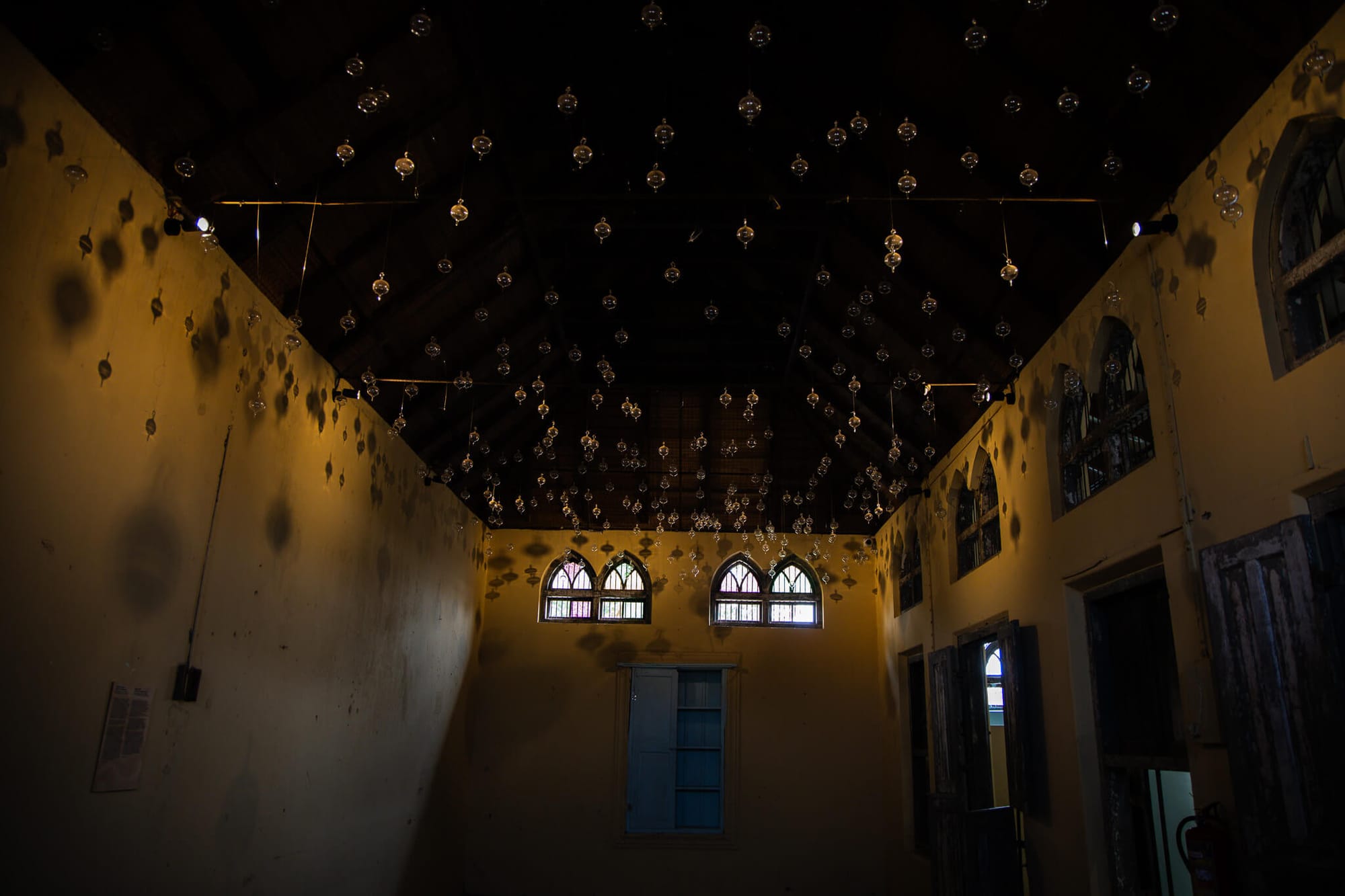
Hundreds of transparent glass baubles hang from the ceiling on thin wires, barely visible, catching light in small glints. This is Air of Firozabad / Air of Palestine (2025), a collaboration between London-based Palestinian artist Dima Srouji and Italian curator Piero Tomassoni. The e-flux review of this Biennale called it a standout.
Of the 451 glass forms suspended overhead, 450 were hand-blown by artisans in Firozabad, India, a city in Uttar Pradesh with generations of glassblowing history. One single bauble was blown in Jaba', Palestine. Both places share this craft. Both communities work under difficult conditions. The baubles are shaped like teardrops, a nod to Marcel Duchamp's 50 cc of Paris Air from 1919, where a pharmacist's ampoule was emptied and sealed with air as a gift.
Here, the air itself becomes the subject. The artists describe the containers not as empty vessels but as preservers of breath, holding air that is increasingly under threat, whether from pollution, warfare, or surveillance.
Stand under the installation for a minute. The glass shifts with every breeze. It feels like it could fall at any moment. That's the point.
From air to underground.
Greek artist and antiquities conservator Athina Koumparouli takes you into an excavation. Literally. In Deep Sea, Deep Time (2025), visitors encounter a mosaic floor revealed inside what looks like a trench. Exposed around it are geometric cross-sections of cables that echo the submarine internet cables running under Kochi's coast today.
The connection Koumparouli draws is sharp: Kochi was once the ancient port of Muziris, a hub for spice trade that connected India to Rome. Today, undersea fibre-optic cables carry data along similar routes. One of the largest submarine cables was recently retired right here. The work treats these cables as archaeological artifacts, asking what a future dig might make of the infrastructure we bury now.
In one corner, a cloud of shattered screens hangs from bamboo scaffolding tied with jute rope. The screens are broken computers and devices reclaimed from Kochi's scrap markets, held together by a structure built from a craft passed down through generations of construction workers. Old methods propping up broken new systems. It's a sharp image.
Nearby, Koumparouli has made new vessels from local soil embedded with fragments of plastic, scrap metal, and electronics, inspired by Roman amphora shards found at the Pattanam excavation site near Kochi. Ancient trade and modern extraction, fused into the same clay.
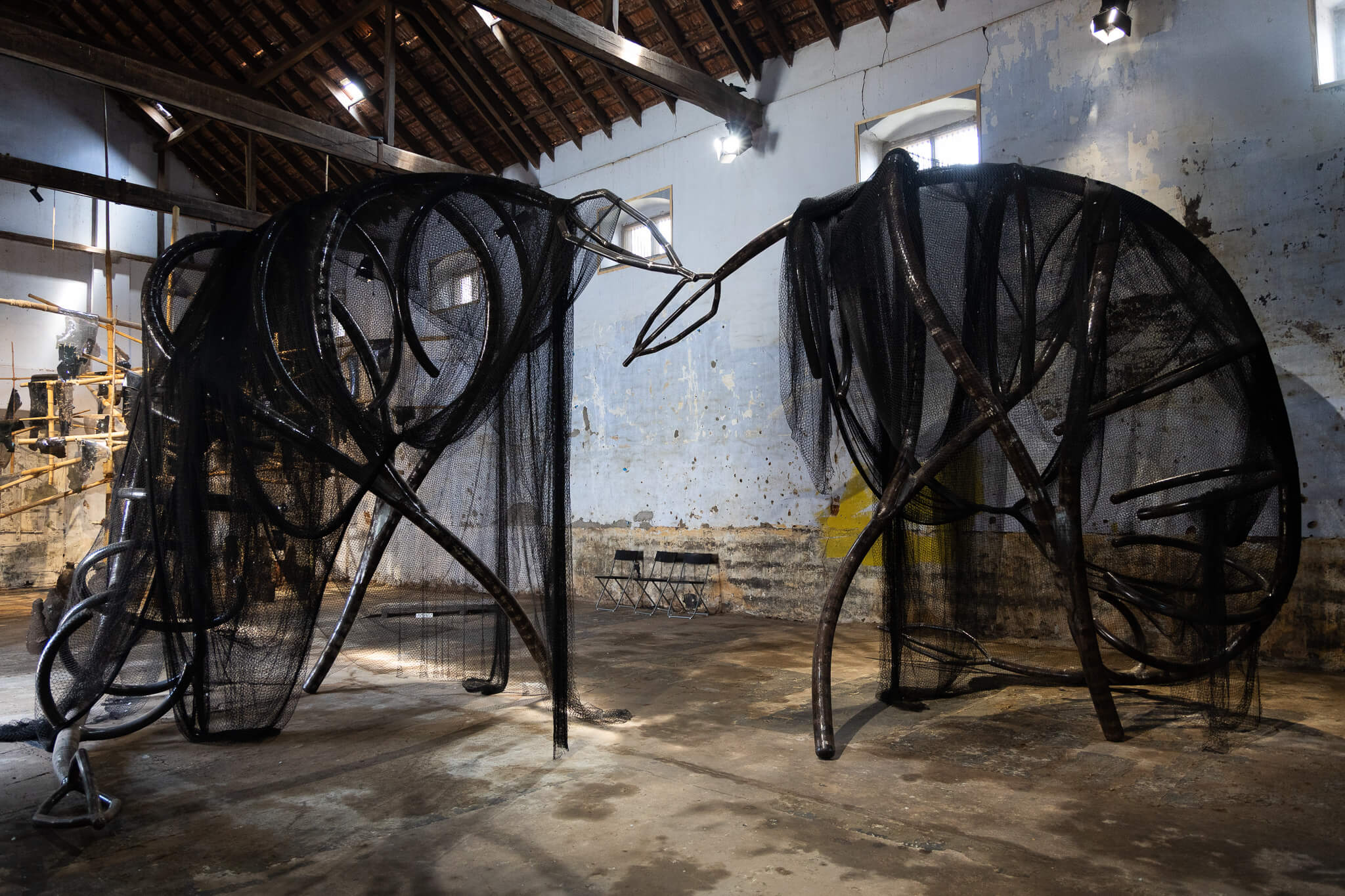
Oslo and Berlin-based Congolese artist Sandra Mujinga's Remember Me (2025) fills a room with two large sculptural creatures, one facing each entrance, as if guarding the space. Their bodies are made from dark fishing nets sourced from Kochi's local markets, moulded and sculpted to create patches of transparency and shadow.
The creatures' heads double as their tails. They could be sentinels, visitors, or kin. Mujinga draws on the basket-weaving traditions of the Chute Wagenia fishing community in the Democratic Republic of Congo, where conical wooden baskets serve as both traps and sieves in the rapids of Boyoma Falls. That technique of weaving, which holds and releases at the same time, gives these figures their structure.
Walk around them. They look different from every angle. Monumental but full of holes. Present but hard to pin down. That's deliberate. Mujinga's work asks what it means to be visible and invisible at the same time.
 Alleppey
And then you step outside.
Behind the building, a laterite pathway leads through old walls reinforced by the roots of a banyan tree, into a garden that didn't exist when the Biennale opened. Belgian-Nigerian artist Otobong Nkanga's Soft Offerings to Scorched Lands and the Brokenhearted (2025) is a living installation, tended daily by local gardeners. It is still growing.
The garden mixes native and non-native species from Kerala's soil: heliconia, thunbergia, zebra leaf, rajamalli, plumeria, hibiscus, bamboo, lemongrass, bush pepper, torch ginger, jungle geranium, areca nut palm, orange jasmine, and white garland-lily. At the centre is a small pond with fish, lotuses, and Ambal water lilies, surrounded by seating moulded from mud and laterite and covered with woven cane and bamboo mats.
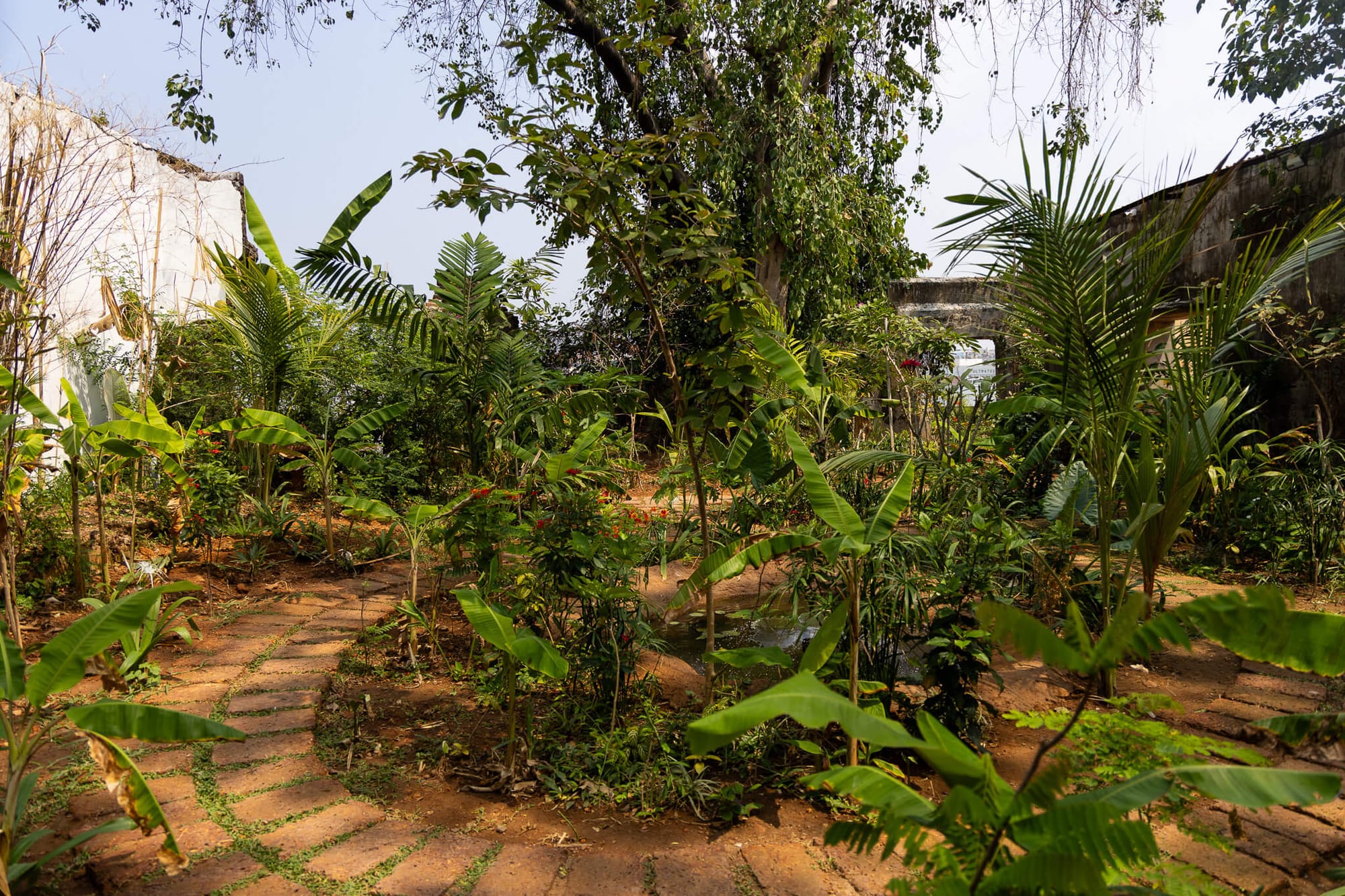
A soundscape by Nithin Shamsuddin plays as you sit: old stories, rhythms, and songs tied to land, family, water, and the body. The work invites you to slow down and witness the ancient timeline from seed to fruit, from soil to bloom.
Art Asia Pacific called this garden a hidden gem of the Biennale. It's easy to see why. After the weight of everything inside, this space feels like an exhale.
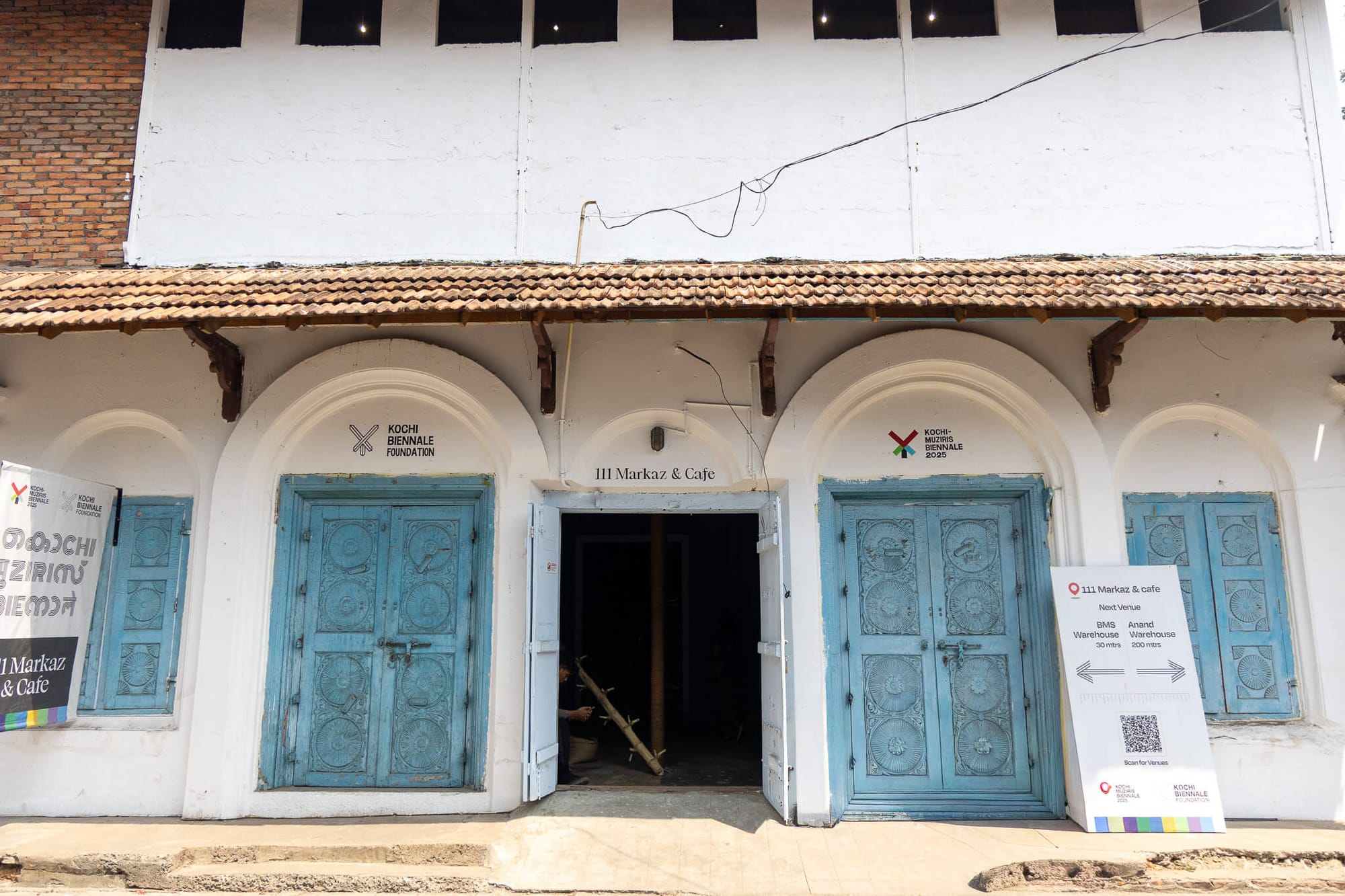
111 Markaz and Cafe is on Bazaar Road in Mattancherry, within walking distance of other Biennale venues like Anand Warehouse and SMS Hall. Open Monday to Saturday, 10 AM to 6 PM, through March 31, 2026. Google Maps Location
Give yourself at least 45 minutes here. The space unfolds in layers, and the garden at the back is easy to miss if you rush. If you're visiting on a hot afternoon, Nkanga's garden is the perfect place to sit and let the morning's art settle.
You may also like
 Ginger
Have you been to 111 Markaz? Which installation hit you hardest? Tell us — we'd love to hear in the comments below.

Kochi-Muziris Biennale is finally here. Browse through Daily Schedules, Highlights, Events, Galleries, Artists in this ultimate guide

I created a Google Calendar to Keep Track of Events. I update it every 1-2 days. You can click on each and add to your Calendar.

A 200-year-old godown in Mattancherry holds eight of the Biennale's most political works. From Flint's water crisis to the Parliament of Ghosts, Anand Warehouse holds the Biennale's toughest stories

Fort Kochi has a beach everyone visits. But not faraway, there are shores with 500 years of stories and almost no tourists. From a beach that once held Portuguese cannons to a fishing village where nothing has changed in a century Kochi's best beaches aren't the ones on the map.