
Coz Layover Cafe, Mattancherry: Iced Coffee in a 600-Year-Old Trading Street
Iced coffee in a former godown on a 600-year-old spice street. Coz Layover Cafe, Mattancherry in Fort Kochi
Iced coffee in a former godown on a 600-year-old spice street. Coz Layover Cafe, Mattancherry in Fort Kochi

Rainforests, incense sculptures, insect paintings - all read through a 2,000-year-old Tamil system of landscape and emotion.


Making Kochi Water Metro more accessible to the travelers & humans of Kochi. Carefully curated water metro route maps, timings, feeder buses, tips and more.

A dot matrix printer screeches in the corner of a Mattancherry warehouse. Slowly, it spits out a long scroll of paper — observations, thoughts, fragments of conversation between artists who may never meet in person.


A dot matrix printer screeches in the corner of a Mattancherry warehouse. Slowly, it spits out a long scroll of paper — observations, thoughts, fragments of conversation between artists who may never meet in person. Visitors tear off pieces and take them home. The art leaves the building in their pockets. One torn piece at a time.
This is what Devassy Jose & Sons feels like right now. Not a gallery. More like a port — things arriving, being exchanged, moving on. A venue where a Sri Lankan collective, a Jakarta-based art movement, Palestinian histories, Brazilian mining echoes, Cameroonian water plants, and Kerala's own Communist Pacha all share the same building. Tucked on Bazaar Road in Mattancherry, this old commercial building is one of the venues for the Kochi-Muziris Biennale.
I could cover roughly nine works or exhibitions at Devassy Jose & Sons. Here's what stood out for me.
The Packet is a group of artists from Sri Lanka. Formed in 2019, they started as eight people making a publication together. Now they've grown into a platform for over twenty young artists working across print, digital, and site-specific projects.
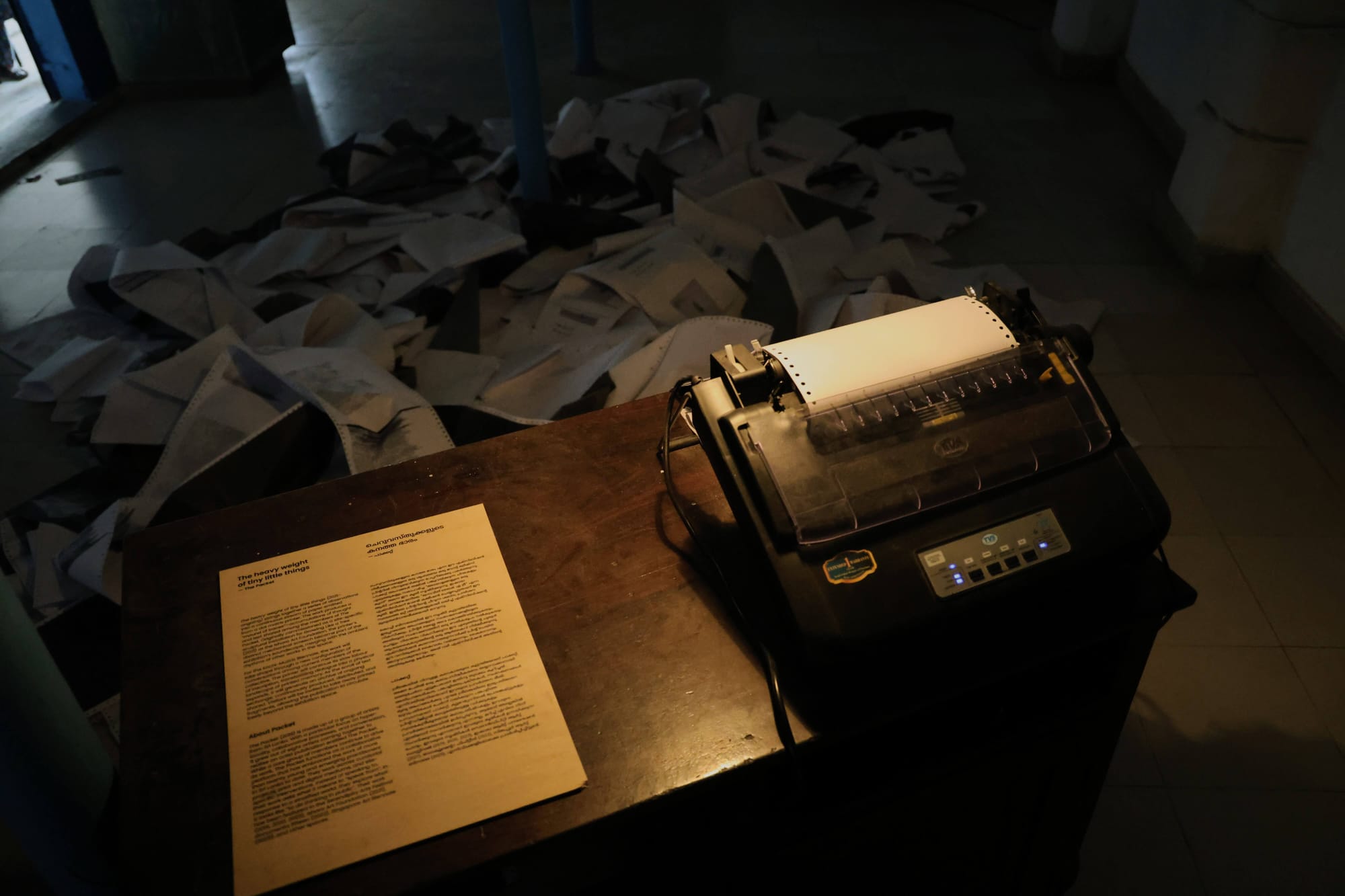
Their work at the Biennale is deceptively simple. A dot matrix printer — the kind you might remember from old offices — continuously prints a stream of text. These are conversations between members of the collective. The paper piles up into what the artists call a "mound of traces."
What makes it special: visitors can tear off and take home printed fragments. The publication literally circulates beyond the exhibition walls. The Packet has shown at documenta fifteen (2022), Serendipity Arts Festival, and the Singapore Art Biennale (2025).
If you follow the global art world, you know this name. ruangrupa is the Jakarta-based collective that directed documenta fifteen in Kassel, Germany — one of the most important (and controversial) art exhibitions on the planet. Founded in 2000, they've spent over two decades building alternatives to how art gets made, shared, and funded.
At the Biennale, they present OK.Video — their media arts platform that's been running since 2003. It started as the Jakarta International Video Festival and has evolved into a living archive of Indonesia's experimental art and activist movements.
The presentation unfolds in three parts: an archive of works from 2003–2017, a replication of a 2025 web platform shaped like a parliament building, and workshops connecting Gudskul (their educational platform in Jakarta) with Kochi through live streaming.
Think of it as art that refuses to stay in one place. The work isn't about displaying objects — it's about organising, communicating, and building networks across countries.
Dar Yusuf Nasri Jacir for Art and Research is an artist-run space in Bethlehem, Palestine, founded by Emily Jacir — a Golden Lion winner at the Venice Biennale. The centre operates from her family's 1890 home, just 600 feet from the Separation Wall.
Their exhibition at KMB is called So We Could Come Back. It brings together artists Emily Jacir, Ahmed Alaqra, Andrés and Francisca Khamis Giacoman, and Reem Khatib. The exhibition looks at migration not as exile but as a circular movement — people gathering, dispersing, and returning in new forms.
One striking piece within this exhibition: Si tú te vas by Andrés and Francisca Khamis Giacoman. It's a three-channel video installation tracing how Palestinian communities from Bethlehem built the textile industry in Chile. Cotton from India fed the factories. The connections are invisible but deep — linking Bethlehem to Santiago to India across continents.
In My Beloved Fort Kochi — a port city shaped by centuries of trade, tides, and migration — these stories of displacement find a natural home.
Here's a story that Keralites will recognise immediately. "Communist Pacha" arrived in Kerala in the 1940s. The plant — Chromolaena odorata — showed up right when the communist movement was rising. "Pacha" means green in Malayalam. So people called it The Red Green.
Artist Flo Maak traces how this one plant means completely different things depending on where it lands. In Ivory Coast, it's called "Indépendance" (it arrived when the country became free from France). In Australia, it's "Devil's Weed." In the Caribbean, it's used in spiritual rituals. Same plant, completely different stories.
The work connects botanical migration to human migration — asking who gets to belong and who gets called "invasive."
Created during a residency in Kochi, this installation uses copper pipes, backwater soil, and sound. Tübke conducted conversations with Kochi residents across generations — translated from Malayalam to English — about how weather and water shape daily life.
The voices flow through copper pipes containing mud and "ekkal" (silt) from the Kochi Backwaters. The soil hardens in the sun — a traditional construction technique — turning soft sediment into stone-like material. Human voices, water, and weather become co-authors of the story.
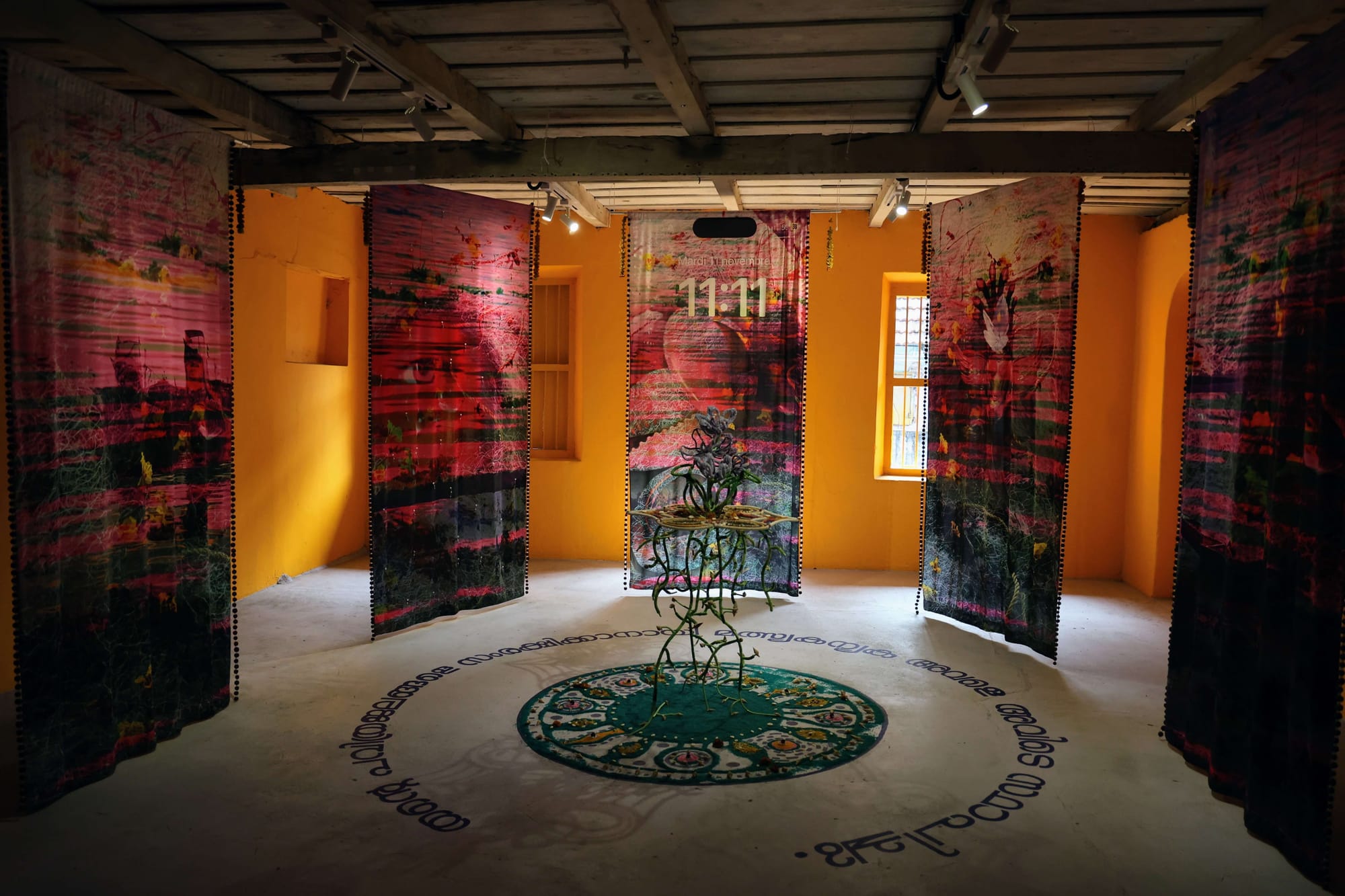
The venue also hosts Shivay La Multiple, an installation using metal, glass beads, seeds, and textile printing to trace the journey of the water hyacinth from Cameroon to India. The artist noticed the same violet carpet of flowers on the Koo River in Cameroon and in the waters around Fort Kochi — and asks what the appearance of these species is trying to tell us.
Armando Queiroz from Belém, Brazil, brings work about Serra Pelada — once the largest open-pit gold mine on Earth. In one video, ants carry sugar letters spelling OURO (gold in Portuguese). A quiet, devastating image of extraction.
And the One Thousand Seas project by the Kochi Biennale Foundation explores oceanic histories that challenge colonial narratives — finding meaning in songs, legends, and the stories of people who crossed seas voluntarily or by force.
Devassy Jose & Sons isn't on most Biennale visitors' must-see lists. Aspinwall House and Pepper House in Fort Kochi get the crowds. But this Mattancherry warehouse does something the main venues don't — it puts Global South conversations in direct dialogue with each other.
A Sri Lankan print collective next to an Indonesian media arts movement. Palestinian displacement stories beside Kerala's own migrant plant histories. Brazilian mining echoes alongside oceanic trade routes.
Mattancherry's Bazaar Road — where this venue sits — has been a meeting point for communities arriving by sea for centuries. Jewish, Arab, Gujarati, Konkani traders all passed through here. The art inside this venue continues that tradition of exchange.
The Kochi-Muziris Biennale 2025 runs until March 31, 2026. Devassy Jose & Sons is on Bazaar Road, Mattancherry — a short walk from Jew Town and the Paradesi Synagogue.
Getting there: Map location. Take the Water Metro from High Court to Mattancherry or an auto from Fort Kochi (about 15 minutes). The venue is open during regular Biennale hours. Combine it with a Mattancherry food walk — because if migration shaped the art here, it also shaped the food on the same street.

Iced coffee in a former godown on a 600-year-old spice street. Coz Layover Cafe, Mattancherry in Fort Kochi

Rainforests, incense sculptures, insect paintings - all read through a 2,000-year-old Tamil system of landscape and emotion.

Making Kochi Water Metro more accessible to the travelers & humans of Kochi. Carefully curated water metro route maps, timings, feeder buses, tips and more.

Chinese tiles, Ethiopian rugs, a Malayalam clock tower. What if I told you that Kochi's oldest synagogue is a world in one room?
Join 1500+ others & Sign up for the newsletter and get our latest posts delivered straight to your inbox.