
The Paradesi Synagogue: 450 Years of Spice, Prayer, and Hand-Painted Tiles in Mattancherry
Chinese tiles, Ethiopian rugs, a Malayalam clock tower. What if I told you that Kochi's oldest synagogue is a world in one room?
Chinese tiles, Ethiopian rugs, a Malayalam clock tower. What if I told you that Kochi's oldest synagogue is a world in one room?

Three colonial powers. One wooden church turned stone. And a tombstone that tells 500 years of Fort Kochi's story.

Planning your Fort Kochi visit? Scroll to your date for a ready-made itinerary — morning cafes, heritage walks, afternoon rest spots, sunset times, and night plans.
An old refrigerator hums in a dark room. Inside its freezer, frozen fish and fungi slowly decay behind glass. Walk through every room of Aspinwall House at the Kochi Biennale. Here's what you'll see


An old refrigerator hums in a dark room. Inside its freezer, frozen fish and fungi slowly decay behind glass - a tiny diorama of everything wrong with how we eat, grow, and consume. This is just the first thing you see when you walk into Aspinwall House at Kochi Biennale 2025/26. It gets stranger, more beautiful, and more haunting from here.
We curate a Google Calendar to Keep Track of Events. We update it every 1-2 days. Check it out and Add your favorite events to your calendar!
Aspinwall House is the main venue of the sixth Kochi-Muziris Biennale, titled "For the Time Being." This edition runs from December 12, 2025 to March 31, 2026. The heritage building on Fort Kochi's waterfront - once the headquarters of a British trading company - now holds work by over a dozen artists from India and around the world.
This guide walks you through every room based on the pictures taken during my visit.
The Coir Godown - the old warehouse attached to Aspinwall House - holds some of the biennale's most powerful installations.
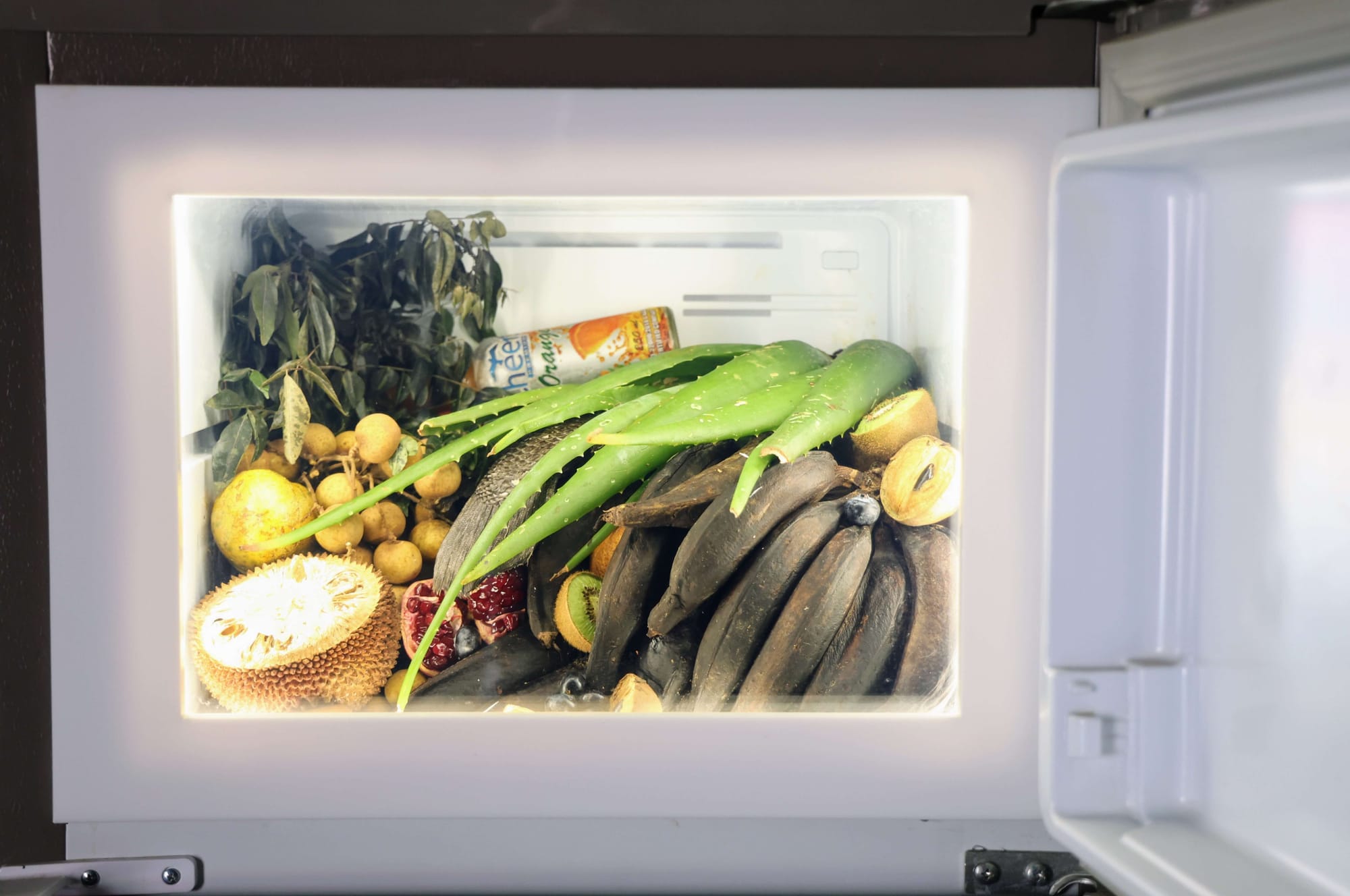
Think of the most ordinary thing in your kitchen. A refrigerator. Now imagine it as a museum display case for everything the planet is losing.
Argentine artist Adrián Villar Rojas takes dated, obsolete refrigerators and transforms their open freezer compartments into glass-fronted displays. Inside: frozen meat, fish, sliced fruit, bottled drinks, roots, leaves - and fungi growing over all of it.
The compositions look like old Dutch vanitas paintings - those 17th-century still lifes about death and the passing of time. But here, the message is updated for our times. Every item in the freezer is a product of industrial farming, global supply chains, and mass production. The fresh skin of a fruit sits next to the glossy label of a packaged bottle. Natural and processed, side by side.
Here's the thing that makes it unforgettable: the sculptures depend on electricity to survive. If the power cuts - and in Kochi's humidity, things shift fast - the slow work of decay begins. Fungi spread. Ice melts. The ruin is built into the design. Villar Rojas has shown this series at the Metropolitan Museum of Art in New York and the Fondazione Sandretto Re Rebaudengo in Turin. But seeing it here, in a former coir warehouse in tropical and beloved Fort Kochi, hits differently.
This is not a single artwork. It's an entire community setting up camp inside the biennale for 100 days.
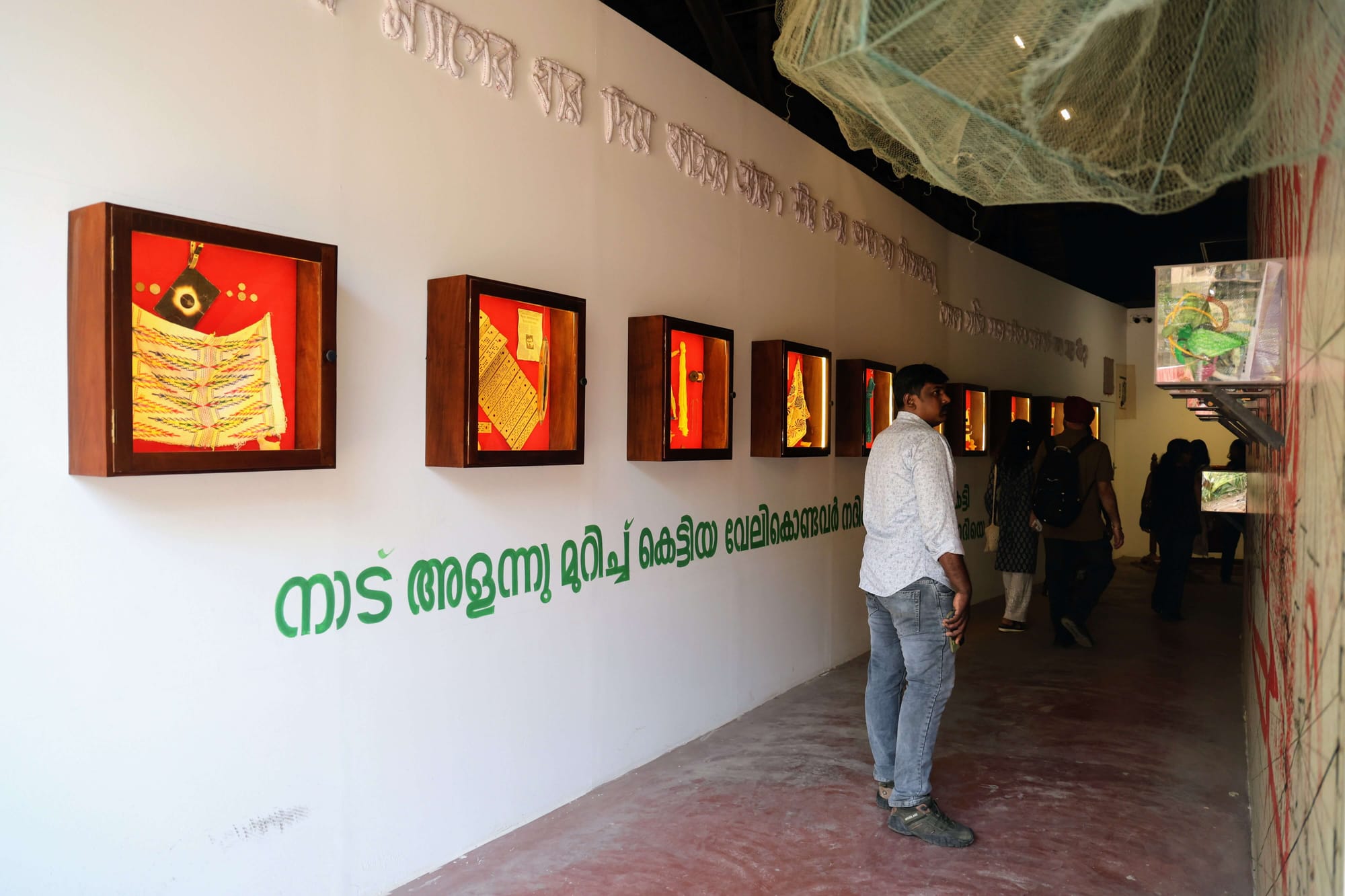
Panjeri Artists' Union is a group of fourteen practitioners - visual artists, filmmakers, musicians, writers, designers - from Banipur in West Bengal, near the India-Bangladesh border. Their name comes from the Persian word "panjeri," a navigation device used by boatmen to cross Bengal's wild rivers.
Their space at Aspinwall changes constantly. Think of it as a workshop that's always open. Discussions happen. Performances unfold. Archives get reworked. The walls fill up over time.
Three works stand out:
Swing and Simhasana / Lullaby and Quiet Chants of Power - Video sculptures that dig into what happens to national anthems when the nations that created them no longer exist. The Union interviewed women from eastern Bengal who were born between the 1940s and 1960s. These women lived through East Pakistan, then Bangladesh, then India. They can barely remember the first two national anthems - songs that once shaped their identity. What survives instead? Memories of home. Stories of leaving. The songs of survival, not the songs of states.
At the centre sits a replica of the boulder stone from Devi Prasad Roy Chowdhury's famous sculpture "Triumph of Labour" (1959) - placed inside a domestic temple altar. A cradle holds a mute TV showing the original sculpture. The cradle rocks gently, as if trying to put a nation to sleep.
Micro-revolts of Stitching Rhythms - Meet Saptak Mistry, the Union's youngest member at 18 years old. He's a rapper from a refugee settlement alongside railway tracks and an open crematorium. His neighbourhood sees frequent deaths on the tracks. His friends have become migrant workers in garment factories, plastic toy units, and bidi factories. Saptak's songs are a journal of this life - survival and dreams, side by side.
The sewing machine in the installation is not random. It's the sound of Bengal's displaced communities. After Partition, sewing machines provided livelihood to refugee women across settlements. The rhythm of the machine weaves into the rhythm of Saptak's rap. A motorized sewing machine operates alongside a 17-minute film built around his songs.
Knitting and Crochet - This ongoing work invites women from Durgapur, Barddhaman, Ashoknagar, and Kolkata to contribute their crochet and domestic textile pieces. Union member Samapti Mondal learned crochet around 1990 in Durgapur during a period of industrial shutdowns and protests. Another member, Sudipta Mondal, brings crochet into dialogue with leather design - a craft historically tied to Dalit and Chamar communities. The installation keeps growing as artists add to it through the biennale's run.
Imagine walking into a garden of carnivorous flowers with sharp white teeth, glowing under blue UV light. News reports about the ULFA (United Liberation Front of Assam) insurgency buzz from speakers - in Assamese, Hindi, and English - but the voices blur into noise. You can't quite make out the words. That's the point.
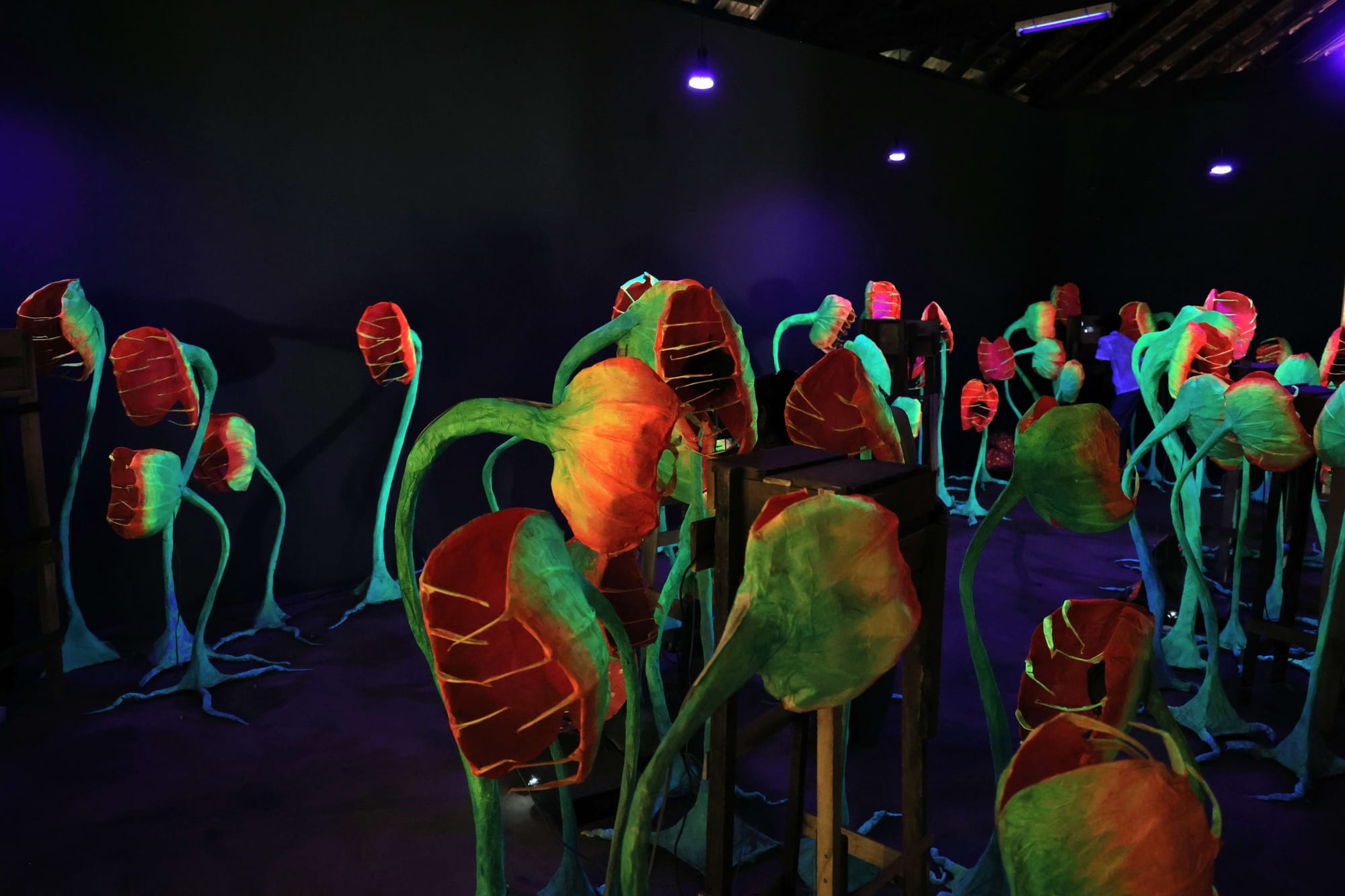
Dhiraj Rabha (born 1995) is from a former ULFA settlement in Goalpara, Assam. His work documents what life looks like in the aftermath of an insurgency - displacement, surveillance, the gap between what the state says happened and what people actually lived through.
Eight watchtowers surround the garden - modelled on the surveillance structures found in every camp. Each tower holds video screens showing conversations with former ULFA members: Anthony Rabha, Jayanta Ray, Juri Rabha, and others. They share memories of loss, violence, and their hopes for their families. In a nearby room, fragments of newspapers, books, and photographs from 1982 to the 2000s lie scattered like the remains of a burnt house. His film "Whispers Beneath the Ashes" (2025) follows children journeying through a forest, searching for home.
Kirtika Kain (born 1990, New Delhi, now based in Sydney) works with materials that carry thousands of years of ritual history - tar, copper, gold, cotton. But she uses them to tell a story that official history has largely erased: the inheritance of the Dalit diaspora.
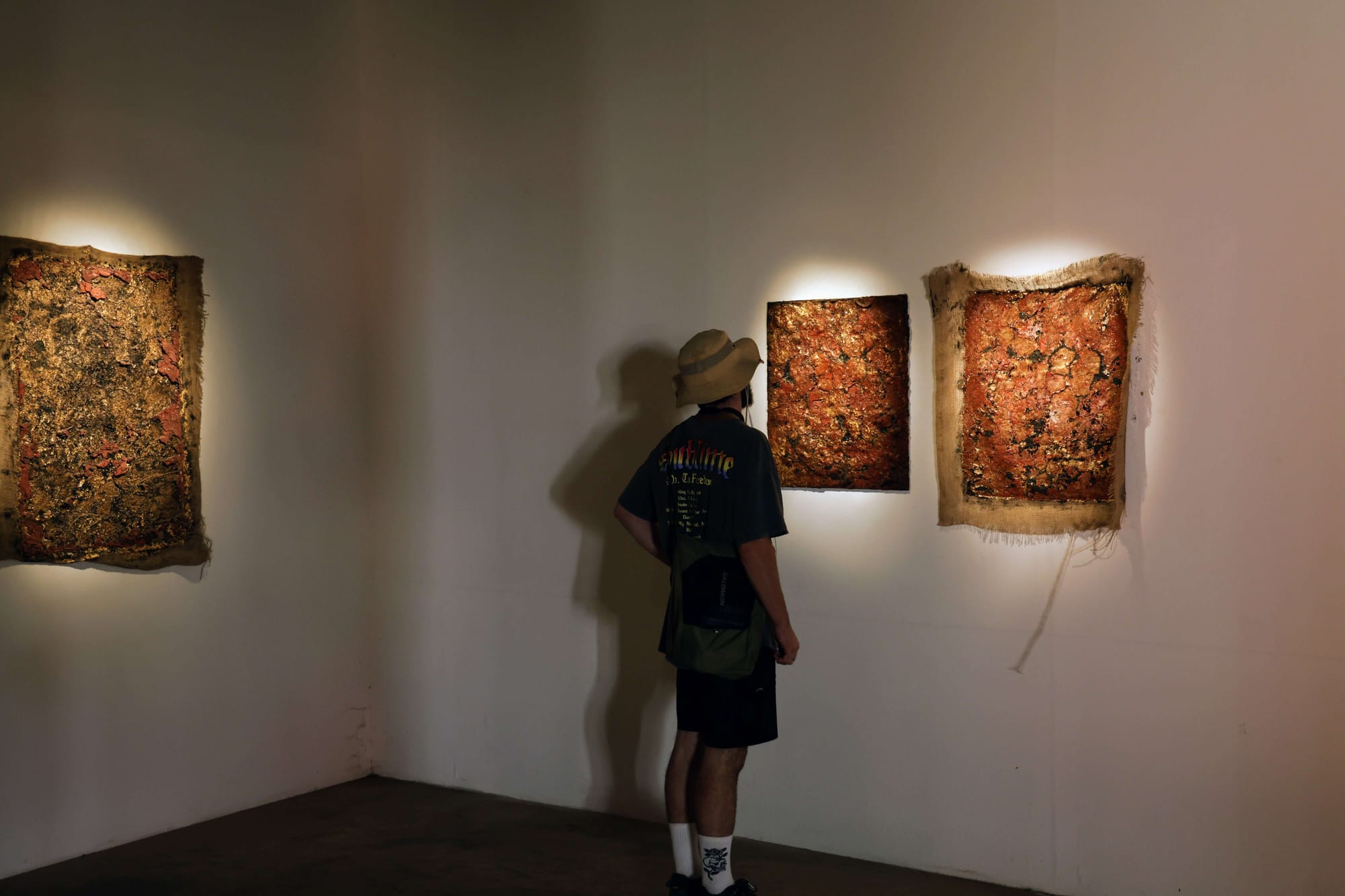
Her tar canvases in "Mimetics" (2025) look like earth charred under extreme heat. Each work begins from a silicon impression of another, creating a series that's connected but never linear - with gaps and additions that echo each other. Some canvases come alive with gold leaf and red pigment over the black tar.
In "Chronicles" (2025), suspended sea-green copper plates hang in the viewing space. Cotton lamp wicks dipped in tar are embedded across the plates. Through heating, acid exposure, and oxidation, Kain reveals copper's many faces - shiny, solid, brittle, crumbling. The patina layers tell time. Her abstraction isn't decorative. It's a language she's built with historical materials and her own body to honour the undocumented histories of Dalit women across India and the diaspora.
What happens when the dead refuse to leave? How do they stay among us - through faith, memory, shared vulnerability?
Pallavi Paul (born 1987, New Delhi) presents "Alaq," a three-channel cinematic installation born from her encounters with frontline workers and gravekeepers during the pandemic. She travelled across Kerala, tracing the presence of contagion - visiting sites shaped by the recurring Nipah virus and the shrine of Beema Beevi, a revered female saint-figure where healing crosses religious boundaries.
The three screens weave together electron microscope views of viral matter, archival fragments, and intimate portraits of care. Science and devotion sit side by side. Medical protocols and prayers mirror each other.
Accompanying the film: "Anasir" (2025), collagraph prints made with Digvijaysinh Jadeja, where images are embossed and etched on paper. And "Trousseau" (2025), which reworks medical body bags with embroidery - turning objects of death into objects of tenderness.
Walk from the Coir Godown into the main Aspinwall Bungalow. The ground floor has seven artists. Here are the ones with detailed descriptions in the biennale programme.
A photographer who died 80 years ago, but his images still feel alive. Lionel Wendt was also a pianist, and you can see the musician's sense of rhythm in his photographs. Working with gelatin silver prints, he used double exposures, chemical bleaching, and hand-toning to blur the line between record and performance.
His portraits of fishermen casting nets, farmers ploughing land, and young men with sickles treat physical labour not as suffering but as beauty. The brown body, in Wendt's camera, becomes a sculpture lit by light and sweat. His landscapes of Sri Lanka - clouds, rocks, silver sea - carry the same intimacy as his portraits of people. There's tenderness in everything he shoots.
Ali Akbar PN (born 1996, Koolimuttam, Kerala) examines what happens when communities build things together - and what happens when those histories get flattened by politics.
"Reliquary" hosts remnants of inter-community relationships from religious and secular sites across Gujarat: the Jami Masjid in Bharuch, Roza-Rozi Dargah Sharif near Mahemdabad, the Maharaja Fateh Singh Museum in Vadodara. Paintings reconstruct these sites and their mixed cultural origins. A ruined life-size pillar carved by Hindu and Muslim sculptors from Sirohi, Rajasthan - who have traditionally worked together at multi-religious sites - anchors the space.
Beside the pillar sits a seated lion sculpture. Some parts echo its Middle-Eastern roots, passed down through Indo-Islamic and Buddhist architecture. But its aggressive expression speaks to contemporary ethno-nationalist pride. The work shows how cultural forms get reproduced, desecrated, and claimed by different powers through history.
Shiraz Bayjoo (born 1979, Port Louis, Mauritius) has created a path from the colonial commercial history of Aspinwall to the sea.
"Sa Sime Lamer" means "The Path to the Sea" in Mauritian Creole. The sea-facing installation revisits a sixteenth-century Portuguese text about medicinal plants of southern India. Suspended textile panels in raw muslin show the plants and spices that were forced into production and shipped as commodities to European and Mauritian gardens.
Fragile terracotta seed sculptures of local species hang from the panels. Ceramic figurines scattered on the floor reference Dutch soldiers sculpted on the base of a traditional bronze lamp in Sree Krishna Swamy Temple, Mavelikara - showing how colonial powers embedded themselves into religious architecture. Wooden plinths host vegetative forms in terracotta, connecting to the ruins of the old Dutch garden in Kochi, where crevices are now used for religious offerings.
Upstairs, seven more artists. Three that demand your time:
Smitha M Babu (born 1981, Kollam) has spent over twenty years in theatre. Her project "Paakkalam" - the Malayalam word for the weaving workspace - is rooted in her life along Ashtamudi Lake in Kollam, where coir making has been a way of life for generations.
Nearly thirty paintings are exhibited here. Her earth-toned watercolours don't behave like typical watercolours. She layers pigments until they become opaque and dense. Scenes of rural life by the lake mix with fantastical figures - bogeymen, masked dancers, strangers. Theatre lighting runs through everything.
Over three days during the biennale, Smitha and a four-member team stage a fifteen-minute performance using coconut husk, coir fibre, and the ratt machine as props and instruments. The soundtrack: recordings from Ashtamudi Lake - spinning wheels, lapping water, the sound of workers.
Huma Mulji (born 1970, Karachi) connects the porosity of port cities, the ecosystems of mangroves, and the precarity of migrant life through blown glass sculptures.
The name "Bombay Duck" comes from an imperial mix-up. "Dak" means "post" in Urdu, and dried bombil fish transported by the Bombay mail train got mislabelled as "ducks." In Mulji's work, swiftly blown glass - shaped under extreme heat, draped around scaffolding - becomes a metaphor for the exiled body. Glass adapts to whatever holds it, just as migrants adapt to wherever they land.
The glass forms sit within mangrove-like structures. Mangroves exist in both Kochi and Karachi (Mulji's hometown) - fragile ecosystems of protection and instability. Fabric knots in the work symbolise the imam zamin, an amulet from Shia homes that represents protection and safekeeping.
The guide above covers the artists with detailed descriptions in the biennale programme. But you'll also encounter works by:
Ground Floor: Mónica de Miranda, Abul Hisham, Sheba Chhachhi & Janet Price, and Matthew Krishanu.
First Floor: Faiza Hasan, Bhasha Chakrabarti, Anja Ibsch & Grüntaler9, Ratna Gupta, and Bani Abidi & Anupama Kundoo.
We'll be adding detailed walkthroughs for these artists as the biennale unfolds. Check back or see our monthly guide to Fort Kochi for the latest.
Where: Aspinwall House, Calvathy Road, Fort Kochi
When: December 12, 2025 to March 31, 2026. Open 10 AM - 6 PM daily.
How long: Plan at least 2-3 hours for Aspinwall House alone. Many visitors come back multiple times.
Tip: Visit on weekday mornings for smaller crowds. Some performance pieces are scheduled - check the biennale schedule on catsofkochi.com before you go.

Chinese tiles, Ethiopian rugs, a Malayalam clock tower. What if I told you that Kochi's oldest synagogue is a world in one room?

Three colonial powers. One wooden church turned stone. And a tombstone that tells 500 years of Fort Kochi's story.

Planning your Fort Kochi visit? Scroll to your date for a ready-made itinerary — morning cafes, heritage walks, afternoon rest spots, sunset times, and night plans.

Built by the Portuguese. Wrecked by the British. Painted by a dying Italian. Santa Cruz Basilica has stories most visitors miss.

Join 1500+ others & Sign up for the newsletter and get our latest posts delivered straight to your inbox.